
Competition for Life, Not War
Rethinking Power in a World Beyond War

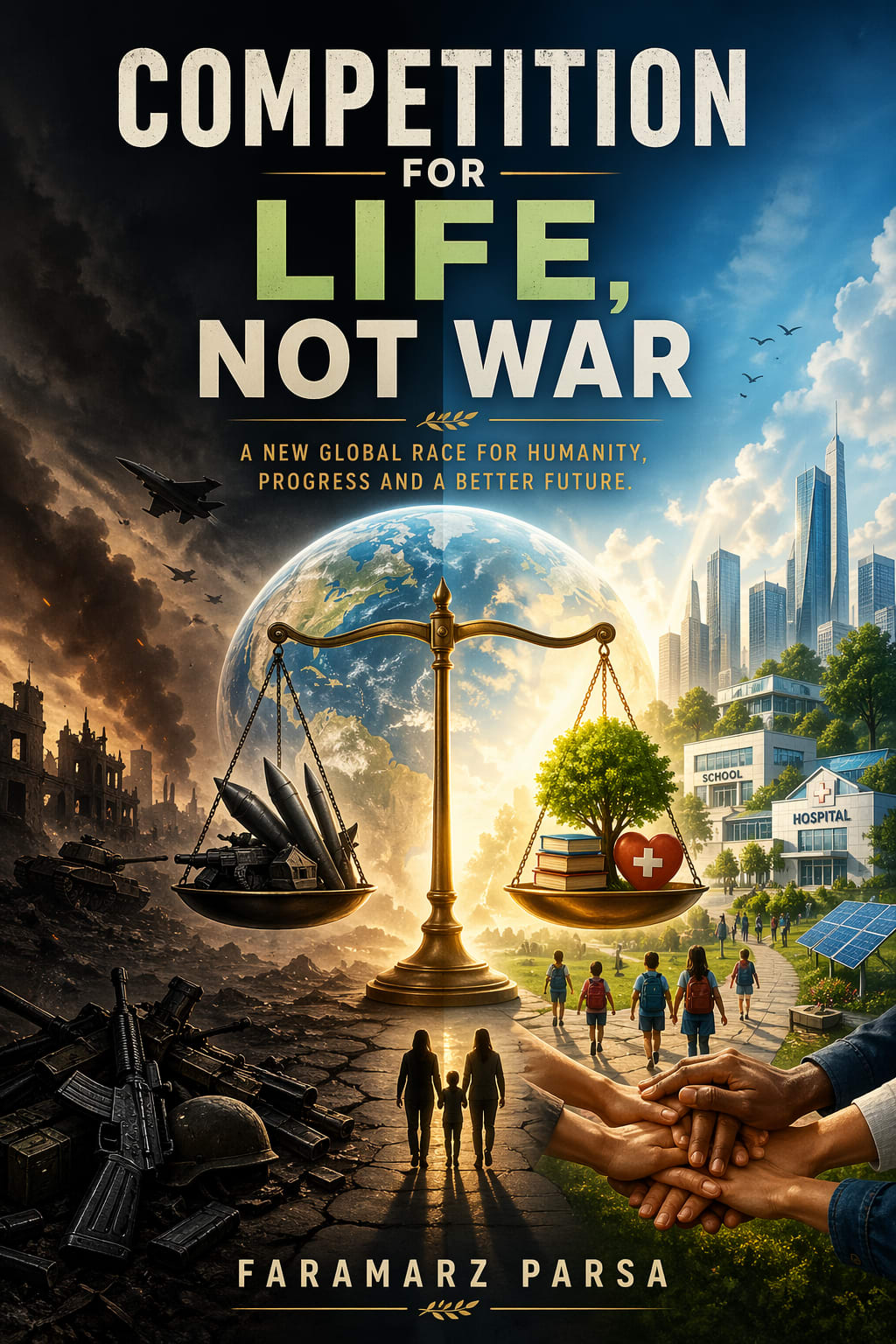
“What if a nation’s power were measured not by the number of its missiles, but by the quality of its people’s education and healthcare—what would the world look like?” “Competition for Life, Not War” is a reflection on rethinking the meaning of power and progress. This piece explores the need to transform the arena of global competition—an invitation to move from an age of militarization to an age defined by the quality of living. This text is a call to reflect on a simple truth: the true victor of history is not the nation with the most destructive weapons, but the one that has succeeded in becoming more human.
Competition for Life, Not War
Faramarz Parsa
If the world is ever to move away from disorder, poverty, and inequality, perhaps it is time to redefine the competition between nations.
Not a competition of weapons, not military superiority, and not even political dominance—but a competition for a better human life.
Imagine a global race, not for destruction, but for construction.
In this competition, countries are not measured by the number of missiles they possess, but by the quality of life they provide for their people. The criteria are clear: job creation, sustainable economic growth, housing provision, free school nutrition programs, and universal access to high-level healthcare and social insurance.
At first glance, such an idea may seem idealistic. But the truth is that the modern world is already full of evaluation systems. Institutions such as the World Bank and the United Nations have long developed indicators for development and welfare. The difference is that these indicators have not yet become a true global “competition that drives change.”
If such a system were established, countries would be forced to invest not in military expansion, but in education, healthcare, infrastructure, and public welfare. In such a path, war would gradually give way to cooperation, because progress would no longer mean defeating others—but improving society.
However, this path does not emerge from wishful thinking alone. Nations will only enter such a competition when they see real benefits in it: access to global investment, expanded trade opportunities, reduced economic barriers, and increased international credibility.
In this context, the role of international organizations becomes essential. Institutions like the United Nations Development Programme could act as neutral evaluators, defining indicators and publishing transparent global rankings. Transparency that informs not only governments, but also people.
Economy is the key to opening the doors of development. But an economy that grows only in numbers, without improving human life, becomes part of the problem itself. True growth is when education, healthcare, agriculture, energy, and infrastructure develop together in service of people.
In such a world, competition between nations would no longer lead to conflict, but to closeness. Trade would replace hostility, and cooperation would replace threat.
This path is not easy. It may even seem far from reality today. But every transformation begins with a change in definition.
Perhaps it is time for governments to measure their strength not in warfare—but in their ability to build a dignified life for their people.
Because in the end, the true winner of this competition is not the strongest nation—but the one that creates the most humanity.
———————
2026/4/24
About the Creator
Ebrahim Parsa
⸻
Faramarz (Ebrahim) Parsa writes stories for children and adults — tales born from silence, memory, and the light of imagination inspired by Persian roots.
Enjoyed the story? Support the Creator.
Subscribe for free to receive all their stories in your feed.
Comments
There are no comments for this story
Be the first to respond and start the conversation.