
Children Should Not Inherit War
They should Inherit Peace
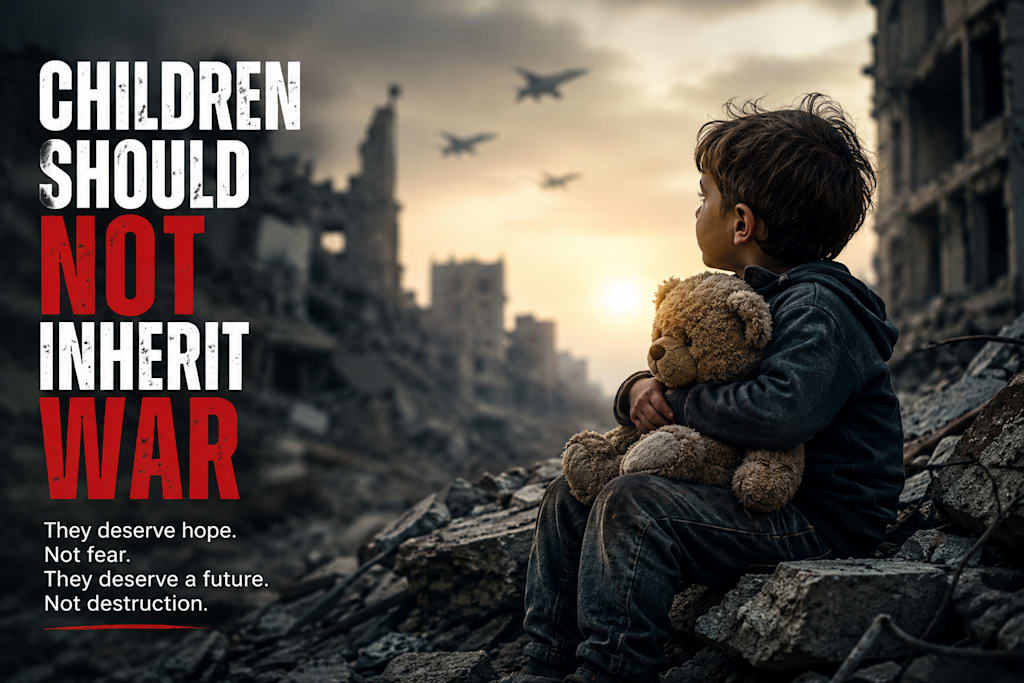
Children Should Not Inherit War
War is often spoken about in numbers. Numbers of soldiers lost, cities destroyed, borders changed, and treaties signed. But behind every number, there is a face that is rarely counted. The face of a child.
A child does not understand why the sky turns red with fire instead of sunrise. A child does not understand why the ground shakes or why their mother’s hands tremble while packing in the dark. A child does not understand why laughter suddenly disappears from their home and is replaced by silence that feels heavy and endless.
And yet, it is the child who pays the highest price.
Children should not inherit war. They should inherit stories of peace, gardens that grow freely, schools that are safe, and nights where sleep comes without fear. But in too many places around the world, childhood is interrupted by conflict that was never chosen by them.
When war begins, adults discuss politics, power, and protection. But in the middle of those discussions, children lose something far more valuable than land or resources. They lose innocence. They lose stability. They lose the simple belief that tomorrow will look like today.
A child forced to grow up in war becomes an adult too soon. They learn the sound of explosions before they learn multiplication. They learn how to hide before they learn how to play in open fields. They learn survival before they learn dreams. And when survival becomes the priority, dreams begin to fade.
What makes this even more painful is that children rarely understand why it is happening. To them, war is not history or politics. It is confusion. It is fear in the night. It is hunger when food becomes scarce. It is the absence of a father or mother who never returned.
In many parts of the world, there are children who wake up not to alarm clocks, but to explosions. Their classrooms are replaced by shelters. Their textbooks are replaced by survival instincts. Some of them carry memories that no child should ever carry.
A child who has seen war does not forget it easily. Even when peace returns, the mind remembers. Loud sounds can bring fear instead of excitement. Nights can feel unsafe even when nothing is wrong. These invisible scars are often heavier than physical wounds.
What is most heartbreaking is that these children did not choose any side. They did not vote for conflict. They did not create the conditions of war. Yet they are the ones who lose their homes, their education, and sometimes their families.
If we truly care about the future of humanity, then protecting children must be a priority above politics, borders, and power. A world that allows children to suffer war is a world that is failing its own future.
Peace is not just a dream—it is a responsibility. And that responsibility belongs to everyone.
We often say children are the future, but we forget that the future cannot be built on broken foundations. If we truly believe in a better world, then protecting children from war must be more than a statement—it must be a commitment.
Peace is not just the absence of conflict. It is the presence of safety, education, and hope. It is a child waking up without fear. It is a classroom full of laughter instead of fear. It is a world where a child’s imagination is not shaped by violence, but by possibility.
No child chooses war, yet every child deserves peace.If humanity is to move forward, we must stop allowing the youngest among us to carry the heaviest burdens. They are not soldiers. They are not negotiators. They are not responsible for the decisions of nations. They are simply children.And children should never inherit war.
They should inherit peace.
About the Creator
Enjoyed the story? Support the Creator.
Subscribe for free to receive all their stories in your feed.
Comments
There are no comments for this story
Be the first to respond and start the conversation.