
Are Good and Evil Real, Or Just Conventions?
Part 2 of the Elucidation series. Previously: What Is Ideology: And Why Does It Matter?
• • •
History moves like a train, passing through plains that each belong to a different era. And if you hold up a magnifying glass over any one of those eras, something unsettling becomes visible: the values people live by keep changing.
Under feudalism, blood ties and family bonds carried enormous weight. A woman's place was in the home. For her to work outside it was considered a disgrace. Financial dealing and moneylending were viewed with contempt.
Then the train entered the age of capitalism, and all those values seemed to put on new clothes. Factories needed labor, all the labor they could get. Suddenly a woman working outside the home was not only acceptable but necessary. Honor shifted from lineage to wealth. Banking, once despised, became the lifeblood of the entire system.
If values change so completely from one era to the next, shaped by economic conditions and social necessity, what are we to conclude? Was what feudalism called "good" merely useful to feudalism? Is what capitalism calls "good" merely useful to capitalism?
The ancient Greek philosopher Protagoras drew the boldest possible conclusion: "Man is the measure of all things." There is no standard outside of us. Good and evil, right and wrong, truth and falsehood, all are weighed only on the scale of human judgment. And human judgment shifts with the times.
The Problem with Protagoras
If Protagoras is right, the consequences are profound. It would mean that no ideology, no set of beliefs, no moral framework is ultimately better or worse than any other. Morality becomes fashion. Ethics becomes opinion. And opinion, as history shows, is infinitely manipulable.
Every tyrant in history has had intellectuals willing to explain why the current arrangement is natural, inevitable, and good. If values are merely conventions, then those intellectuals are not wrong, they are simply speaking the language of their era.
But something in us resists this conclusion. When we see injustice, we do not experience it as a matter of cultural preference. When a person sacrifices their life for others, we do not say, "Well, that was good for their era." Something deeper is at work.
Sartre's Student
Jean-Paul Sartre, the French existentialist, tells a story that sharpens the problem to a knife's edge.
During the Second World War, at the height of the struggle against fascism, a young student came to Sartre with a dilemma. The student's brother had been killed in battle. His mother, devastated by grief, was living only for him, her surviving son. He was everything she had left.
The student wanted to join the resistance. He believed in the cause. But joining would mean leaving his mother all alone, and it would very likely mean his own death. What should he do?
Stay, and comfort the one person who depends on him completely? Or go and fight for his homeland?
Sartre's answer was honest: I cannot tell you. You must choose.
But think about what this implies. If the most celebrated philosopher of the twentieth century cannot offer a standard by which to judge such a decision, if neither reason, nor morality, nor any system of thought can tell this young man what to do, then we are truly at a loss. Every moral choice becomes arbitrary. There is no right answer. Only the answer you happen to pick.
Why Sartre Couldn't Answer
But there is a reason Sartre could not answer the student, and it is not that answers do not exist. It is that he was operating without a foundation.
Without a coherent picture of reality, of what the world is, what a human being is, and where history is going, there is no standard against which to measure a decision like this. The student's dilemma is not unsolvable. It is unsolvable within Sartre's framework, because that framework has no summit, no destination, no direction against which a step can be judged as right or wrong.
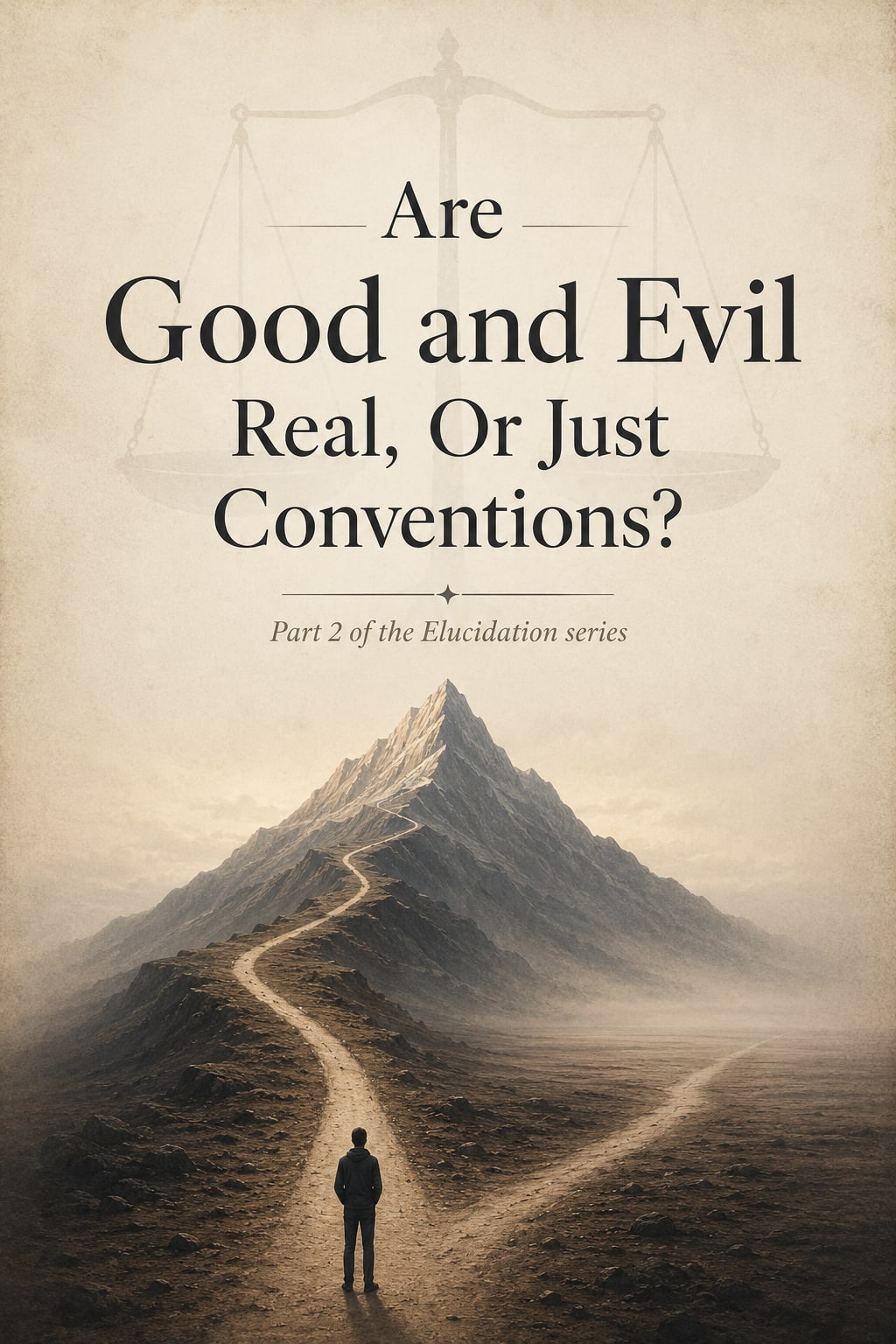
Remove the summit from a mountain, and every path is equal. Remove the shore from an ocean, and the ship has nowhere to go. Remove the direction from existence, and every choice is as good as every other.
But what if existence does have a direction?
That is the question the next article takes up, and it begins with one of the most fundamental questions in philosophy. Does reality exist outside the mind?
• • •
Next: Does Reality Exist Outside the Mind?**
Elucidation is a series of articles inspired by philosophical lectures given around 50 years ago. New articles are published weekly.
This article is part of the Elucidation series. The articles have been written and reviewed by the author with the assistance of AI.
About the Creator
Han Elucidation
Why do we exist? A searcher. Exploring existence, meaning, and what it means to be human through the Elucidation series.
Enjoyed the story? Support the Creator.
Subscribe for free to receive all their stories in your feed.
Comments
There are no comments for this story
Be the first to respond and start the conversation.