
Angulimala Story: How Buddha Transformed a Ruthless Killer Into an Arahant
The terrifying Buddhist story of a murderer who wore a necklace of human fingers—and the encounter with Gautama Buddha that changed his life forever

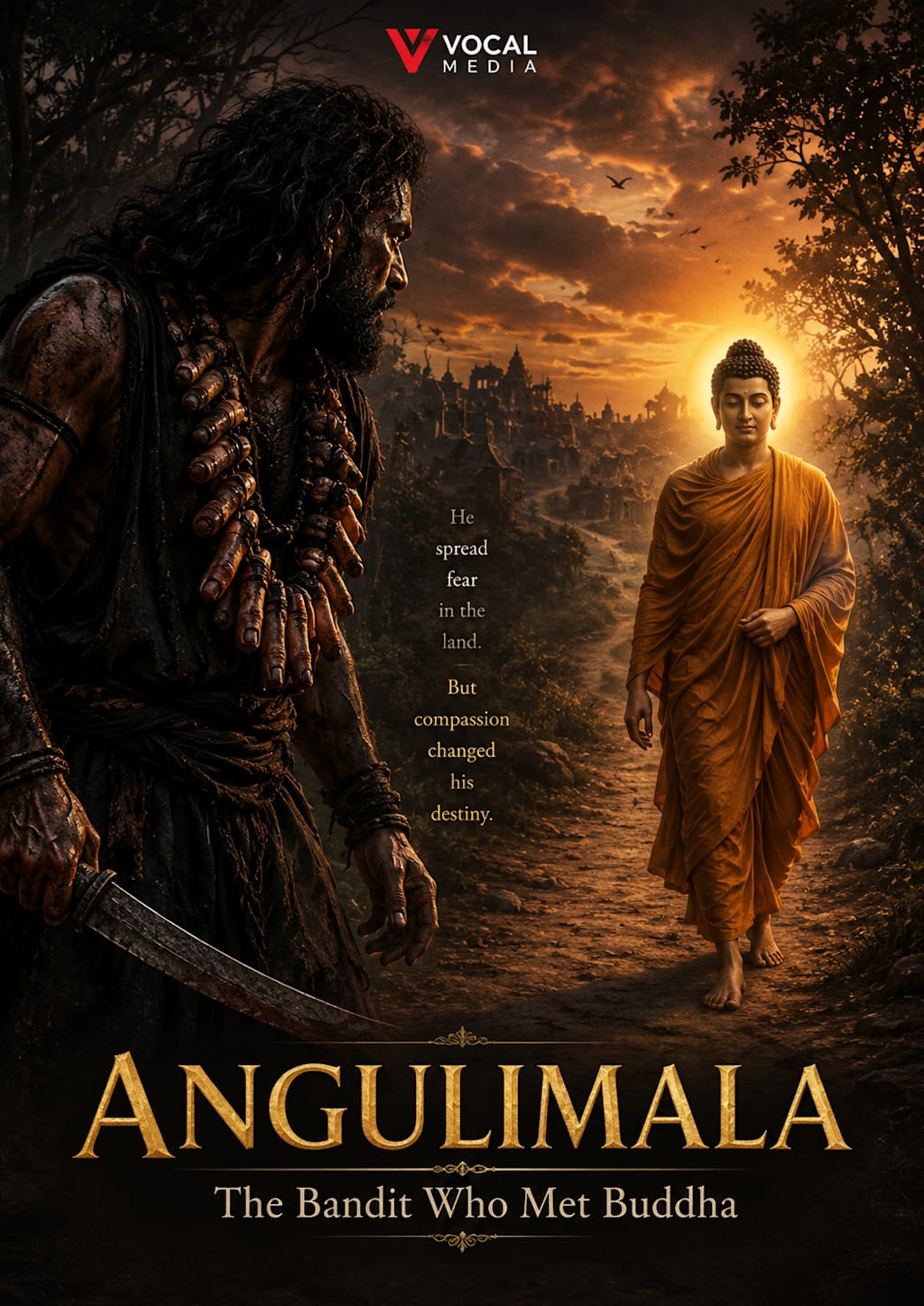
Few transformation stories in Buddhist tradition are as dramatic as the story of Angulimala and Gautama Buddha.
Angulimala was no ordinary criminal. Buddhist texts describe him as a violent bandit who terrorized communities, killed travellers and wore a garland made from the fingers of his victims. Entire settlements were reportedly abandoned because people were terrified of crossing the territory in which he operated.
Yet the same man would eventually put down his weapons, become a Buddhist monk and attain the state of an arahant.
How could someone with such a violent past change so completely?
That is what makes the Angulimala story one of Buddhism's most powerful teachings about violence, karma, repentance and human transformation.
Who Was Angulimala?
The name Angulimala literally refers to a “garland of fingers.” Buddhist tradition remembers him as a dangerous robber who collected fingers from the people he killed.
The Angulimala Sutta, found in Majjhima Nikaya 86, describes him as a ruthless killer who had devastated villages, towns and the countryside. He had become so feared that people avoided areas where he was believed to operate.
Later Buddhist traditions add more dramatic details to his biography.
According to one well-known version, Angulimala was attempting to collect 1,000 fingers from 1,000 victims. He had supposedly reached 999 and was desperately searching for one final person.
Some later accounts even say that when nobody else could be found, his own mother entered the forest to warn him that King Pasenadi's forces were searching for him. Angulimala, blinded by his obsession, was allegedly prepared to make her his final victim.
It is important to distinguish these later narrative traditions from the earliest surviving sutta account: the famous number 999 and the episode involving his mother are not presented in the same way in MN 86.
Buddha Walks Into Angulimala's Territory
Everyone else wanted to stay away from Angulimala.
Buddha did the opposite.
Despite repeated warnings that the road was extremely dangerous, Buddha deliberately travelled into the region where Angulimala was hiding.
Eventually, Angulimala saw him.
Here was a solitary monk walking calmly through an area where almost nobody dared travel.
Angulimala decided to pursue him.
What happened next became the most famous scene in the entire story.
Angulimala Runs—but Cannot Catch Buddha
Angulimala began running after Buddha.
This was a man accustomed to capturing travellers. According to the sutta, he believed he could normally catch even fast-moving animals and vehicles.
Yet something impossible happened.
Buddha continued walking at an ordinary pace, but no matter how fast Angulimala ran, he could not catch him.
Eventually, exhausted and confused, Angulimala shouted for Buddha to stop.
Buddha responded with one of the most memorable teachings associated with this story:
He explained that he had already stopped—and Angulimala was the one who had not stopped.
The meaning was deeper than physical movement.
Buddha had “stopped” violence, cruelty and the destruction of life.
Angulimala had stopped running for a moment, but inwardly he was still being driven by violence and destructive impulses.
That single confrontation challenged everything Angulimala had become.
The Killer Puts Down His Weapons
Instead of attacking Buddha, Angulimala listened.
The encounter affected him so deeply that he abandoned his violent life and asked to enter the Buddhist monastic order.
The man whom soldiers struggled to capture was transformed without a battle.
Buddha did not defeat him with a sword.
He defeated the violence controlling his mind.
Angulimala became a monk and followed Buddha back toward Savatthi.
King Pasenadi Meets the Man He Could Not Capture
Meanwhile, King Pasenadi of Kosala was dealing with the crisis Angulimala had created.
People had complained about the killer, and the king intended to suppress him.
When Pasenadi later met Buddha, Buddha asked him an extraordinary question.
What would the king do if Angulimala had shaved his hair and beard, put on monastic robes, stopped killing and begun living a disciplined spiritual life?
The king replied that such a person deserved respect and support—but he found it almost impossible to imagine Angulimala undergoing such a transformation.
Buddha then revealed that the monk sitting nearby was Angulimala himself.
The king was astonished.
According to the sutta, Pasenadi ultimately accepted his transformation and offered to provide him with monastic necessities.
It is one of the story's most striking moments: the state had been preparing to defeat Angulimala through force, while Buddha had already changed him through teaching.
Becoming a Monk Did Not Erase His Past
The story does not claim that simply putting on a monk's robe erased everything Angulimala had done.
People remembered him.
When he later walked through Savatthi collecting alms, some people attacked him.
A stone struck him. Other objects were thrown at him. His head was injured, his bowl was broken and his robe was torn.
He returned to Buddha bleeding.
Buddha told him to endure it, explaining that he was experiencing consequences connected with his previous actions.
This part is essential because the Angulimala story is not simply saying:
“Do terrible things, apologize, and everything disappears.”
His transformation changed his future conduct, but it did not magically remove every consequence of his past.
From Murderer to Arahant
Angulimala continued his spiritual practice.
The same man once associated with killing eventually became devoted to nonviolence.
According to MN 86, he practiced seriously in solitude and ultimately attained arahantship, the liberation that represents the completion of the Buddhist path.
This is why Angulimala occupies such an unusual position in Buddhist literature.
His story is not powerful because he began as a saint.
It is powerful precisely because he did not.
He represents one of the most extreme examples of transformation.
What Does the Angulimala Story Really Teach?
The story can be understood on several levels.
First, a person's past does not have to dictate every future action. Angulimala could not undo the lives he had taken, but he could stop creating further suffering.
Second, real repentance requires a change in behavior. His transformation was not merely verbal. He abandoned weapons, entered disciplined monastic life and accepted hostility without returning to violence.
Third, the story distinguishes between external and internal stopping.
When Angulimala told Buddha to stop, Buddha's response pointed toward a deeper question:
Have you stopped physically, or have you stopped hatred, greed and violence within yourself?
Finally, the story demonstrates the Buddhist idea that transformation can sometimes achieve what punishment alone cannot.
King Pasenadi had soldiers.
Angulimala had weapons.
Buddha arrived with neither.
Yet Buddha accomplished what an entire kingdom had struggled to achieve.
Final Thoughts
The Angulimala story remains unforgettable because it asks an uncomfortable question:
Can someone who has committed terrible acts genuinely change?
Buddhist tradition answers yes—but change does not mean pretending the past never happened.
Angulimala had to abandon violence, accept the consequences of his former actions and completely transform the direction of his life.
The man once feared for his necklace of human fingers ultimately became remembered not merely as a killer, but as an example of radical spiritual transformation.
Perhaps that is the deepest message of the story.
Stopping your feet is easy.
Stopping the violence, hatred and darkness inside the mind is the real challenge.
SEO tags
Angulimala, Angulimala Story, Gautama Buddha, Buddha Stories, Buddhism, Buddhist Stories, Angulimala and Buddha, Arahant, Buddhist Teachings, Spiritual Stories
About the Creator
parwinder singh
🎬 Movie & Entertainment Writer sharing reviews, ending explanations, story breakdowns, plot twists and hidden details from Bollywood, Hollywood, South Indian cinema, Korean dramas and OTT releases.
Enjoyed the story? Support the Creator.
Subscribe for free to receive all their stories in your feed.
Comments
There are no comments for this story
Be the first to respond and start the conversation.