
800 Rupees for a Shroud, Not a Cent for a Soul
hypocracy of peopel

.No one really knew when Master Ilyas had come to this neighborhood or when he had rented that small room. But everyone knew that Master Ilyas was a migrant and that he belonged to some area of Ambala, because his accent clearly reflected that region.
Master Ilyas lived in a rented room, and the boys of the neighborhood would come to him to learn counting, recite multiplication tables, and practice writing on wooden slates. He owned two fighting quails and one purebred rooster. The quails remained confined in cages, but the rooster stood a little distance away from the door of his room. Master Ilyas had tied a strong string to a brass ring in the rooster’s leg, and the other end of the string was fastened to a nail fixed into the threshold of his room.
All the residents of Mohsin Mohalla respected Master Ilyas. Whenever they passed by his door, they would greet him with “Assalamu Alaikum.” Master Ilyas also did some other work, but no one knew exactly what it was. Perhaps he worked as a clerk in the vegetable market, or maybe he sold goods in distant neighborhoods, or worked as a daily wage laborer in some factory. No one knew for sure, but everyone understood that he lived a very modest and financially strained life.
In reality, Master Ilyas was a simple man who did not know how to keep up with the ways of the world. His appearance did not inspire affection or sympathy in people, and his way of speaking was such that no one found it convincing. He never lied. He did not cheat. He did not exaggerate. He did not boast. He never tried to intimidate anyone. And for this very reason, people did not trust him.
No one believed what he said. His speech contained many grammatical and stylistic errors, which irritated listeners and made them leave his company. He was so straightforward and uncomplicated that he hardly seemed human. He felt like a burden on the entire neighborhood and society. Since no one liked forming relationships with such people, he had no friends. This was why people merely showed him formal respect, greeting him in passing and moving on.
One winter evening, the landlord scolded Master Ilyas harshly and warned him that if he did not pay the rent for the past six months within three days, all at once, he would throw his belongings out. Master Ilyas was so frightened that he could barely speak. He did not have one hundred and eighty rupees in total—only forty rupees, which he had tied together with a ten-rupee note to make fifty.
Previously, the landlord used to accept smaller payments like twenty-five, forty, or fifty rupees and extend the deadline. But this time he became strict. He threw the fifty rupees, tied in a string, in front of the rooster and said, “Take it away! I won’t accept this. Bring me the full one hundred and eighty.”
After he left, Master Ilyas picked up the fifty rupees from the floor, put them in his waistcoat pocket, then went inside his room and sat on his charpoy, deeply distressed. His throat tightened with grief—it was perhaps the first time someone had been choked with emotion without even crying.
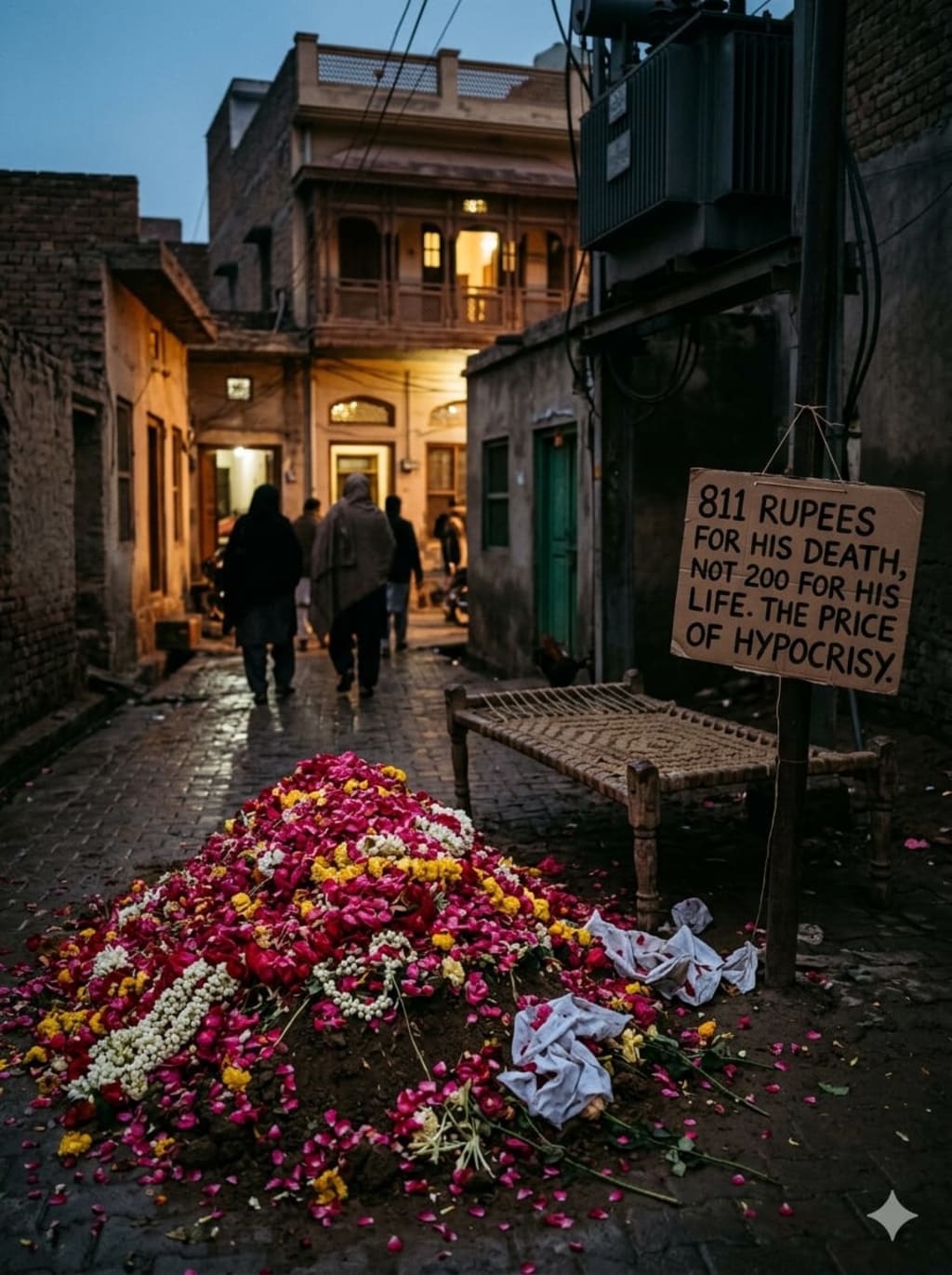
As promised, the landlord threw his belongings out. Master Ilyas’s charpoy was placed behind two electric transformer poles, and the rest of his belongings were arranged around it. The landlord locked the room with a new Chinese lock and left on his scooter. His house was far away, and he used to come monthly to collect rent.
Master Ilyas spent the night under the transformer. The next day, he went to the mansion of Sheikh Karim Nawaz and asked him for a loan of two hundred rupees. Sheikh Sahib, considering him a simple and naive man, avoided giving him the money, thinking it unwise to lend large sums to such people.
Then he went to Ismail the cloth merchant and reduced his request to one hundred and fifty rupees, but he too refused. Master Ilyas approached every barber, confectioner, butcher, doctor, physician, and lawyer in the neighborhood, but everywhere he faced disappointment. People were struggling with inflation and had nothing to lend.
On the eighth day of sleeping under the transformer, Master Ilyas went to a homeopathic doctor to have his pulse checked. The doctor examined him with a stethoscope and said, “Master Sahib, you have pneumonia. I can give you medicine, but you should consult someone else as well.” Master Ilyas replied, “Very well,” and went to Jabbar the confectioner’s shop to drink warm milk.
After drinking the milk, he showed his pulse to Jabbar and then humbly requested a loan of two hundred rupees. Jabbar burst into laughter. He knew that no one would lend even a single rupee to such a simpleton, yet here he was asking for two hundred. Such an unlikely request made him laugh, though in ordinary life he rarely laughed.
For three continuous days, Master Ilyas sat on his charpoy with a quilt wrapped over his head. Anyone passing by would greet him and casually ask, “So, Master Ji, enjoying the sunlight?” And he would reply in a muffled voice, “Yes, just feeling a bit cold.”
On the fourth day, at the time of the Fajr call to prayer, Master Ilyas passed away. Every single person in Mohsin Mohalla felt deep sorrow at his death. By the end of breakfast time, people stood silently in the sunlight, wrapped in grief.
His quails were given a bowl full of grain, and his rooster was fed dough pellets. Sheikh Karim Nawaz came from his mansion and arrived under the transformer. A large mat was spread there, and a few fresh newspapers were placed. People began to gather.
Sheikh Karim Nawaz took out two hundred rupees and sent Saeed and Bilal on a scooter to arrange for the grave. He gave three hundred rupees to Babu Jalal to take care of washing the body, arranging the shroud, rose water, and flowers. Jabbar the confectioner sent a large pot of tea to the gathering.
People started collecting donations for Master Ilyas’s burial, and soon the residents of Mohsin Mohalla collected eight hundred and eleven rupees and handed it over to Sheikh Karim Nawaz for safekeeping
About the Creator
Enjoyed the story? Support the Creator.
Subscribe for free to receive all their stories in your feed.
Comments
There are no comments for this story
Be the first to respond and start the conversation.