
Why Seaweed Ash Was Worth a Fortune in the Nineteenth Century, and What It Was Used For
How burned seaweed became a vital source of alkali and iodine, then lost its value when industrial chemistry changed the market.
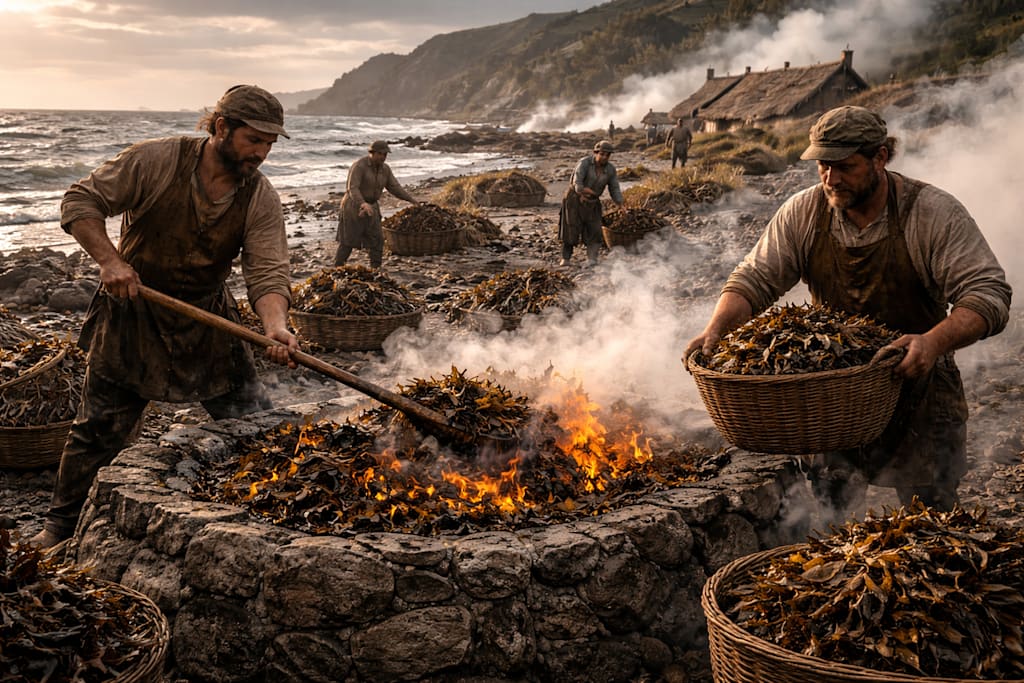
Today, seaweed is usually associated with food, cosmetics, or eco-friendly packaging. But 200 to 300 years ago, people in Europe saw it very differently. They collected it on the shore, dried it, and burned it to obtain ash. That ash was a valuable industrial raw material.
How valuable ash was made from seaweed
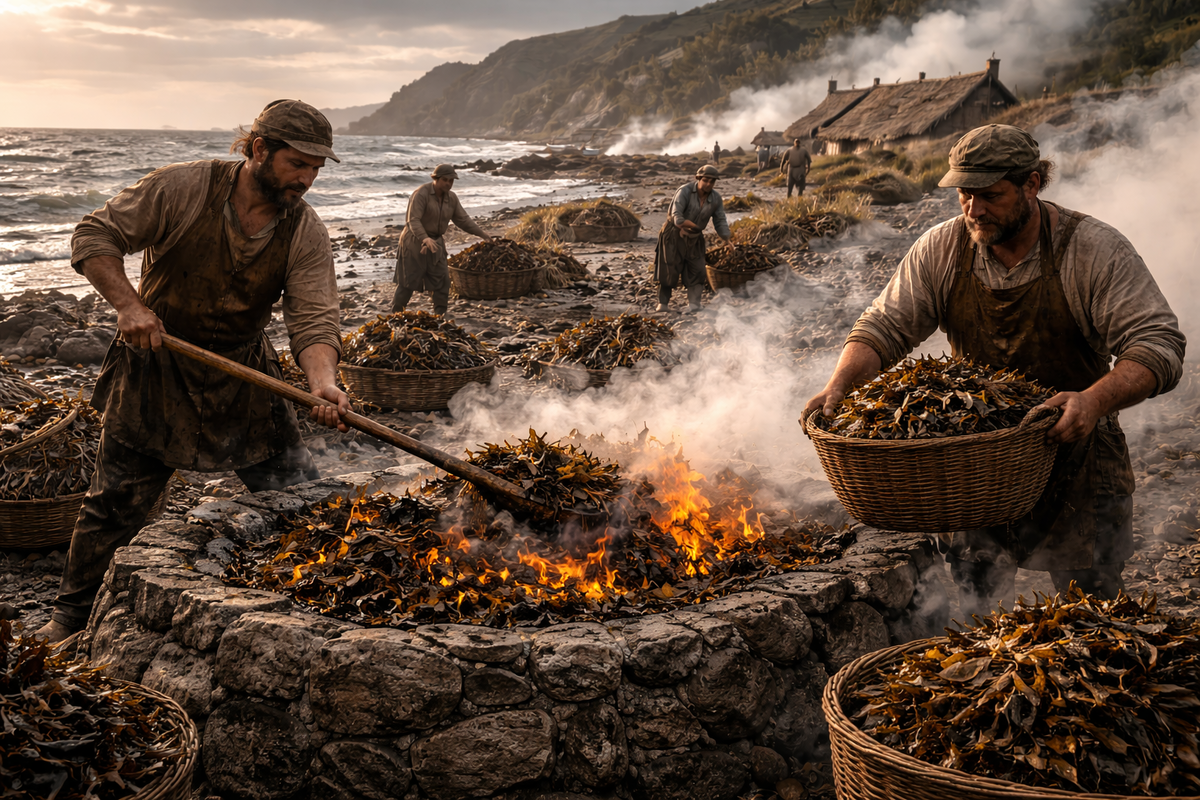
The process was known as kelp burning. In Britain, kelp referred both to brown seaweed itself and to the product obtained by burning it. Here is how it worked: After storms or at low tide, peasants went out to the shore and gathered kelp and wrack. Sometimes the seaweed was cut directly from the rocks with hand rakes. The raw material was then dried on the shore for several days until it stopped dripping. After that, it was burned in shallow stone pits or furnaces. The fire was kept going for 12 to 24 hours, while the mass was constantly stirred with iron rods. In the end, what remained at the bottom was a fused, glassy gray-green mass — this was kelp. It was broken into pieces and sold. The volume shrank by twenty to thirty times. A ton of raw seaweed yielded about 50 to 100 kilograms of ash. That made the process profitable: transporting a dense finished product was far cheaper than hauling piles of rotting weed.
Why alkali mattered so much to industry
The main things obtained from seaweed ash were soda and potash. From them, manufacturers produced alkali. In the eighteenth and nineteenth centuries, alkali was an essential industrial substance: without it, it was difficult to make glass, soap, and other necessary goods. For glass: Sand melts at 1700°C, which is expensive and difficult. If alkali is added, the temperature drops to 1200–1300°C. The glass becomes fluid and much easier to melt and shape. Without alkali, ordinary window glass and bottle glass would simply not have existed on that scale. For soap: Fat, whether from sheep, cattle, or palm oil, does not remove dirt by itself. Alkali breaks fat down into glycerin and salts of fatty acids — and that is soap. Before industrial electrolysis, soap was made precisely with ash: birch ash, oak ash, or seaweed ash. Seaweed ash was valued more highly than wood ash because it contained more potassium salts and iodine. It was used to make soap that was softer and also stored well.
The kelp boom: Scotland, Ireland, and France from the seventeenth to the nineteenth century
The height of the trade came between about 1720 and 1830. European cities were growing and needed glass and soap. Traditional alkali — soda made from Spanish barilla, a saltwort plant — was in short supply. Trade wars, and then Napoleon’s Continental Blockade from 1806 to 1814, cut off southern supplies. The answer was simple: burn local seaweed. The Scottish Hebrides and Orkney Islands became global centers of kelp production. In the 1720s, farmers were bringing in 20 to 30 tons of ash a year. By the 1790s, output had risen to 2,000 to 3,000 tons annually. At the peak, around 1810, a ton of kelp sold for 20 to 25 pounds sterling — enormous money for a poor crofter, a small tenant farmer. An entire family could earn 5 to 10 pounds over a summer — about the same as the annual income of an agricultural laborer. In France, especially in Brittany, seaweed was burned not so much for alkali as for iodine, which became even more important later. But the scale was comparable. In Ireland, on the western coast, especially in counties Kerry and Mayo, kelp provided work for thousands of families living on the edge of starvation. The work was brutal. The stench, the smoke, the burns. Women and children carried baskets of wet seaweed over slippery rocks. Men stayed awake by the furnaces for days at a time. Even so, most of the money went to landowners and middlemen. Peasants received very little.
How Bernard Courtois discovered iodine and transformed the industry
In 1811, in Dijon, the French chemist Bernard Courtois was working at a plant where seaweed ash was processed into saltpeter for gunpowder. During one of his experiments, he noticed unusual violet vapors. When they settled on cold metal, shiny black crystals appeared on the surface. Courtois realized that he had encountered a new substance. It was later named iodine, from a Greek word meaning “violet.” In 1813, the French chemist Joseph Louis Gay-Lussac and the English chemist Humphry Davy independently confirmed the discovery and proved that iodine was a distinct chemical element.
Iodine as one of the great medical aids of the nineteenth century
Before iodine, wounds were washed with wine or vinegar, with limited effect. After the 1820s, surgeons began using tincture of iodine. It killed bacteria more effectively than almost anything else available at the time. Iodine saved lives: in amputations, where gas gangrene could be held back; in the treatment of abscesses and fistulas; later, in the treatment of goiter, when it became clear that thyroid disease was caused by iodine deficiency. Between the 1830s and 1850s, France led the world in extracting iodine from seaweed. In Brittany, dozens of small plants burned thousands of tons of kelp each year. The iodine yield was only 0.1 to 0.3 percent of the mass of the ash, but the price was high — about 600 francs per kilogram in 1830, roughly a worker’s annual wage.
Why the industry died: chemistry defeated chemistry
By the middle of the nineteenth century, the kelp industry had collapsed. The reasons were technical, not environmental. For alkali: In 1791, the Frenchman Nicolas Leblanc patented a method for producing soda from common salt and sulfuric acid. By the 1820s, Leblanc plants were producing tons of cheap soda. Seaweed ash was no longer needed. For iodine: In the 1860s, Chilean nitrate deposits were found to contain iodine impurities. Chilean nitrate cost very little, and its extraction was done by mining rather than by hand. By the 1880s, Chilean iodine had pushed seaweed-derived iodine out of the market. By 1860, people in the Hebrides were still trying to burn kelp, but prices had fallen from 20 pounds a ton to just 3 or 4. The trade died. Thousands of families lost their source of income.
About the Creator
Enjoyed the story? Support the Creator.
Subscribe for free to receive all their stories in your feed.
Comments
There are no comments for this story
Be the first to respond and start the conversation.