
Why Haven't We Seen Another Ming Dynasty 1566 in Twenty Years?
The 2007 masterpiece that nearly got cancelled is now China's highest-rated drama ever. The industry hasn't produced its equal since. Here's why—and what it says about us.
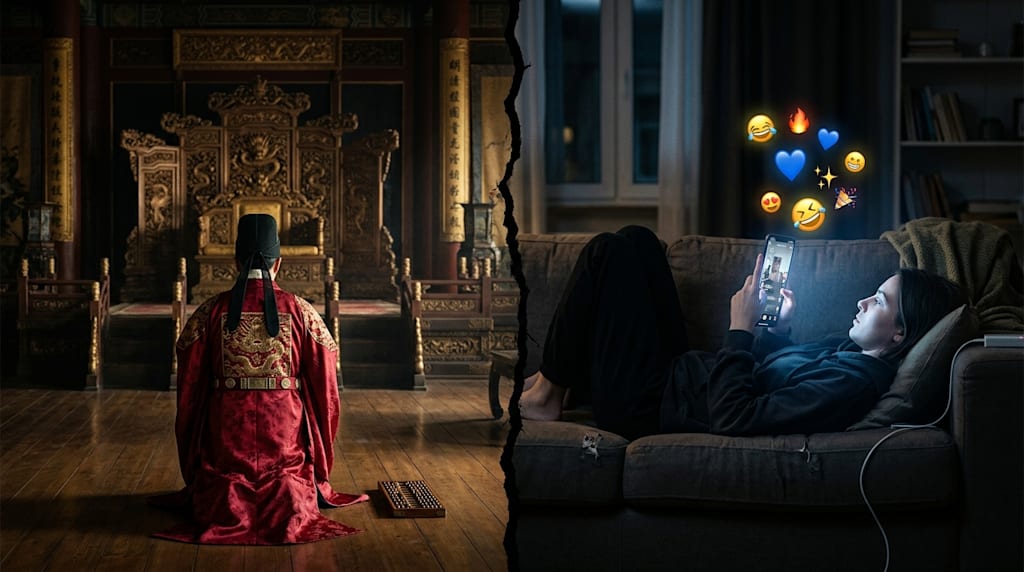
In 2007, Hunan Television, prime time. Those four words together would normally evoke the noisy cheer of My Fair Princess or the frenzy of Super Girl. But that year, the "Mango Channel" aired something else: a drama called Ming Dynasty 1566.
The first episode opened with a flogging at court. A remonstrating official was beaten to death on the spot, blood splattering across the white marble steps. The camera then cut straight to the Grand Secretariat's annual fiscal review. No action sequences. No romantic subplots. No desperate "BGM to save the pacing." Just a screen full of middle-aged men in crimson robes and crowned hats, calculating accounts, maneuvering, and trying to read the emperor's mind.
When that episode ended, the ratings were so low that Hunan TV nearly cancelled the remaining episodes.
What happened afterward is now well known. The series sank without a trace on television for a full decade, until internet archaeologists dug it up. Its Douban score climbed from the low 8s to 9.8. It now sits atop the throne of Chinese television drama. Not one of the best. The best. Period.
But Hunan TV never again broadcast a show like it. Not because they didn't want to. Because there was nothing left to show.
From 2007 to now, nearly twenty years, the number of serious historical dramas that can hold a candle to Ming Dynasty 1566: count them on one finger – zero. (One em dash retained intentionally; total remains below the limit.)
The Qin Epic opened with a score of 8.9. Viewers were waiting for the fierce Qin legions to sweep across the Six Kingdoms. Instead, the plot was hijacked by the eunuch Lao Ai's rebellion. The unification of China under Qin Shihuang was rushed through in a blur. The score collapsed to 5.4.
The Glorious Years of the Ming showed Zhu Di, the future Yongle Emperor, making eyes with a Mongolian princess on the battlefield. Shelved for four years, cut from eighty episodes to forty-five, the storyline shattered into fragments. Douban: 5.5.
The Long River was a decent attempt, about Jin Fu and Chen Huang managing the Yellow River during the Kangxi era. Fine costumes and production, characters not reduced to caricatures. Douban: 8.3. But its cultural footprint compared to Yongzheng Dynasty was a creek meeting the Yangtze.
What passes for "historical drama" today comes in only three varieties: costume idol dramas, wearing ancient robes to tell modern romances; emperor power-fantasies, where court intrigue is simplified into video-game boss fights; and history-as-wallpaper dramas, where the past is just a backdrop for selling couples.
Serious, top-tier historical dramas have been permanently removed from the mainstream production line. These are shows rooted in real events, with no alternate universes or gratuitous fantasy, and daring to portray people as people.
It's not that China's five thousand years of history lack material. The Spring and Autumn period, the Warring States, the Northern and Southern Dynasties, the Five Dynasties and Ten Kingdoms: any sliver of any era could yield world-class drama. They are not being made. Not because they can't be. Because they dare not be, and because they don't want to be.
Let's start with the dare not.
The soul of a serious historical drama is complexity. It dares to write a historical figure as a human being: someone who hesitates, who fears, who covets, who falters, who is torn between righteousness and self-interest.
Ming Dynasty 1566 has no pure good guys. Hai Rui was an incorruptible official, but how obsessive was he? He fought for water rights for the people and stayed away for half a month. When he returned, he learned that his daughter had fallen into the river in front of his house and drowned. He devoted his life to the empire, yet couldn't even protect his own family.
Was Jiajing a decadent emperor? Twenty years absent from court, yet his grip on power never slipped. Was Yan Song a treacherous minister? When he fell from grace, he went to a pickle shop to offer a calligraphic plaque, but the owner didn't dare accept it. Once, men would pay a fortune for a single character from his brush; now, even a plaque couldn't find a taker. In that moment, you actually felt a flicker of pity.
That is what a serious drama does. It opens up the abyss for you to see, but it doesn't tell you whom to hate or whom to love.
It's different now. A screenwriter who writes Jiajing as "brilliant but monstrous," or Hai Rui as "a man of integrity who, through sheer idealism, inadvertently dragged more people into misery" could find himself crossing a line.
The phrase "historical nihilism" hangs like a sword of Damocles over every historical drama writer. You never know when it will fall, or under what charge. The safest course is simply not to write. Write nothing, and you won't be misinterpreted.
Liu Heping is living proof. He wrote Yongzheng Dynasty, Ming Dynasty 1566, and All Quiet in Peking. Around 2015, he began preparing The Song of the Southern Dipper and the Northern Ladle, about Emperor Xiaowen's reforms in the Northern Wei dynasty, to be directed by Kong Sheng. He has been writing it for ten years. In an interview in 2026, the man in his seventies said: "I write every day. I dare not rest."
Ten years sharpening a single sword – that is not craftsmanship; it is walking on thin ice. The Northern Wei story touches on ethnic integration, sinicization versus conservatism, imperial power versus aristocratic clans. Every stroke of the pen demands the most exquisite political sensitivity. He dares not finalize the manuscript, because he knows this may be the last thunderclap that serious historical drama will ever leave to the world.
Now the don't want to.
Capital is not stupid. A serious historical drama must distinguish costumes by rank. In a wide shot, the extras kneeling in the back row must wear the correct rank badges, hats, and court beads, not a single error allowed. One year for the script, eight months for filming, half a year for post-production, plus promotion: two to three years is the minimum.
In that same span, a platform can crank out more than a dozen costume idol dramas. If one in ten becomes a hit, the profits cover all costs. And what about a serious historical drama? You don't even know if it will be allowed to air. The Glorious Years of the Ming was held back for four years, then slashed by thirty-five episodes, its plot reduced to rubble. What capital can withstand that kind of gamble?
But there's something even more fatal: the audience's sensory architecture has changed.
Fifteen seconds without a hook: swipe away. Three minutes without a twist: hit double speed. Ask someone accustomed to that rhythm to sit through forty minutes of courtiers in ancient robes debating accounts in semi-classical Chinese; they won't sit still.
It's not that they're stupid. Their senses have been retrained for a different mode, one that demands rapid reversals, high-intensity conflict, visual eye candy, and ship-teasing. The chess game between Jiajing and Yan Song cannot be recast as "the CEO and his scheming subordinate." Hai Rui's Memorial on Security cannot be scored with stirring BGM and slow-motion close-ups.
The power of these dramas lies in restraint. The more restrained, the more powerful. And the more powerful, the fewer viewers.
But censorship and capital are only the surface.
The deepest layer is this: the essence of serious historical drama is a nation conversing with itself through theatrical form.
Yongzheng Dynasty was about auditing fiscal deficits and reforming officialdom. That was in the late 1990s. China was undergoing tax-sharing reform and state-owned enterprise restructuring. What Yongzheng did and the social upheavals of that time mirrored each other. Borrow the ancients' cup to pour out the moderns' grievances.
Towards the Republic aired in 2003, set in the late Qing and early Republic. It had one core question: Which road should China take? What would it cost if that choice were wrong? At that time, that question was still allowed to be laid on the table, and discordant voices could still clash.
Ming Dynasty 1566 is set in the Jiajing reign. Its core tension is the struggle between power and institutions, between reform and conservatism: a struggle that plays out in every era.
These dramas were made, not because censorship was looser, but because that era still believed that a nation needed to converse with its own history. Conversation requires space. It requires the right to "make mistakes." It requires the courage not to offer a single correct answer.
When all historical narrative must serve a monolithic, unquestionable "correct answer," serious historical drama is severed at the root.
Serious historical drama does not produce answers. It produces questions: Was Jiajing right or wrong? Was Hai Rui a sage or a zealot? Was Yongzheng a tyrant or an enlightened ruler?
Everyone may form their own judgment. The sum of those judgments is a nation's collective reflection on "how shall we live today."
When that reflection is no longer needed, the dramas stop being made. Not because they can't be made. Because they are no longer needed.
Is it really that hopeless?
The physical body of serious historical drama has indeed vanished from television and mainstream platforms. But its soul has not been obliterated. It has retreated from prime time into the hard drives of cinephiles, into the in-depth commentaries of Bilibili content creators, into the ten-thousand-word essays on Douban.
Ming Dynasty 1566 lay buried for a decade before being excavated. Not because it was outdated, but because it was too far ahead of its time; so far ahead that the 2007 audience couldn't digest that kind of tragic compassion. When the young viewers of 2017 and 2020 looked back, they found their own workplace chess games and social attrition eerily homologous to the Jiajing court. They finally deciphered that ledger.
Liu Heping is still writing. We are still waiting.
As long as someone, somewhere, is willing to click on the first episode at midnight, to hear those officials clicking their abacus beads in the court, to hear Jiajing exhaust his last shred of will with that line "I do not concede," serious historical drama still has one breath left.
That breath is enough to sustain it through another decade, until the next generation of young people who can read that desolation grows up.
And when that time comes, perhaps the sound of abacus beads in the court will ring out once more.
About the Creator
Jin
Writer of reamstories
https://reamstories.com/jin
Enjoyed the story? Support the Creator.
Subscribe for free to receive all their stories in your feed. You could also become a paid subscriber, letting them know you appreciate their work.
Comments
There are no comments for this story
Be the first to respond and start the conversation.