
When a Michigan Hotel Was the Whole Vacation
Three vintage postcards reveal the porches, dining rooms, and waterfront gathering places that helped shape Lake Huron resort life.

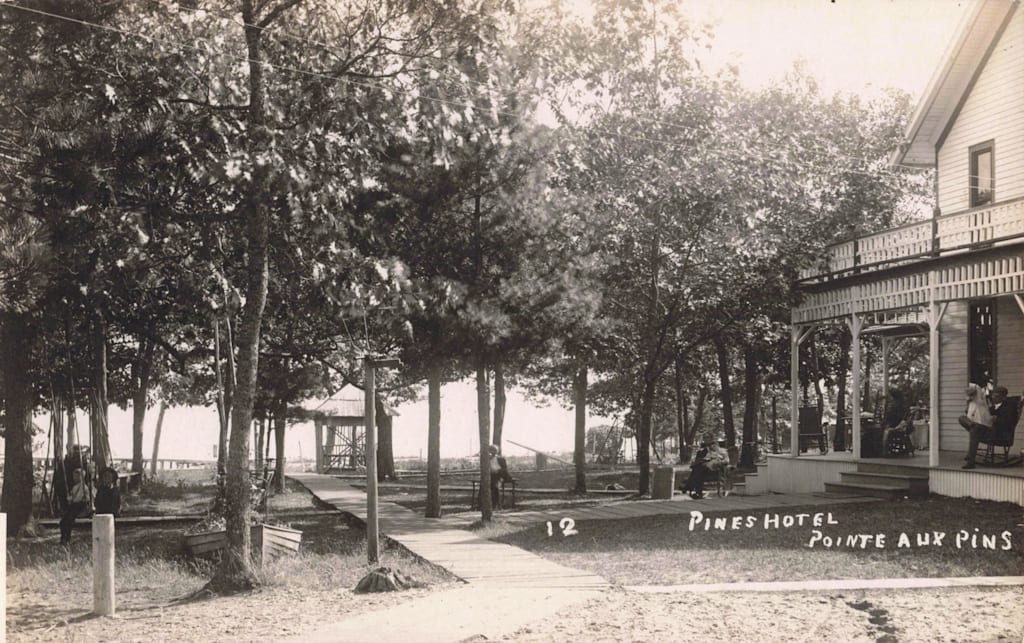
Look closely at the people outside the Pines Hotel. Some sit on the porch. Others gather beneath the trees. A wooden walk leads toward the water, and a small open pavilion stands beyond it.
No one in this photograph appears to be rushing to the next attraction.
The undated postcard, preserved in the University of Michigan’s David V. Tinder Collection of Michigan Photography, captures a vacation setting built around shared spaces. The hotel’s grounds gave visitors places to sit, meet, and watch the day unfold.
Two more postcards, from Pointe Aux Barques near Port Austin, carry that story indoors and along another stretch of Lake Huron. Together, the photographs invite a different way of looking at a resort hotel: as part of the vacation itself.
The Pines Hotel at Pointe Aux Pins on Bois Blanc Island shows guests on its porch and shaded grounds. David V. Tinder Collection of Michigan Photography, William L. Clements Library, University of Michigan Library Digital Collections. Record 36736.
The island hotel that brought neighbors to dinner
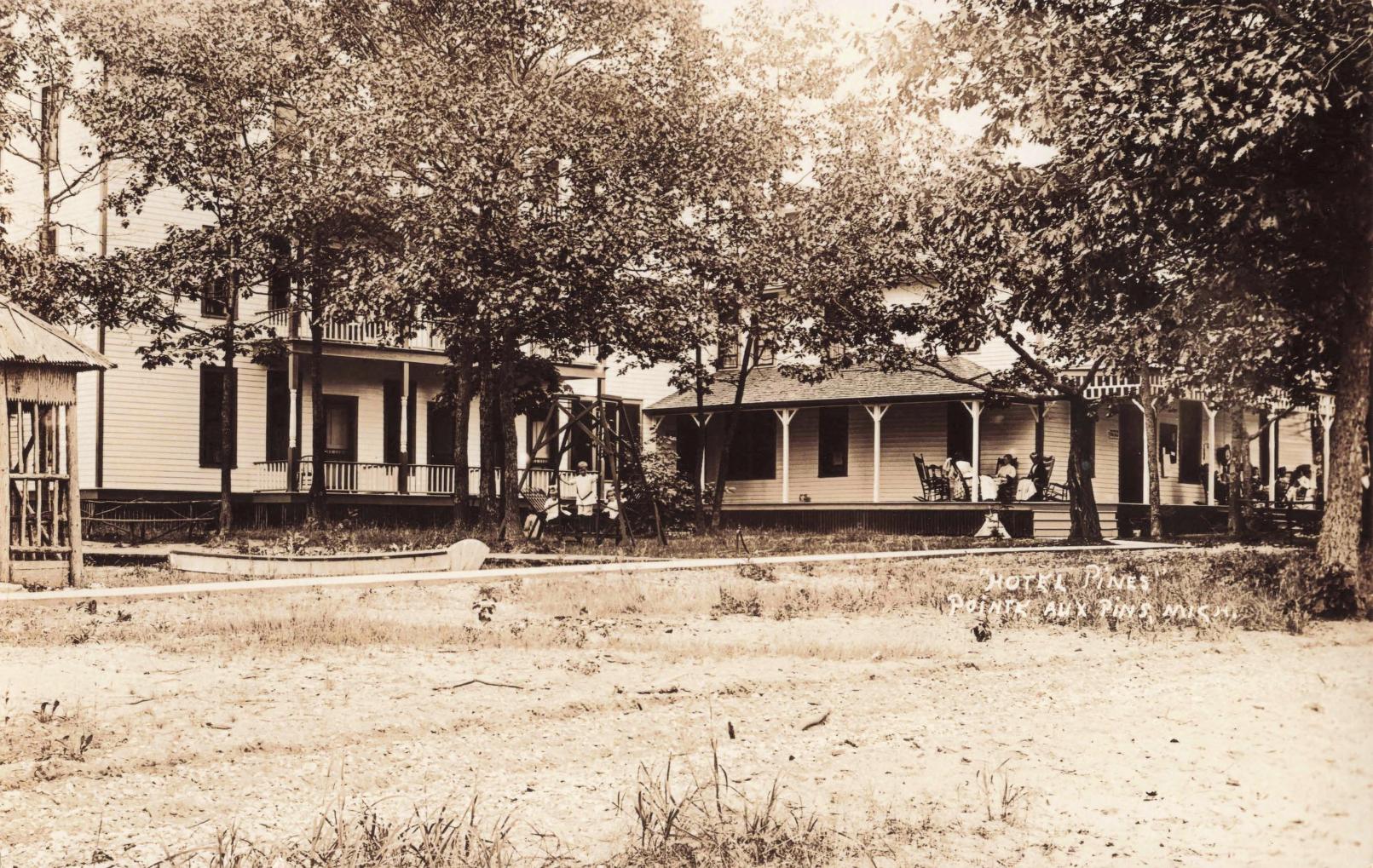
Pointe Aux Pins is on Bois Blanc Island near the Straits of Mackinac. It is separate from Pointe Aux Barques in Michigan’s Thumb.
The Bois Blanc Island Association’s history dates the Pines Hotel’s opening to July 9, 1888. That summer, the steamer Jennie King connected the developing resort with Cheboygan and Mackinac Island.
The association records an especially revealing detail: by 1904, a 41-room hotel could draw as many as 125 people for dinner. Nearby cottages supplied additional diners. The developer offered cottages without kitchens and directed occupants to eat at the hotel.
That arrangement made the hotel a meeting place for more than just overnight guests. The same local history describes frequent dances, sailing, swimming, and other outdoor activities.
The postcard gives those accounts a setting. Chairs, shade trees, a broad porch, and intersecting walks suggest how easily people could encounter one another between planned events. We cannot know the conversations in this particular scene. We can see the spaces that made them possible.
At Pointe Aux Barques, the view was part of the invitation
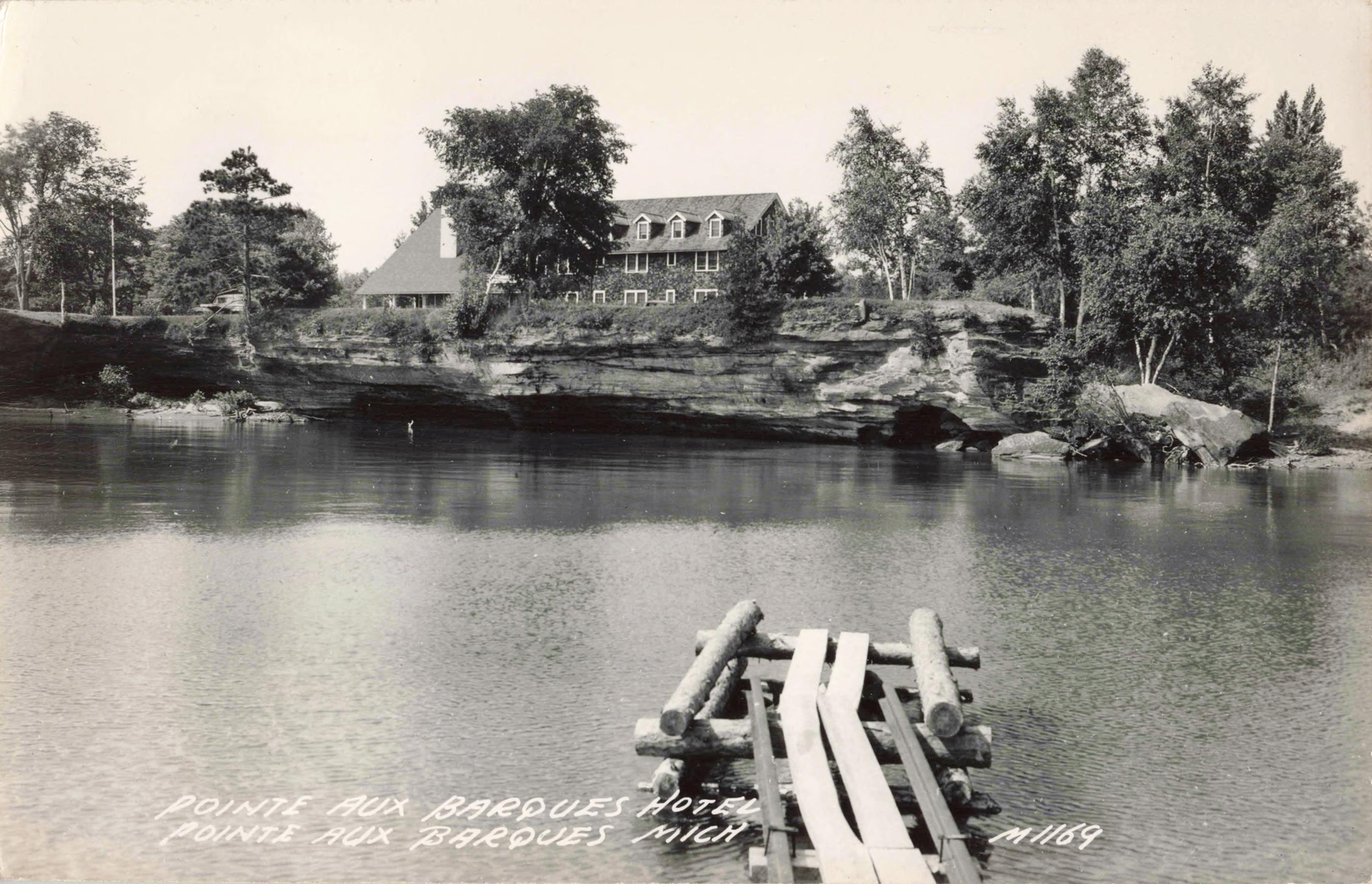
An undated postcard identifies this waterfront building as the Pointe Aux Barques Hotel. Trees and exposed shoreline rock frame the view. David V. Tinder Collection of Michigan Photography, William L. Clements Library, University of Michigan Library Digital Collections. Record 23279.
The Pointe Aux Barques exterior offers a different composition. Water fills the foreground. Layered rock runs beneath the hotel grounds. The building sits back among the trees, while a narrow wooden structure projects into the scene from the photographer’s side of the water.
It is an appealing invitation: come here for the setting.
A reproduction of the resort’s 1899 guidebook description shows that scenery was only part of its sales pitch. The account promoted convenient train connections, summer comfort, and social life. It also emphasized restrictions on excursion visitors. The promised retreat depended partly on controlling who could enter it.
That exclusivity belongs in the story alongside the attractive views. These postcards preserve a particular version of leisure, rather than a summer available to everyone.
The dining room deserves a closer look
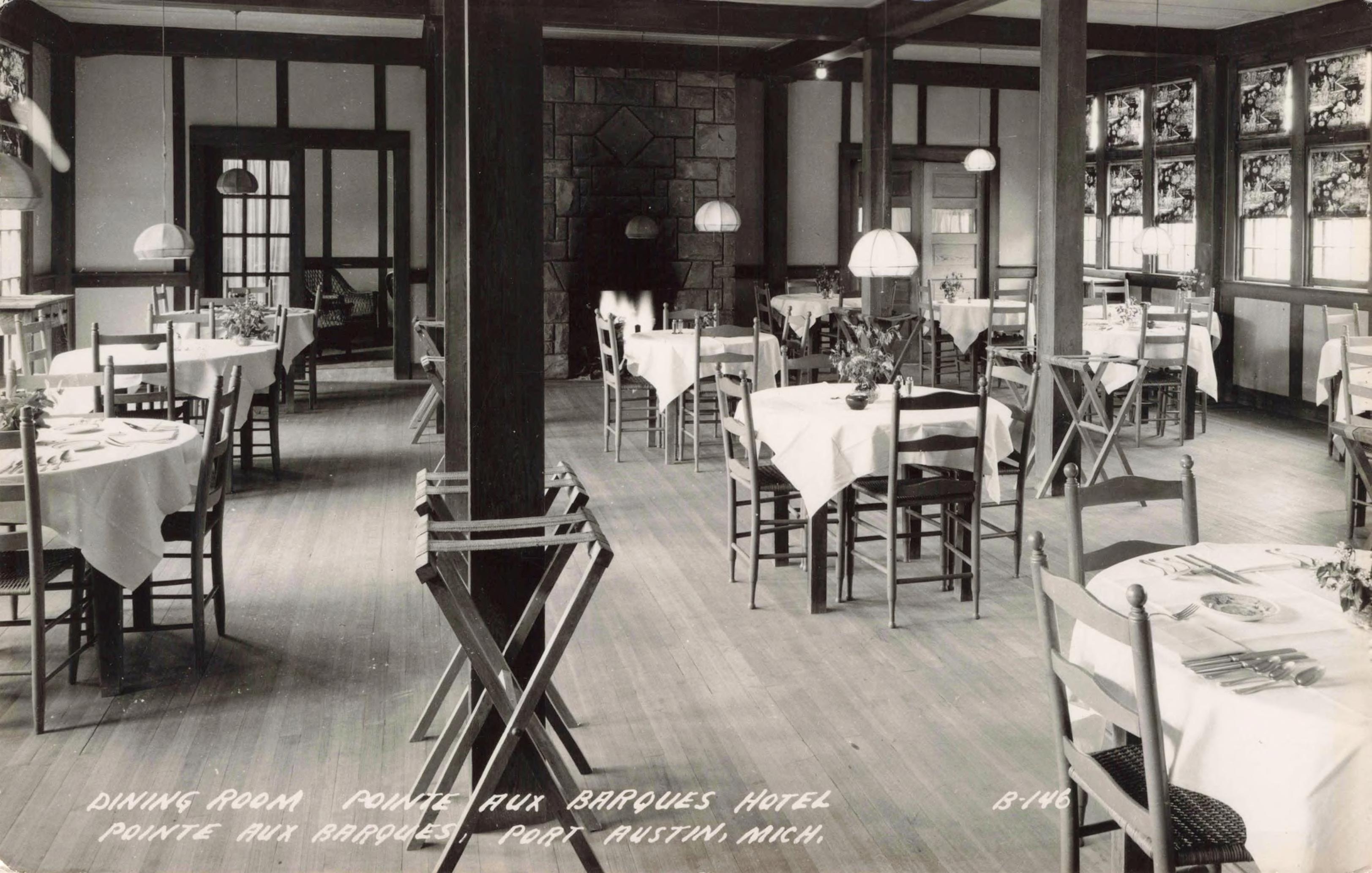
Tables are set beneath hanging lamps in the Pointe Aux Barques Hotel dining room, with a stone fireplace at the rear. The collection record provides no date for the photograph. David V. Tinder Collection of Michigan Photography, William L. Clements Library, University of Michigan Library Digital Collections. Record 23317.
The dining-room photograph may be the most revealing of the three. White tablecloths cover small tables. Heavy posts divide the room. Hanging lamps and a large stone fireplace give the space its character.
There are no diners in view. The room is ready for them.
Read beside the Pines Hotel history, it encourages a useful question: how much of a vacation happened around the table? Meals could structure the day and bring people together repeatedly, giving the hotel a role beyond its bedrooms.
These images cannot tell us how long every visitor stayed or why each hotel eventually changed. They preserve something more specific: the places where guests spent their time.
For another view of hotels and transportation along this coast, read The Holland Hotel: A Railroad-Era Landmark in East Tawas.
The people in the Pines Hotel postcard are still there on the porch, waiting for us to notice them. Their afternoon is worth a second look.
Sources and postcard records
https://bbiassociation.org/resources
https://thumbwind.com/2022/01/26/pointe-aux-barques-resort/
https://quod.lib.umich.edu/t/tinder/x-36736/tinder-rppc-073471
https://quod.lib.umich.edu/t/tinder/x-23279/tinder-rppc-046557
https://quod.lib.umich.edu/t/tinder/x-23317/tinder-rppc-046633
Related reading: https://vocal.media/history/the-holland-hotel-a-railroad-era-landmark-in-east-tawas

About the Creator
Paul Austin
Paul is a noted freelance writer with hundreds of articles online and in print. Paul is motivated by regional foods. His most recent project is cataloging unique events in Michigan History. You can find more of his work at Michigan4You.com
Enjoyed the story? Support the Creator.
Subscribe for free to receive all their stories in your feed.
Comments
There are no comments for this story
Be the first to respond and start the conversation.