
Under Scottish Crannog, Archaeologists Discover a 5,000-Year-Old Timber Platform
A Wooden Base Underneath the Stone

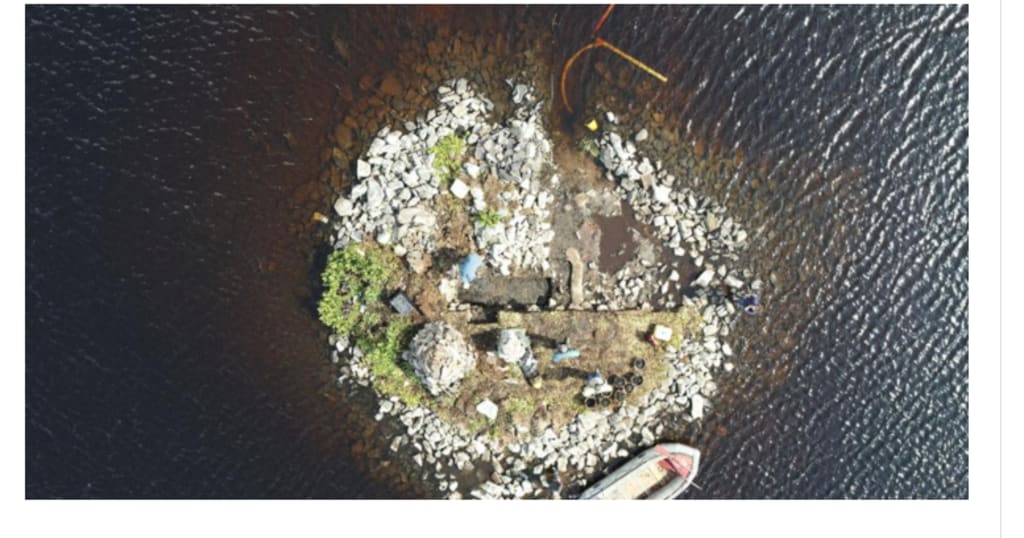
Our knowledge of prehistoric engineering has been completely transformed by a discovery unearthed by archaeologists in the murky waters of a remote loch in Scotland. Researchers from the University of Southampton and the University of Reading have used cutting-edge shallow-water
photogrammetry to confirm that the Loch Bhorgastail crannog, which was previously thought to be a straightforward stone mound, was actually constructed upon a massive, sophisticated timber platform that dates back more than 5,000 years.
This astounding discovery shows that these man-made islands in the Outer Hebrides are much older than Stonehenge, extending the region's history of intricate building to the Neolithic era. The discovery that the main load-bearing component of these constructions was wood rather than stone demonstrates the sophisticated capabilities of the people that constructed them.
A Wooden Base Underneath the Stone
For many years, the Loch Bhorgastail crannog on the Isle of Lewis looked like an artificial island made of stone from above. This presumption has been refuted by the Islands of Stone project, which is supported by the Arts & Humanities Research Council.
University of Southampton archaeologist Dr. Stephanie Blankshein described the significance of the discovery as follows. "We discovered that this cohesive, sizable timber structure was actually beneath what you would see as the stone island today when we actually started excavating."
The original base of the crannog was found by the researchers to be a 23-meter circular timber platform with brushwood on top. Between 3500 and 3300 BC, this basic structure was established. Another layer of stone and brushwood was added some 2,000 years later during the Middle Bronze Age, and more work was done during the Iron Age.
Overcoming Obstacles in Shallow Water
The team had to map the crannog above and below the waterline in order to completely comprehend the structure. This posed a serious problem because fine particles, turbulent conditions, and distorted light make standard photogrammetry notoriously challenging in shallow water.
According to Southampton Marine and Maritime Institute director and primary investigator Professor Fraser Sturt, this issue is a "well-known frustration for archaeologists." The group created a novel method to get around this by mounting two tiny, waterproof, low-light cameras on a frame at predetermined distances from one another.
With the help of this arrangement, which was controlled by a diver with centimeter-level accuracy, the researchers were able to produce a high-resolution 3D digital model of the complete continuous structure. The journal Advances in Archaeological Practice just published their technique.
A Center of Neolithic Activity
The Loch Bhorgastail crannog is not a unique occurrence. A now-submerged stone causeway previously connected the island to the coast, and hundreds of pieces of Neolithic pottery have been found in the loch bed surrounding the site.
Throughout the Outer Hebrides, similar findings have been made. Large collections of nearly complete Neolithic vessels have been found in some of the island chain's estimated 170 crannogs, indicating systematic, potentially ritualistic, dumping into the water.
"The resources and labour needed to build these islands suggest not only complex communities capable of such feats, but also the great significance of these sites, even though we still don't know exactly why these islands were built," Dr. Blankshein said.
Other crannogs in the Outer Hebrides will now be subjected to the new shallow-water photogrammetry technique, which promises to provide more insight into these mysterious "islands of stone" and the ancient people who constructed them.
According to Professor Brown, shallow reefs found in lake beds and along river estuaries were initially chosen by ancient architects. These islands were then constructed using "stone, timber, and peat - to a diameter of nearly 30 meters (100 feet)," according to the researchers.
The team of archaeologists investigated three submerged crannogs and collected organic samples for their examination, despite the fact that such wetland sites are "much more difficult to study than those on land," according to the new study.
About the Creator
Enjoyed the story? Support the Creator.
Subscribe for free to receive all their stories in your feed.
Comments
There are no comments for this story
Be the first to respond and start the conversation.