
Time's ticking in hunt for the illusive Nazi gold train
On the trail of buried treasure in Poland's Owl Mountains

War, huh, yeah, what is it good for? Absolutely nothin... words written by Norman Whitfield and Barrett Strong for the Motown label in 1969 that, although first recorded as an album track by The Temptations, went on to become a number one hit for Edwin Starr.
Released as a single in June 1970, Starr's "War" became a runaway hit on the back of the anger the anti-war movement in the United States felt towards the conflict in Vietnam and held the Billboard Hot 100 top spot for three weeks in August and September that year.
But why have I got Starr's only number one hit buzzing around my brain at the moment? Well, it could be a product of Israel’s ongoing genocidal war mongering in the Middle East that’s being supported by the US and some of its greed-fuelled United Nations associates... but it’s more likely a result of research I’ve been doing recently on the “Nazi gold train”.
And, if I’d had to think about it I would probably have been able to figure out Starr's song was released a good 50 years ago, but the fact there’s been so much conflict on the planet ever since left me without any real timeline to work on at all, until I figured it could provide a poignant intro to this article... so I looked it up.
Why? Well, war is undoubtedly the most stupid indulgence mankind gets cajoled into but, for those doing the cajoling, it’s certainly good for something... like making pots and pots of filthy lucre!
For the corporate conglomerates and business titans there’s nothing better than a good war to plump up the coffers and make hay from the suffering of others. So, you see, Whitfield and Barrett had it wrong... war is exceptionally good for something, something that requires absolutely no respect for human life whatsoever.
I began a recent article on “tall tales buried by the Smithsonian” by stating the US’ incursions into Iraq beginning in the 1990s saw the disappearance of thousands of priceless artefacts from the National Museum in Baghdad and was widely considered to be the worst act of cultural vandalism since World War II.
Many of those stolen artefacts have now found their way back to the Iraqi capital but far more have been lost to a lucrative black market in historical relics where provenance is a particularly dirty word. But if you go back a further 50 years to war ravaged Europe in the 1940s the scale of looting and art theft was exponentially greater, with the Nazis scouring the continent for priceless artefacts, gold and currency.
And, since the conflict came to an end in 1945, vast amounts of that looted treasure has not seen the light of day since, some of it probably locked away in secret Swiss bank vaults but far more secreted away across Europe by retreating Nazi loyalists.
Probably the most enduring story about the Nazi pillage begins in late 1944 or early 1945 as the Red Army was advancing west towards Germany during the final months of World War II. The Third Reich had plundered immense riches and personal valuables from across the continent with much of it stashed away for safe keeping in underground bunkers across Lower Silesia, which is now southwestern Poland.
But with the Red Army closing in on the regional capital of Breslau (now Wrocław) Nazi generals decided all the bullion, artwork, gems and documents stored inside the city’s banking infrastructure needed to be moved to safety in the underground passages under the Owl Mountains that had been constructed as part of Project Riese, the codename for an immense tunnel complex carved out of the rocks from 1943-45.
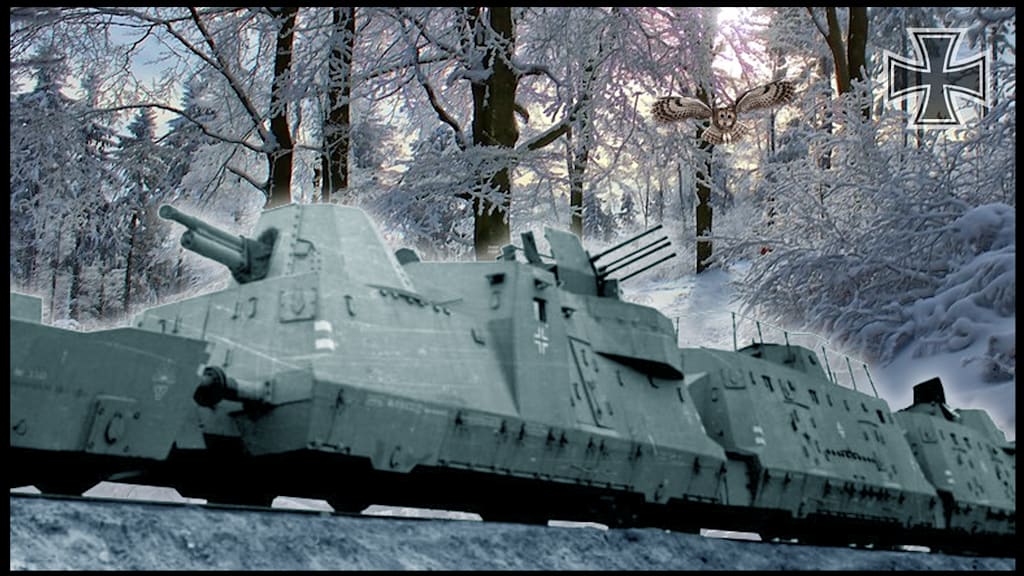
The valuable freight was allegedly loaded onto an armoured train for transportation back to Germany or, more likely, a safe haven in the mountains where it could be retrieved at a future date. However, after departing Breslau the train vanished somewhere in the mountains, allegedly near Wałbrzych.
The legend is the product of postwar accounts by Polish railway officials and German soldiers, who claimed the gold train – although there could have been more than one – entered a siding not far from Ksiaz Castle but never emerged, leading to speculation it could be buried inside a tunnel dynamited to conceal its whereabouts from the Red Army.
In the 80 years since it allegedly disappeared many searches have been carried out, especially since the fall of communism which opened Poland up to private exploration in the 1990s. Stories of the gold train resurfaced in books, television documentaries and tabloid reports, reaching global prominence in 2015 when treasure hunters Piotr Koper and Andreas Richter announced to the world they’d found the site in Wałbrzych where the train was buried.
Based on meticulous research and ground-penetrating radar scans the pair, co-owners of mine exploration company XYZ, located what appeared to be a 100-metre-long object under an old railway embankment and, through a team of lawyers, negotiated a 10 per cent “finders fee” with the Polish government in return for information leading to the train’s discovery.
On 4 September the pair went public for the first time, releasing their ground-penetrating radar images and announcing what they believed was the precise location of the train, which they’d passed on to the Polish authorities.
The authorities sectioned off a woodland area near the 65 kilometre point on Polish State Railways’ Wrocław-Wałbrzych line, where Koper and Richter believed there was something hidden at the bottom of a deep man-made shaft.
By mid-November Koper and Richter’s team and another from the AGH University of Science and Technology in Krakow were cleared by Wałbrzych city authorities to make non-invasive assessments of the site. But on 15 December the AGH team, headed by mining specialist Janusz Madej, announced they had found no evidence of a train, although they had identified the possibility of a collapsed tunnel.
A bit of a setback for the treasure hunters but, despite Madej’s opinion that no train existed, they pressed ahead with their plans and in May 2016 secured permission to begin digging at the site from Polish State Railways. Excavation work began on 15 August – employing a team of engineers, geologists, chemists, archaeologists and a specialist in military demolitions – but stopped after just seven days when no tracks, tunnel or train had been found.
However, while no train was discovered hidden underground the treasure hunters’ efforts weren’t entirely in vain... tourism in Walbrzych surged 44 per cent as a result of the publicity, injecting an estimated US$200 million into the local economy.
But the excavation, financed by private sponsors, had reportedly cost €116,000 with the radar images, thought to show a gold train, revealed to be natural ice formations. So, with financing becoming a huge concern for the treasure hunters following the failed 2016 excavation, that could have been the end of the search for the train... but the prospect of a buried locomotive loaded with gold and priceless artefacts is just too good a story to die without a fight and it hit back last year with another group claiming to have discovered its location.
A group calling themselves Gold Train 2025 claimed their radar scans showed multiple freight wagons hidden in a tunnel near Walbrzych and stated their data was “complete from the point of view of physics, mathematics and logic”. But, as with previous claims, no verifiable proof has been made public yet.
The latest chapter began in May last year when an anonymous letter was sent to the Silesian Treasure Hunters’ Foundation claiming to pinpoint the location of three camouflaged train carriages buried near Walbrzych. The letter provided detailed directions to a location in the Swidnica Forest District, with local historian and foundation member Lukasz Kazek saying: “This is the most credible lead we’ve had in years. The letter’s specificity – describing three carriages hidden in a sealed tunnel – matches long-standing legends about the train. We’re cautiously optimistic but eager to investigate.”
Wałbrzych city officials said they’d also received a formal report, under Poland’s 2025 Found Objects Act, citing the discovery of “three freight train wagons from World War II, concealed behind a sliding steel gate inside a camouflaged tunnel”.
“Each wagon is approximately 12 metres long, four metres wide and four metres high,” the letter continued. “The wagons are hidden behind a closed, sliding steel gate at the entrance to the tunnel.”
City spokeswoman Kamila Swierczynska described the claims as “substantive and concrete”, adding that the report included several attachments with maps, geodetic data and a witness account from a resident who’d lived in the area when the train was allegedly hidden.
Confirming receipt of the document – dated 23 April, from an anonymous sender – Swierczynska said it claimed the wagons contained valuable precious metals, including gold.
Wałbrzych officials are believed to have met with the anonymous informant in late April, along with regional heritage conservationist Anna Nowakowska, to outline legal requirements for excavation work to proceed.
Under Polish law accidental discoveries during permitted searches aren’t eligible for rewards, although finders may keep non-historic valuables. Nowakowska, while supportive of “passionate” amateur archaeologists, admitted she’d prefer the train to hold “art over gold” for its cultural value.
Cautious after previous disappointments, the Silesian Treasure Hunters’ Foundation has been conducting non-invasive surveys using advanced radar and LIDAR technology before any excavation work begins. “We’re not rushing in blindly,” Kazek said. “The technology available today – ground-penetrating radar, thermal imaging and drones – gives us a better shot than ever to verify this claim without disturbing the site unnecessarily.”
For Walbrzych, a former coal-mining town struggling since the collapse of communism, the renewed hunt is once again paying dividends with hotels and tour operators reporting a spike in bookings, and Ksiaz Castle registering a surge in visitors.
Since the story of his audacious claim broke last year the anonymous informant has come forward as Michał Motak and in late January this year he revealed Poland’s heritage conservation authority had issued a one-year permit for him to conduct a search for the gold train in the forests between Wałbrzych and Swiebodzice.
Motak’s team has since been conducting geophysical surveys of the area before deciding on the most promising location to excavate. “What I set out to achieve from the very beginning has now become a fact,” Motak said. “I know that now nothing will stop me. What I announced will happen. We will do it and shock the whole world.”
They're an optimistic bunch these treasure hunters aren't they! But maybe, just maybe, this time Motak’s crew are on the verge of solving one of the greatest mysteries to perplex the world since Germany's surrender in 1945?
About the Creator
Steve Harrison
From Covid to Gaza and Ukraine... nothing is as it seems in the world. Don't just accept the mainstream brainwashing, open your eyes to the bigger picture at the heart of these globalist agendas.
JOIN THE DOTS: https://not.wildaboutit.com
Enjoyed the story? Support the Creator.
Subscribe for free to receive all their stories in your feed.
Comments
There are no comments for this story
Be the first to respond and start the conversation.