
They are all Americans
"Lucy, we're not guests. We've made this place what it is."

Ten years ago, I watched a movie called Source Code.
The protagonist wakes up on a commuter train bound for Chicago, inhabiting another man's identity and trapped in the same repeating eight-minute window. He was forced to repeat those moments over and over to find the answer.
Years later, as I walked out of Chicago’s Union Station hauling three rolling suitcases, I looked up and caught a glimpse of the sky through the steel-framed dome—and suddenly, the film source code came to me.
Little did I know then that, years later, I would actually find myself living out a new life in this city under a different identity.
If I had to describe Chicago with a single color, it would be black.
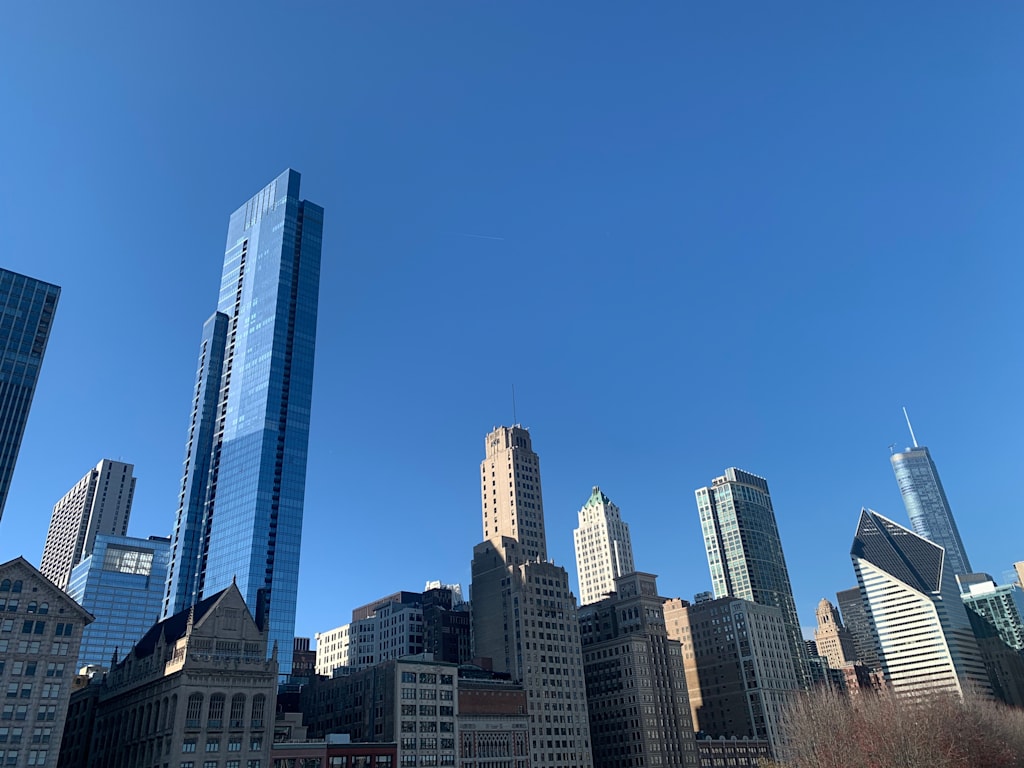
By November, winter has already settled over Chicago. The skyscrapers stand so tall and dense that even on sunny days, the sunlight struggles to find a way through the gaps in steel and concrete to reach the streets below. Office workers in the city center hurry along, bundled in black coats or black down jackets, crunching over ice and snow while clutching hot coffee as they rush toward their respective buildings.
On the subway, on the streets, and in the corridors, you see nothing but black coats, black scarves, black cars, black lampposts, and a dark, brooding sky.
What truly made me remember this city wasn't its appearance, but its sound.
Chicago’s elevated railway is known as the "L"—short for "Elevated"—and is said to be one of the oldest elevated rail systems in the world. Silver trains weave between the buildings, day and night.
Like lightning streaking across the sky, or a pulse coursing through the city's veins, its roar drowns out the conversations of everyone on the street.
During those first few months, I would often sit alone on the steps beneath the tracks. Every few minutes, a train would thunder overhead, the screech of steel on steel drowning out everything else. Amidst that sound, you could hear neither others nor yourself.
At the time, I thought I had arrived in an typical American city.
Only later did I realize that I had stepped into the entire world.
Devon Avenue: Here, We Can Only Be Friends
Devon Avenue was the most incredible stretch of road I walked on this trip. There's a neighborhood called "Little India" here.
Less than two kilometers long, one side is lined with Indian spice shops, sari stores, and goldsmiths, the air thick with the scents of cumin and cardamom; next door is a Pakistani kebab restaurant, and further on, an Orthodox Jewish bakery, men in black caps lining up for halal bread; a few steps further, Russian signs. But such scenes are indeed commonplace in America.
What stunned me most were the street signs. This street has honorary names: one section is called Gandhi Marg, the other Muhammad Ali Jinnah Way. Gandhi and Jinnah. On the other side of the world, their names signify a bloody partition; on this street in Chicago, they are next-door neighbors.
I chatted for a long time with the owner of a spice shop. He was from India. I asked him what the neighborhood was like.
He laughed heartily, recounting how last year during the Cricket World Cup, the India-Pakistan match, he and the owner of the shop next door watched it together, hurling insults at each other for two hours, neither giving in. After the match, they packed up their stalls together, locked the door together, and walked to the subway station together.
Then his laughter subsided, and he said very seriously,
"Over there, we can't be friends. Here, we can only be friends." At that moment, I suddenly understood that immigration isn't just about moving to a different place; sometimes it's about changing your algorithm for "who is the enemy."
Those in the Church Who Had No Choice
On Sunday, I went to St. Hedwig's Church (Polish: Kościół Świętej Jadwigi) in the north of the city.
The Mass was in Polish. Chicago's Polish neighborhood is astonishingly large; I sat in the last row of a bench, not understanding a single word, but I understood the unified trembling of the hymns. After the Mass, an elderly woman named Helena pulled me aside and kept repeating the English phrase, "Far, very far." I didn't know if she was referring to Poland or something else.
Later, I went to the village near the western edge of Ukraine. The dome of St. Nicholas Church, a striking contrast of gold and blue against the gray sky, was eye-catching. There was a donation box at the entrance, with the place name handwritten on a cardboard sign. A young man in his twenties was collecting money, wearing an ordinary hoodie and ordinary sneakers.
I asked him if he was going back.
He said, "My mother is still in Kyiv."
Then neither of us spoke again.
That day, on my way back to the subway station, I was thinking: We're too used to viewing "immigration" as an inspirational story, especially in the eyes of many Chinese people, immigrating to the United States means striving, achieving success, buying a house, and realizing the so-called "American Dream." This young man's story isn't like that. Some departures are choices, some departures are simply because there's no other way.
South City: We Were Immigrants Too, Just Not Crossed the Sea
One sunny day, I went to Bronzeville.
At the intersection of King Avenue and 26th Street, there's a sculpture: a man standing with his back to the south, carrying an old, patched-up suitcase, his shoes worn through.
That's the "Great Migration" monument. In the decades following 1916, six million African Americans from the Southern United States traveled north by train, flooding into Chicago, Detroit, and New York. Local Black newspapers even openly called on their Southern compatriots to go north, setting a departure date. The place where they disembarked wasn't far from this sculpture.
I chatted with an old man for a while outside a nearby barbershop. He said his grandfather came from Mississippi, picked cotton for half his life, and arrived by train at twenty-one, penniless.
I said, "Your story is so similar to what I've heard these past few days."
He nodded and uttered the last sentence of his journey that struck me deeply:
"We were immigrants too. We just didn't cross the sea."
The longer I stay in the US, the more I realize that these experiences have taught me: all cities are built by people who left their hometowns. The cityscapes around me seem to be gradually blurring.
We talked for a long time. She still spoke quickly, and still laughed so much. Before hanging up, she said,
"Lucy, we're not guests. We've made this place what it is."
About the Creator
Lucy Guo
Born and raised in Shanghai, used to live in Helsinki, Syracuse, Chicago; now living in Fairfax, VA. Researcher at the intersection of artificial intelligence and education. Loves writing AI reflection stories and travel blogs.
Enjoyed the story? Support the Creator.
Subscribe for free to receive all their stories in your feed.
Comments
There are no comments for this story
Be the first to respond and start the conversation.