
The Strange Rise of America’s G-Men
Movies, Comics, TV Shows, Toys, etc...

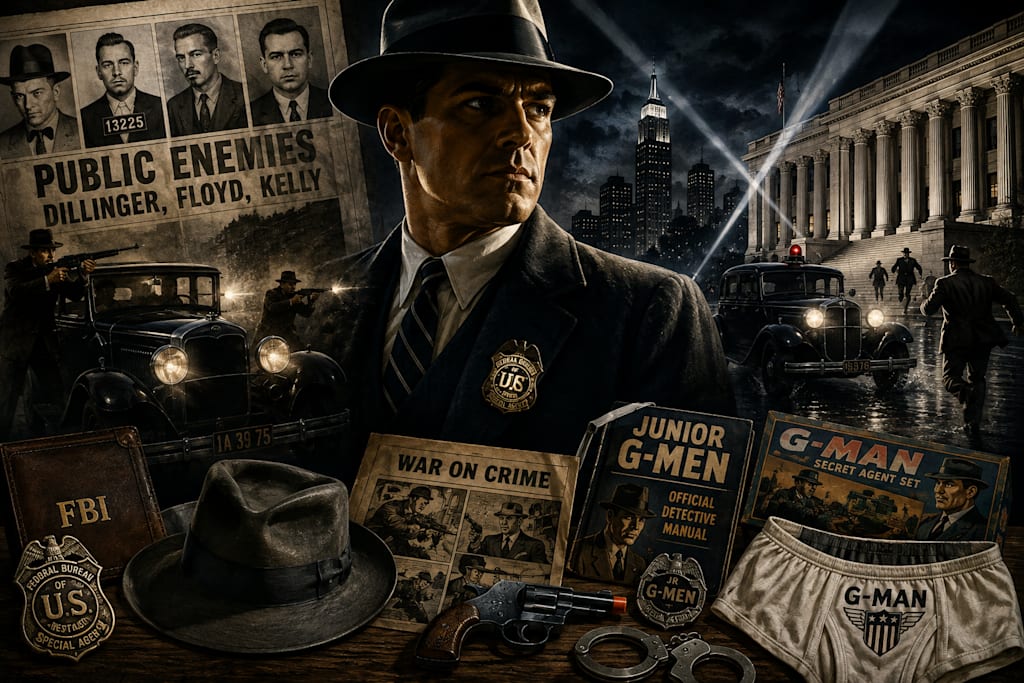
For a few remarkable years during the Great Depression, some of the most famous men in America were bank robbers. Their names appeared across newspaper front pages: John Dillinger, “Pretty Boy” Floyd, “Baby Face” Nelson, “Machine Gun” Kelly, Bonnie Parker, and Clyde Barrow. Their photographs were recognizable, their exploits became national news, and newspapers followed their movements as if they were sporting events, while rumors and exaggerations transformed violent criminals into something approaching folk heroes.
Children knew their names. Hollywood knew their names. America knew their names. And J. Edgar Hoover had a problem. If the American public insisted upon turning criminals into celebrities, the government needed better celebrities.
Enter the G-Man. To modern ears, the term sounds almost comical, conjuring images of trench coats, fedoras, enormous automobiles, Tommy guns, and some square-jawed fellow shouting, “Come out with your hands up!” But during the 1930s, the G-Man became one of the most recognizable heroes in American popular culture, and his rise tells a fascinating story about crime, entertainment, public relations, and the moment the federal government discovered the enormous power of controlling the narrative.
The term itself simply meant “government man.” Its transformation into a national catchphrase supposedly began with one of America's most notorious criminals. George “Machine Gun” Kelly was a bootlegger, robber, and kidnapper whose criminal career brought him national attention. In 1933, Kelly and several accomplices kidnapped wealthy Oklahoma oilman Charles Urschel and demanded a $200,000 ransom. Federal investigators pursued the kidnappers. On September 26, 1933, agents surrounded a house in Memphis, Tennessee, where Kelly was hiding. According to the legend, Kelly realized escape was impossible and shouted: “Don't shoot, G-Men!” It was perfect.
There was only one problem: he probably never said it. The famous line appears to have been embellished, or perhaps invented entirely, after the arrest; even the FBI has acknowledged that the quotation is likely apocryphal. But historical accuracy didn't matter. The newspapers had their phrase. America had its G-Men. And J. Edgar Hoover had the beginnings of a brand.
Hoover had become director of the Bureau of Investigation in 1924 and spent years trying to transform the organization into a professional law-enforcement agency. He emphasized education, fingerprinting, forensic science, centralized records, and disciplined investigative techniques. He wanted federal agents viewed not as political operatives or hired guns, but as modern professionals.
Then the Depression-era crime wave arrived. Bank robbers and kidnappers exploited automobiles, machine guns, and America's patchwork of state jurisdictions. A criminal could rob a bank in one state and cross into another before local authorities could coordinate a pursuit. The federal government responded by expanding federal criminal laws and giving Hoover's agents greater authority. Suddenly, the Bureau had targets the public already knew: Dillinger, Floyd, Nelson, Kelly. Federal agents began hunting America's celebrity gangsters.
Hoover understood that capturing them was only part of the battle. The public had to understand who the heroes were. The FBI became remarkably sophisticated at cultivating journalists and encouraging stories that emphasized disciplined federal agents confronting dangerous criminals. Hoover maintained relationships with reporters and provided selected access to Bureau cases. Newspapers increasingly described federal investigators as scientific, fearless, incorruptible professionals.
The gangster had spent years dominating the front page. Now the G-Man was coming for his headline. Hollywood noticed immediately. In 1935, Warner Bros. released "G-Men", starring James Cagney. The casting itself was almost perfect. Cagney had become famous playing gangsters. In The Public Enemy, he portrayed the kind of charismatic criminal audiences found simultaneously frightening and fascinating. Now Hollywood flipped the script. Cagney played the government man. The message could hardly have been clearer: yesterday's cinematic gangster had changed sides. The G-Man was the new hero.
Movies portraying heroic federal agents proliferated. Radio dramas followed. Detective magazines published stories about government investigators. Newspaper features described crime laboratories, fingerprint identification, firearms training, and the supposedly relentless professionalism of federal law enforcement. Even comic strips joined the campaign. Journalist Rex Collier created a newspaper feature called War on Crime, drawing material from closed FBI cases made available with Hoover's cooperation. Readers could follow dramatic versions of actual investigations. Crime became entertainment. But now the investigators were the stars. Comic books and juvenile publications quickly embraced similar themes.
In 1936, Jerry Siegel and Joe Shuster, the young creators who would soon give America Superman, produced "Federal Men", featuring government agent Steve Carson battling kidnappers, racketeers, and gangsters. Before Superman was leaping over buildings, his creators were already imagining another kind of American superman: the federal agent.
Then the G-Man phenomenon entered its most wonderfully American stage: someone realized they could sell it to children. Enter Melvin Purvis. Purvis had been one of the FBI's most famous agents and participated in the pursuit of several notorious criminals, including John Dillinger. He became enormously famous, too famous, perhaps, for Hoover's liking. After leaving the Bureau, Purvis became associated with the Junior G-Men, a nationwide youth phenomenon built around the excitement of crime fighting. Children could join clubs, receive badges, learn secret codes, listen to radio programs, and get detective materials encouraging good citizenship and crime prevention. Suddenly, American children no longer needed to pretend to be Dillinger; they could hunt Dillinger.
The idea spread rapidly. Police departments sponsored Junior G-Men organizations, radio programs encouraged membership, and commercial promotions joined the craze. Breakfast cereal companies got involved. Children could obtain detective equipment and membership materials through product promotions. And naturally, toy manufacturers smelled opportunity. Soon America's department stores contained an astonishing assortment of G-Man merchandise: toy pistols, toy machine guns, badges, handcuffs, detective kits, games, books, costumes, G-Man pajamas, and yes, even G-Man underwear. Somewhere in America, a child apparently woke up wearing officially branded government-agent underpants, ate breakfast while studying his Junior G-Man detective materials, strapped on a toy revolver, and marched outside prepared to bring organized crime to its knees.
J. Edgar Hoover wanted a professional federal law enforcement agency. American capitalism gave him merchandising. Yet underneath the amusing products was something historically significant. The hero of the American crime story had changed. During the early Depression, criminals often possessed the better mythology: they were rebels, they drove fast cars, they carried dramatic nicknames, they escaped across state lines, they thumbed their noses at banks during an era when millions of Americans deeply distrusted financial institutions, and some became folk heroes despite the very real violence surrounding their crimes.
The G-Man offered a competing mythology: he was educated, disciplined, scientific. He used fingerprints rather than folklore, laboratories rather than luck. He didn't rob the bank; he arrived afterward and figured out who did. The image was carefully polished, and reality was inevitably more complicated than the mythology suggested. Federal agents made mistakes. Investigations failed. Hoover himself would eventually become one of the most controversial government officials of the twentieth century, particularly because of FBI surveillance and political intelligence operations conducted during his long tenure.
But during the 1930s, the heroic G-Man proved enormously successful. The famous gangsters began disappearing. Bonnie and Clyde were killed in 1934. Dillinger was shot outside Chicago's Biograph Theater that same year. Pretty Boy Floyd died months later. Baby Face Nelson followed. Machine Gun Kelly went to prison. The age of the celebrity interstate outlaw faded. The G-Man remained.
The image became so deeply embedded in American culture that later generations barely remembered how deliberately it had been cultivated. Government agents became standard characters in movies, television programs, novels, comics, and eventually the modern true-crime universe. The language changed: the fed, the special agent, the profiler, the investigator. But the basic character remained familiar: cool under pressure, scientifically trained, persistent, always one clue behind the criminal until, inevitably, he isn't. The G-Man had become an American archetype.
And perhaps the strangest part of the story is how modern the entire campaign feels. Long before social media, viral videos, and carefully managed public-relations departments, Hoover understood something fundamental about mass culture: catching criminals wasn't enough. People needed a story about the people catching them. The FBI didn't invent America's fascination with crime; it simply realized that if Americans were determined to turn crime into entertainment, the government might as well make sure somebody remembered who the good guys were supposed to be.
So the next time an old movie character adjusts his fedora, flashes a badge, and announces that he's a G-Man, remember that you're watching more than a piece of forgotten slang. You're seeing the remains of one of America's great battles for public attention. The gangsters had the nicknames. They had the fast cars. They had the Tommy guns. They had the headlines. Then the government discovered something even more powerful... better publicity.
About the Creator
The Iron Lighthouse
Where folklore meets freeway. A guide to the strange heart of the American backroads...
Enjoyed the story? Support the Creator.
Subscribe for free to receive all their stories in your feed.
Comments
There are no comments for this story
Be the first to respond and start the conversation.