
The Slow Decline of America Nobody Wants to Talk About
From economic pressures and political division to shifting global power, the warning signs are becoming harder to ignore.

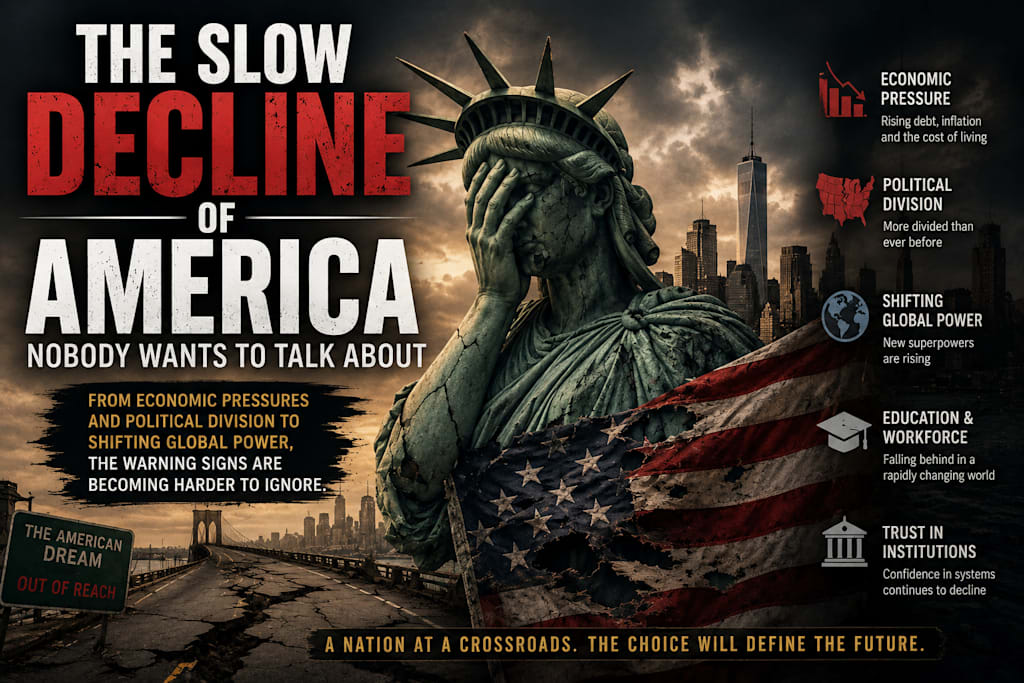
# The Slow Decline of America Nobody Wants to Talk About
## From economic pressures and political division to shifting global power, the warning signs are becoming harder to ignore.
For most of the twentieth century, the United States stood as the symbol of power, innovation, and opportunity.
Its economy dominated global markets.
Its military influence stretched across continents.
Its universities attracted the brightest minds from around the world.
Its culture shaped music, movies, technology, and ideas far beyond its borders.
For generations, America was not just a country.
It was a dream.
Millions believed that hard work could create a better life. Families crossed oceans seeking opportunity. Students traveled thousands of miles hoping to study at world-class institutions. Entrepreneurs looked to America as the birthplace of innovation.
Yet today, a growing number of people are asking a difficult question:
**Is America beginning to decline?**
The answer depends on who you ask.
Some believe the United States remains the most powerful nation on Earth and will continue to lead for decades.
Others see warning signs that resemble patterns experienced by powerful empires throughout history.
While predictions of collapse are often exaggerated, several challenges facing America are real, significant, and increasingly difficult to ignore.
### The Growing Economic Pressure
One of America's greatest strengths has always been its economy.
For decades, economic growth created jobs, wealth, and opportunities that attracted people from around the world.
However, many Americans now feel that prosperity is becoming harder to reach.
Housing costs have risen dramatically in many cities.
Young adults often struggle to buy homes.
Student debt affects millions of graduates.
Healthcare expenses remain among the highest in the world.
For many families, wages have not kept pace with the rising cost of living.
As a result, some citizens feel that the traditional promise of upward mobility has become more difficult to achieve.
The American Dream still exists for many people, but it no longer feels as accessible as it once did.
### Political Division Like Never Before
Political disagreement has always existed in America.
Debate is a normal part of democracy.
What concerns many observers today is the intensity of polarization.
Americans increasingly consume different news sources, trust different institutions, and often view political opponents not merely as people with different opinions but as threats.
Social media has accelerated this trend.
Algorithms reward outrage.
Controversy spreads faster than compromise.
As divisions deepen, solving national problems becomes more difficult.
Infrastructure, healthcare, education, immigration, and economic policy often become trapped in political battles.
History shows that nations facing internal division often struggle to respond effectively to external challenges.
### The Rise of Global Competitors
For much of the post-World War II era, America faced limited competition at the top of the global system.
Today, the world looks different.
Emerging powers are investing heavily in technology, manufacturing, artificial intelligence, infrastructure, and education.
Competition has intensified.
Global influence is no longer concentrated in a single nation.
Instead, power is becoming more distributed.
This does not necessarily mean America is collapsing.
It means America now operates in a far more competitive environment than it did several decades ago.
Maintaining leadership requires continuous innovation and adaptation.
History shows that no nation remains dominant forever without addressing new realities.
### Infrastructure Challenges
Visitors often expect the world's richest nation to possess the world's most advanced infrastructure.
In some areas, America excels.
In others, significant challenges remain.
Roads, bridges, public transportation systems, and aging utilities require major investment.
Many experts argue that modern infrastructure is essential for economic competitiveness.
When transportation becomes inefficient and public systems age, productivity suffers.
Countries investing aggressively in modern infrastructure may gain advantages in attracting business and talent.
### Education and Workforce Concerns
America still hosts many of the world's best universities.
Its research institutions remain global leaders.
Yet concerns about educational outcomes continue to grow.
Employers increasingly seek advanced technical skills.
Technology evolves rapidly.
Artificial intelligence, automation, and digital transformation are reshaping industries.
The challenge is not simply educating students.
It is ensuring that education evolves as quickly as the economy itself.
Nations that successfully prepare future generations may gain a competitive advantage in the decades ahead.
### Trust in Institutions
Strong societies depend on trust.
Trust in government.
Trust in media.
Trust in courts.
Trust in elections.
Trust in public institutions.
Recent years have seen growing skepticism across many areas of American society.
When citizens lose confidence in institutions, cooperation becomes more difficult.
Every disagreement becomes more intense.
Every challenge becomes harder to solve.
Rebuilding trust is often one of the most difficult tasks any nation faces.
### The Lessons of History
History is filled with powerful civilizations that appeared unstoppable.
The Roman Empire.
The British Empire.
The Ottoman Empire.
The Soviet Union.
Each possessed enormous strength.
Each influenced the world for generations.
Yet history teaches an important lesson:
Decline rarely happens overnight.
It is usually gradual.
Small problems accumulate.
Institutions weaken.
Divisions grow.
Competitors emerge.
Adaptation slows.
By the time decline becomes obvious, many warning signs have existed for years.
This does not mean America will follow the same path.
History never repeats itself exactly.
But it does offer valuable lessons.
### America's Greatest Strength
Despite its challenges, America possesses advantages that many nations would envy.
Its economy remains among the largest in the world.
Its universities continue to attract global talent.
Its innovation ecosystem produces groundbreaking technologies.
Its entrepreneurial culture encourages risk-taking and creativity.
Its democratic institutions, though imperfect, provide mechanisms for reform and change.
Perhaps most importantly, America has repeatedly demonstrated an ability to reinvent itself.
The country has faced economic crises, wars, political turmoil, and social conflict before.
Each time, many predicted permanent decline.
Yet America often emerged stronger by adapting to new realities.
### The Future Is Not Written
The question is not whether America faces challenges.
It clearly does.
The real question is whether those challenges will inspire renewal or accelerate decline.
History suggests that nations are not defined by the problems they encounter.
They are defined by how they respond.
The United States stands at a crossroads.
One path leads toward continued innovation, reform, and leadership.
The other risks deeper division, stagnation, and reduced influence.
Which future becomes reality will depend not on predictions, but on choices.
The story of America has never been one of perfection.
It has always been a story of struggle, ambition, failure, adaptation, and resilience.
Whether this period becomes remembered as the beginning of decline or the start of another national renewal remains one of the most important questions of the twenty-first century.
And the answer has yet to be written.
About the Creator
younas khan
1. Emotional Storyteller
I write stories that carry emotions, silence, and hidden truths. Every word I share is a piece of heart, every story a journey of feeling
Enjoyed the story? Support the Creator.
Subscribe for free to receive all their stories in your feed.
Comments
There are no comments for this story
Be the first to respond and start the conversation.