
The Secret Feng Shui War Behind Macau's Casinos
Birdcages, copper mirrors and golden eggs
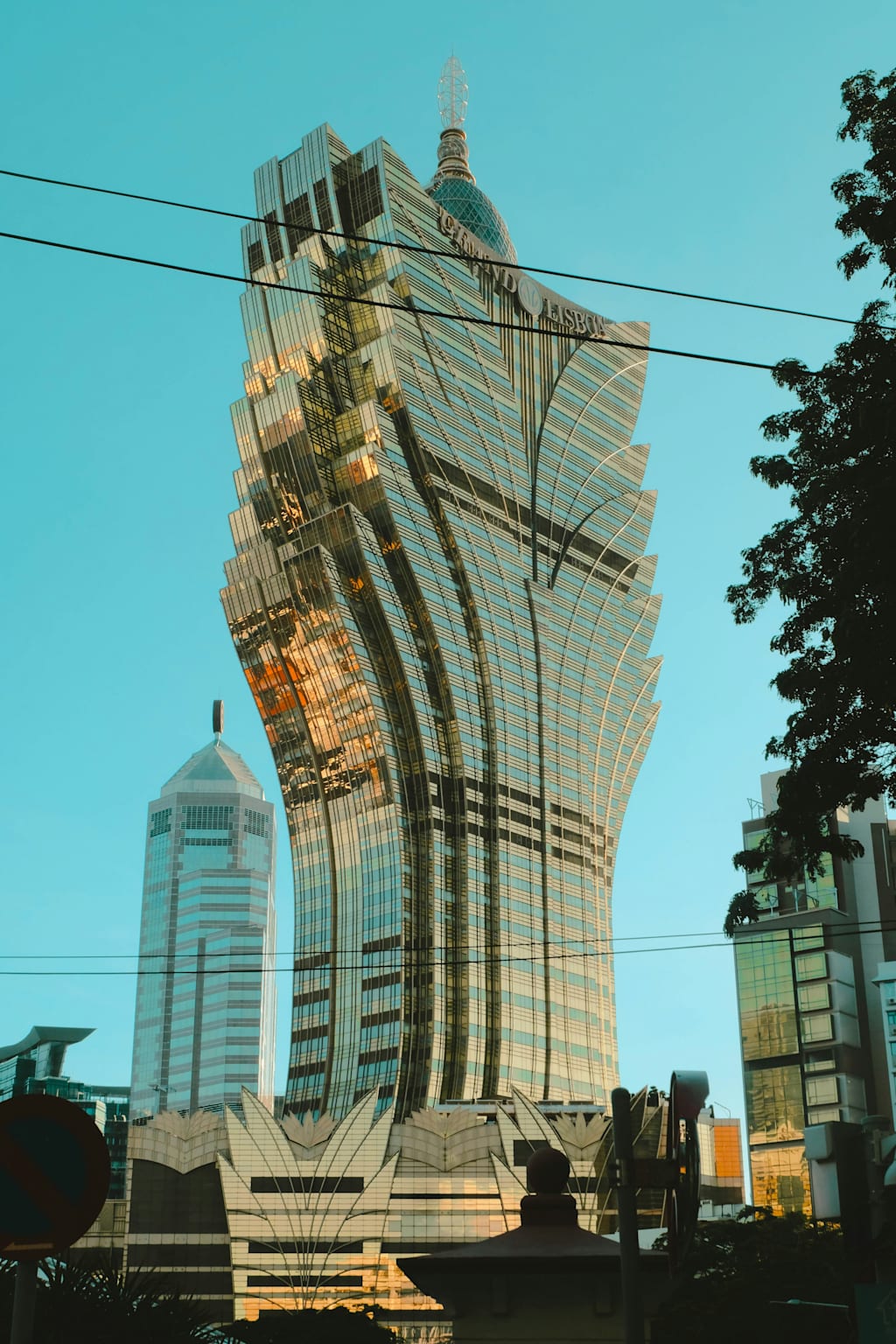
The Grand Lisboa isn't shaped like an onion by accident.
If you visit Macau and walk its streets at night, you'll see glittering casino complexes in every direction. Most tourists duck into at least one. But if you know any locals, they'll tell you something the tourist brochures won't: Macau residents generally avoid the casinos. And if you ask why, the conversation doesn't turn to odds or addiction. It turns to feng shui.
Locals will tell you about hidden design formations with names like "A Hundred Birds Returning to the Nest" and "Dragon's Tooth Sucking Water." They'll ask why the Lisboa Casino is under renovation 365 days a year, and why the more obsessed a gambler becomes, the faster they lose.
Whether you believe in feng shui or not, the story of how Macau's casinos were designed ,and redesigned to steal each other's luck is one of the most fascinating architecture narratives in the world.
The Gambling King's forty-year monopoly
To understand Macau's casino feng shui, you need to start with one man: Stanley Ho.
Ho was born in 1921 into a prominent Hong Kong family. When he was thirteen, his family went bankrupt. The wealthy young heir became a struggling teenager overnight. He threw himself into his studies, landed a job at a trading company, and earned a bonus of one million , his first real capital. By the mid-1950s, he was a major player in Hong Kong real estate. But he wasn't satisfied.
In 1961, the Portuguese colonial government in Macau officially designated gambling as a pillar industry. Facilitated by Yip Hon — Macau's legendary "Gambling Saint" — Ho teamed up with his brother-in-law Teddy Yip and industrialist Henry Fok. They won the new gambling franchise by a margin of just 17,000 patacas. On March 31, 1962, Ho signed the franchise contract with the Governor of Macau.
He would hold the monopoly for forty years.
How Did Macau Become A Major Gambling Center?
The Birdcage: Hotel Lisboa
In 1970, Ho invested over 60 million patacas to build the Hotel Lisboa on the shores of Nam Van Lake. Today it's known as the "Old Lisboa," and its design is a masterclass in feng shui symbolism whether Ho admitted it or not.
The building's exterior resembles a giant golden birdcage. In feng shui terms, the meaning is blunt: every gambler who walks in becomes a bird trapped inside.
Atop the cage sits a round object bristling with spikes — arrows shooting in all directions — symbolizing dominance over competitors. The main entrance is shaped like a bat with outstretched wings. In Chinese, "bat" (蝠, fú) is a near-homophone for "fortune" (福, fú), so the bat carries money straight into the house's mouth. Inside, the lobby floor features a flowing wave pattern leading toward a giant ancient Chinese coin — successive waves pushing the coin forward, symbolizing ever-increasing revenue.
When a reporter once asked Ho directly whether the birdcage was a deliberate feng shui arrangement, he said he never believed in feng shui. But having lived in Hong Kong for over a century, his family could hardly have been untouched by it. And the design spoke for itself: the Lisboa drew crowds from the day it opened.
Why location is everything: the bridge, the roundabout, and the energy loop
To understand the feng shui battle that followed, you need to see the landscape.
The Pearl River Delta is a natural powerhouse in feng shui terms. More than twenty "water dragons" (river tributaries )converge at the Pearl River Estuary, creating what practitioners call a "Grand Ming Tang," or Grand Hall of Brightness. But before these waters can escape to the open sea, they hit an outer archipelago of over 150 islands. This traps the energy. The result is a natural "Dragon's Lair," with Hong Kong and Macau serving as its two guardian flanks.
In 1974, the Governor Nobre de Carvalho Bridge was completed, spanning 2,569 meters between Taipa Island and the Macau Peninsula. It features a distinctive hump in the middle. In feng shui, straight roads and bridges channel qi ( energy ) like a firehose aimed at whatever sits at the end. This is why many Chinese consider it bad luck to live in a house at the end of a dead-end street.
To neutralize this rushing energy, the government built a roundabout — the Praça de Ferreira do Amaral — at the bridge's terminus. Behind it, they placed a large bus terminal. Building a bus depot on prime waterfront real estate might seem foolish, but the circulating buses carry the dispersed energy along arterial roads, distributing it across the entire peninsula.
The Hotel Lisboa sits just 150 meters northeast of that roundabout. A prime spot to catch all the incoming wealth.
The Wynn strikes back
For decades, Ho's birdcage sat unopposed. Then, in 2002, the monopoly ended. The Macau government issued three gaming licenses. Ho's SJM kept one; Wynn Resorts took another; and Sheldon Adelson's Las Vegas Sands backed Galaxy Entertainment to claim the third.
Wynn acquired a square plot of land directly east of the bridge. Good location, but there was a problem: the bridge's energy flowed past Wynn's site without stopping. The wealth simply wouldn't turn in.
The solution was a massive concave mirror structure built into the Wynn's facade, facing directly at the Lisboa. In feng shui, convex mirrors deflect energy, but concave mirrors absorb it. The implication was unmistakable: "You're raking in wealth? I'll suck it away."
The mirror was reddish-copper, creating what practitioners call "Fire Sha" — negative fire energy. The Lisboa's birdcage design belongs to the Metal element in the Five Elements system, and Metal is most vulnerable to Fire. So the Wynn wasn't just siphoning the bridge's wealth — it was bombarding the Lisboa with fireballs.
The Grand Lisboa answers
Stanley Ho, of course, didn't sit still.
Shortly after Wynn began construction, Ho purchased a plot northwest of the old Lisboa and started building the Grand Lisboa. It opened in February 2007, just months after the Wynn's September 2006 debut. Standing 228 meters tall with 44 stories, it's the tallest building in Macau, and its exterior resembles a golden lotus flower , though locals joke it looks like a giant onion.
Don't underestimate the onion. Its design follows a formation called "Dragon's Tooth Sucking Water."
Beneath the Praça de Ferreira do Amaral roundabout lies a large parking garage. After the bridge's rushing energy is dispersed by the roundabout, much of it gets absorbed into this underground facility. The airflow then drifts slowly toward the underground entrances of commercial buildings across the peninsula. The Grand Lisboa's lotus shape — wide at the base, narrowing upward — mimics groundwater flowing toward a spring. It intercepts the wealth right at the source, cutting off the Wynn's attempt to siphon it.
The entire building is clad in gold. While "Fire conquers Metal" is a feng shui principle, there's a corollary: "Excessive Metal extinguishes Fire." Against this massive gold tower, the Wynn's copper-mirror fire energy is, as practitioners would put it, a spark trying to start a wildfire in a gold mine.
At the base sits a giant golden egg. It functions as a convex mirror, deflecting any remaining negative energy from the bridge back toward the roundabout — where it gets absorbed underground and cycled right back to the Grand Lisboa. The building essentially created a closed loop that feeds itself.
Inside, the golden egg houses an aquarium-style lobby. The ceiling is hung with bat-shaped crystal chandeliers, alongside decorative lights shaped like fishhooks and nets. In Cantonese slang, "fish" (shui yu) also means "sucker." The moment you enter the Grand Lisboa, you're a fish swimming into an aquarium — and the nets are already overhead.
The newer players: Galaxy and the Venetian
The feng shui game didn't stop with the Lisboa-Wynn standoff.
Galaxy Macau, opened in 2011, features three golden towers encircling a massive swimming pool and a 575-meter lazy river which is the world's longest skytop rapids. In feng shui terms, this is a "Metal Generates Water" formation: golden towers (metal) surrounding flowing water (wealth), with the entire complex nestled in the embrace of both mountain and water.
The critical detail: the "mountains" and "waters" are elevated above the third floor. The casino occupies the first three levels, effectively sitting underground, buried beneath the resort. Any space sealed off from sunlight is dominated by yin energy , an environment feng shui considers highly favorable for gambling establishments. The result? Within six months of opening, Galaxy recorded a total betting volume exceeding 600 billion Macau patacas.
The Venetian, completed in 2007, uses a similar strategy. An artificial sky creates the illusion of perpetual daylight, while the curved hotel structure and man-made Grand Canal wrap around the complex from above. The casino sits below on the lower levels, divided into four themed halls: Imperial, Red Dragon, Phoenix, and Jinling. It attracted 10 million visitors in its first 169 days.
The story of Yip Hon, the man behind Stanley Ho's rise, and the deeper history of Macau's gambling culture.
The renovation that never ends
There's one more detail locals love to share. The Lisboa Casino is under renovation every single day of the year — restrooms, elevators, something is always being torn apart and rebuilt.
This isn't poor maintenance. In Cantonese, the word for "renovation" (zhuāng xiū) is a near-homophone for "gathering wealth" (zhuāng shōu). Perpetual renovation is perpetual wealth-gathering. The construction never stops because, symbolically, the money must never stop flowing.
Does any of this actually work?
In 2021, Macau police arrested a mainland gambler who had arranged six axes and six hammers into a feng shui "bewilderment formation" on a vacant lot near the Praça de Ferreira do Amaral roundabout, hoping it would help him win big. Whether the formation worked is anyone's guess — but axes and hammers are classified as prohibited weapons in Macau, so his night ended at the police station rather than the baccarat table.
That story captures the paradox of Macau perfectly. Feng shui is, depending on whom you ask, ancient wisdom, cultural tradition, architectural strategy, or elaborate superstition. The casino operators hire feng shui masters and deny believing in feng shui in the same breath. The designs are too consistent and too competitive to be coincidence, yet too mystical to be engineering.
What's undeniable is this: Macau's casinos weren't just built to house gambling tables. They were built to wage a silent, invisible war against each other — a war of mirrors, golden eggs, underground parking garages, and perpetual renovation — all fought in the language of wind and water.
About the Creator
Lucy Guo
Born and raised in Shanghai, used to live in Helsinki, Syracuse, Chicago; now living in Fairfax, VA. Researcher at the intersection of artificial intelligence and education. Loves writing AI reflection stories and travel blogs.
Enjoyed the story? Support the Creator.
Subscribe for free to receive all their stories in your feed.
Comments
There are no comments for this story
Be the first to respond and start the conversation.