
The Prospector and the Alchemist: Why Amateurs Beat Historians at Their Own Game
One man with a metal detector rewrote ancient history. The other spent a lifetime in a library. The truth is, they couldn’t exist without each other.
Late one night, a post appeared on a history forum.
The title was sharp: “If amateurs can teach themselves to outperform trained historians, what’s the point of even having history departments?”
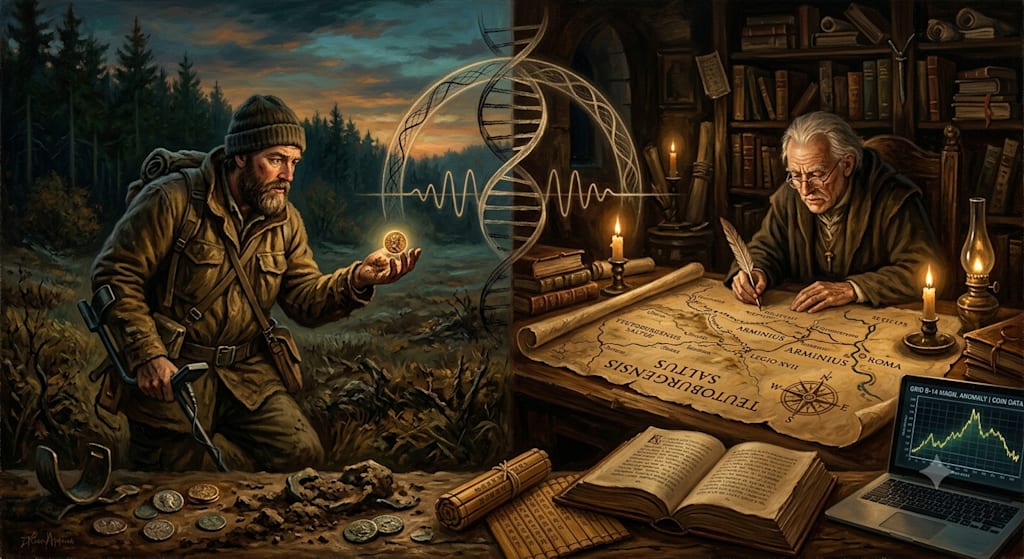
Three hundred replies piled up beneath it. Someone dug out the classic case, the British officer Koren, carrying a metal detector, following a casual suggestion from the German archaeologist Schlüter, and unearthing relics from the Battle of the Teutoburg Forest. Roman coins, weapon fragments, human bones. An outsider had done what countless academic historians never manage in a lifetime.
That case landed like a stone through the glass window of every “establishment” scholar.
But if we stare only at that stone, we miss how the whole wall was built.
The first thing professional training teaches you is not how to read more books. It’s how to stop lying to yourself.
There’s a term in historiography: anachronism, imposing today’s mind on yesterday’s decisions. You think the Chongzhen Emperor was a fool for not moving south. But professional training demands you first understand: how large was the Ming fiscal base? How stubborn was the civil service faction? How wildly inaccurate were contemporary maps of the southern geography? By the time you’ve worked through all that, the word “fool” no longer fits your mouth.
Your supervisor interrupts you, again and again: “That source you’re citing—compiled eighty years after the event. Can you use it?” “You keep saying ‘sprouts of capitalism’—did anyone in that period ever use that term?”
These interruptions hurt. But they grind away the thin layer of arrogance that every beginner wears. They teach you one thing: historical inevitability is, most of the time, an illusion written after the fact. What actually turns the wheel are the contingencies that even the people living through them couldn’t name.
A lone enthusiast can read through the Twenty-Four Histories without much trouble. But he lacks someone to slam the brakes when his thinking derails. That’s the first reason those university people exist—not to give you more facts, but to raise the odds that you’ll reason with discipline. Not the odds of knowing more. The odds of not reasoning badly.
But to see amateurs merely as “people with metal detectors” is also to underestimate them.
The weakness of the professional system is that it’s too stable. So stable that it’s slow. While the professors are still arguing over which edition of the Veritable Records of the Ming is authoritative, an amateur who can code has already scraped hundreds of thousands of epitaphs and literary collections, mapping out the hidden marriage networks of the Ming gentry in a visual graph. Once that graph appears, things that had been buried between the lines can no longer stay hidden.
Then there’s the climate engineer who brought ice-core data into historical discussion. He used the numbers to show historians that the collapse cycles of several dynasties correlate closely with fluctuations in temperature curves. That angle was never taught in any history department—because the curriculum doesn’t move as fast as technology.
Koren found the Teutoburg Forest because he knew how to use a detector. But today’s amateur who wants to “outperform” the academy doesn’t do it by copying texts more diligently. He does it by carrying his own trade’s tools and crashing in from the side.
What they offer is not a conclusion. It’s a new way of asking.
But the spotlight only hit Koren. Where was Schlüter?
Schlüter was in the library. He spent his life collating Roman army routes and emending Latin place-names. He may never have dug up a single Roman coin with his own hands, but he told Koren’s detector where to ring.
Universities are filled with these people. They compile massive bibliographic indices. They sort through excavated bamboo slips. They verify the birth and death years of a county magistrate, just to correct a single character in the Draft History of Qing. Maybe one in a hundred will ever be remembered by the public. But without those ninety-nine, that piece of metal is just a lump of rust. It never enters the historical narrative.
It’s a relay race. Schlüter dies; his students continue. Koren stops digging; the next cohort of graduate students writes up his finds, indexes them, deposits them into the national memory.
The second illusion amateurs often fall for is equating “shock value of an opinion” with “scholarly merit.” An amateur can post an essay titled “Zhuge Liang’s Northern Campaigns Were a Perfect Strategic Blunder” and get a million reads. A professional spends ten years just to calculate the actual attrition rate of the Shu Han grain convoys crossing the Qinling mountains. The former gets remembered; the latter gets forgotten. But the latter is the precondition that makes the former even possible.
Without that foundation, every dazzling discovery is just an isolated anomaly.
So back to the original question: if an amateur can outperform a professional, does the profession still matter?
It does. And precisely because the amateur might outperform, the profession matters more.
They are not opponents in a boxing ring. They are a double helix. The profession builds the bridge—slow, steady, every step compacted. The amateur scouts the path—fast, wild, throwing a beam of light from an unexpected direction. If the bridge breaks, the light has nowhere to land. If the light never comes, where is the bridge even heading?
The smartest move for an amateur is not to try to beat the academics on their own track—you don’t have to get a degree in paleography. The smartest move is to take the tool that no one else in that room has, walk up to the door of the scholarly community, and say: “Here’s a move you might not have seen.”
And the people inside the academy have to admit that their toolbox is missing one Swiss Army knife, and its name is wild intuition.
Historical truth has never been locked in an ivory tower. It belongs to anyone brave enough to ask, “And then what?”
Schlüter’s campaign map still sits in some archive somewhere. Along its newest edge, someone has added a few lines of annotation in a different color of ink. The handwriting is not the same.
The prospector and the alchemist share the same sheet of paper.
About the Creator
Jin
Writer of reamstories
https://reamstories.com/jin
Enjoyed the story? Support the Creator.
Subscribe for free to receive all their stories in your feed. You could also become a paid subscriber, letting them know you appreciate their work.
Comments
There are no comments for this story
Be the first to respond and start the conversation.