
The Market Stall Where Two Languages Met
A common tongue makes daily life easier. It can also leave a grandmother and her grandson needing a translator at the dinner table.
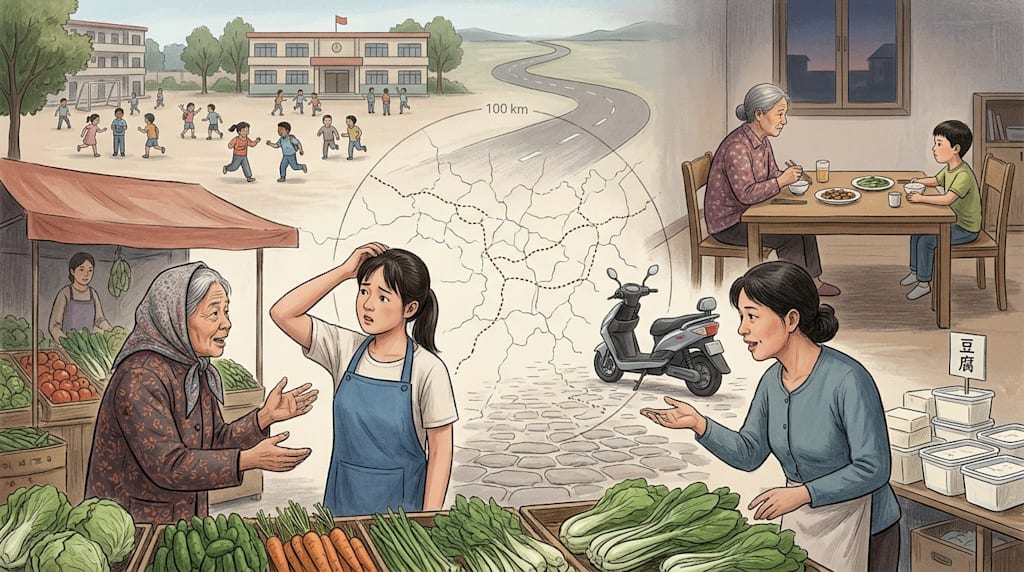
At the vegetable market, an old woman points at the greens on a stall and asks the price. She speaks the local dialect. The vendor, a young man in his twenties, freezes for a moment, then turns to the woman selling tofu next to him. She translates one sentence into Mandarin, and only then does the young man quote a price. The old woman takes out some change and mutters something under her breath. The young man does not respond. He lowers his head and goes back to sorting vegetables.
This scene happens every day. It is not rudeness. Two sets of speech did not meet.
What was a dialect originally? The common speech of a small area. In the past, people traveled on foot, on horseback, on oxback, or in horse-drawn carts. The limit of a person’s lifetime range of activity might have been a hundred kilometers around the place where they lived. Within those hundred kilometers, people went to market, visited relatives, farmed, married, and buried their dead. They dealt with one another often, and gradually a shared language took shape. Beyond those hundred kilometers, with high mountains, long roads, and few people coming and going, the need to communicate was low. Language grew into another system. The saying “speech differs every ten li” was not designed by anyone. Geography and the radius of travel pressed it into being.
Things are different today. Transportation technology has compressed a hundred kilometers into a twist of an electric scooter’s throttle. Information technology has compressed a thousand miles into a screen. A child meets classmates and teachers from all over the country at school. An adult working, handling affairs, seeing a doctor, or traveling faces people with different accents. The old language limited to a very small area becomes inadequate. The radius of communication has changed, and language changes with it. Language is not an exhibit in a museum. It adapts as technology develops and the times advance.
I am polite about this. When I meet someone from Shaanxi, I am willing to say a few sentences in Shaanxi dialect. When I meet someone from Henan, I can speak Henan dialect. Occasionally, when I meet someone from Sichuan, I can squeeze out a few Sichuan words. For the rest, I really cannot. I can only use Mandarin. It is impossible for anyone to learn all the dialects of China. Even if such a language genius existed, there would be no need. A person going from Beijing to Guangzhou, from Shanghai to Chengdu, from Xi’an to Harbin cannot switch to a complete language system at every stop. Public settings need a common denominator. Mandarin is that common denominator. It covers a wide area, costs relatively little to learn, and has the strongest policy and school support.
In cross-regional public communication, speaking Mandarin is reasonable. If you are the only one speaking a dialect and most people around you cannot understand it, should everyone else learn your dialect to accommodate you, or should you learn Mandarin and keep up with everyone? The answer is simple. A dialect speaker learning the common language gains reach. The older generation spent childhood in an era of horses, oxen, and the old heavy “28-inch” bicycles for going to town. The dialect they learned as children is understandable. Their conditions determined it. Children today no longer have that environment. The distance an electric scooter covers with a twist of the throttle would once have taken a day’s travel. The school is full of people from all directions. Naturally, they will lean toward a standard language that lets them communicate smoothly with most people around them.
If the article stopped here, it would slide toward another extreme: as if dialects were only backward things that should be eliminated. I do not agree.
My grandmother only speaks dialect. When she tells stories, some words lose a layer of meaning when I translate them into Mandarin. When she describes someone as not being neat or efficient in doing things, the word she uses has no exact equivalent in Mandarin. When she talks about an old neighbor, “That person, he does things decently and properly,” the phrase in her mouth is grown together with her, with that alley, and with that era. If I translate it into Mandarin, the meaning remains. The flavor is gone. That flavor is not sentimentality. It is a set of expressions nourished by a particular place and water. Changing the language changes the feel.
A dialect is not a small Mandarin. Many dialects have complete sound systems, vocabulary, grammar, and historical layers. They record a place’s way of life, folk wisdom, and emotional expression. A person can speak Mandarin in public, speak dialect at home, and hear local speech in the local community. This is bidialectal competence, not backwardness. Promoting Mandarin and preserving dialects are not naturally a life-and-death relationship.
Language death cannot be waved away with “natural selection.” I have seen a scene. A grandmother asks her grandson in dialect what he ate at school. The grandson answers in Mandarin. The grandmother does not understand and turns to look at her son. The son translates one sentence. The grandmother nods and says something else in dialect. The grandson does not fully understand either. He smiles, lowers his head, and goes back to eating. A family sits at one table, with a translation between them.
The cost is more than losing an accent. An old person and a child have one less bridge to walk directly across. You can say the child will understand when he grows up, or that the old person can learn Mandarin too. Both are true. But a bridge is not built in a day. It is not something you can tear down with “what should die out will die out” and still feel indifferent about.
The practical question is which language fits which setting. In cross-regional public communication, Mandarin comes first. In local communities, inside the family, in local opera, and in folk expression, dialects have their value. An individual does not need to learn all dialects, nor should they demand that others learn their dialect to accommodate them. Society does not need to treat dialects as obstacles that must be cleared away. Mandarin should be promoted, because everyone needs to handle affairs, live, and communicate together. Dialects should be kept where they can be kept, because they carry the origins of the people of a place.
From a hundred kilometers to a thousand miles a day, language will change. Change does not mean everything old should be mocked. It does not mean everyone must be left with only one accent.
The old woman at the vegetable market later squats down to pick vegetables, still muttering something. This time the young man does not turn his head. He understood the three words “make it cheaper.” The old woman also understood the “three yuan fifty” the young man quoted. In their own ways, the two of them complete the transaction.
About the Creator
Jin
Writer of reamstories
https://reamstories.com/jin
Enjoyed the story? Support the Creator.
Subscribe for free to receive all their stories in your feed. You could also become a paid subscriber, letting them know you appreciate their work.
Comments
There are no comments for this story
Be the first to respond and start the conversation.