
The Last Industrial Nation
China spent one trillion dollars and three generations of bare‑bones living to build the world’s last complete industrial system. That door is now permanently closed to everyone else.
In 2022, the United Nations Industrial Development Organization published its annual report on global manufacturing competitiveness. After weighted calculations, fewer than 20 of the 193 sovereign states assessed were classified as “fully industrialised.”
The remaining 90 percent—Brazil, Mexico, Indonesia, Nigeria, Egypt—have spent half a century trying every conceivable path: import substitution, export orientation, debt‑financed infrastructure, foreign‑direct‑investment‑led growth. Yet in all of them, manufacturing value‑added as a share of GDP has either stagnated around 15 percent or fallen from higher levels.
Two hundred years of industrial history show a simple truth: those who got there got there long ago; those who didn’t, it seems, never will.
In 1950, China and the Soviet Union signed the Treaty of Friendship, Alliance and Mutual Assistance. Over the next decade, the USSR supplied 156 complete sets of industrial equipment under what became known as the “156 Projects.” The book value of this assistance was roughly 9.4 billion rubles, or about 1.0–1.3 billion US dollars at the contemporary exchange rate. A significant portion consisted of military‑related machinery.
During the same period, China’s total fixed‑asset investment in the state‑owned sector reached approximately 600 billion yuan. At the official exchange rate of the time, that equated to roughly 300 billion dollars.
The ratio is 1:230. In other words, more than 94 percent of China’s early industrial accumulation came from domestic sources.
Where did that money come from? Between 1952 and 1978, the cumulative surplus extracted from agriculture through the urban‑rural “price scissors”—the gap between state‑procured farm prices and state‑set industrial goods prices—amounted to somewhere between 600 and 800 billion yuan. The mechanism was mundane: the state fixed procurement prices for grain a few cents per catty below market levels, while the prices of tools, cloth, and other daily necessities sold to peasants were set a few dimes above production cost. Cent by cent, dime by dime, that surplus fed the blast furnaces of Anshan, the chemical plants of Lanzhou, and the roadbeds of the Chengdu‑Kunming Railway.
In 1960, the average annual consumption expenditure of urban residents in China was 142 yuan. By 1970, that figure had crept to 164 yuan. Over a decade, the average Chinese city dweller had an extra 22 yuan to spend each year. Over the same decade, pig‑iron output rose from 11 million tonnes to 26 million tonnes, and crude steel from 8 million to 18 million tonnes.
These numbers need no interpretation. They speak for themselves.
China’s industrialisation path was different from both the Soviet and Japanese models.
The Soviet model was centralised ministry‑giant‑factory administration: one product, one plant, one line of command. Japan’s model was the keiretsu‑style vertical subcontracting chain—giants like Toyota and Mitsubishi surrounded by layers of small suppliers, but with all financial flows ultimately converging at a handful of megabanks.
China built something else. On one hand, the 156 key projects were deliberately located inland—Lanzhou, Baotou, Chengdu, Chongqing—with blast furnaces and chemical works rising on barren hills. On the other, almost every county was encouraged to set up “Five Small Industries”: small steel, small fertiliser, small cement, small coal, and small farm machinery.
In 1975, the gross output of China’s commune‑and‑brigade‑run enterprises was about 30 billion yuan, roughly 8 percent of total industrial output. Quality varied wildly. Many small blast furnaces charged more than half scrap metal, and sulphur and phosphorus levels often exceeded specifications. But they were scattered across more than two thousand counties, and each county now had its own repair shop, its own cement kiln, its own little coal pit.
By the time the reforms began in 1978, China had accomplished something almost no other latecomer had: industrial skills had been democratised down to the county level. It was not just Shanghai, Shenyang, and Wuhan that had skilled machine operators; townships in Jiangsu, mountain villages in Sichuan, and farming communities in Shandong all had people who could run lathes, tune electric motors, and calculate mixture ratios. A decade later, these same people became the first generation of township‑enterprise directors, technicians, and salesmen—and they responded to market signals faster than any central planning bureau ever could.
In July 1960, the Soviet Union withdrew all its technical advisers from China. At the Lanzhou uranium enrichment plant, then under construction, about a quarter of the design blueprints were taken away. China’s nuclear establishment mobilised every available engineer and spent three months recalculating and redrawing the missing sections. That hand‑drawn set of amended drawings became the technical template for all subsequent diffusion‑separation plants.
This episode does not appear in any official propaganda publication. It is mentioned only in a 1978 internal summary document from the Ministry of Nuclear Industry—seven thousand Chinese characters in total, with the redrawing effort occupying two paragraphs. No exclamations, no eulogies. Only dates, places, personnel numbers, and drawing codes.
Those drawings remained in production use for nearly twenty years. In 1985, they were superseded by a computer‑aided design system. The old blueprints were archived under the number LZ‑60‑07.
The “scale effect” of Chinese industrialisation is often discussed abstractly, but one concrete case is telling.
In 2021, a Shenzhen‑based medical‑device company needed a special specification of titanium‑alloy bone screws. Globally, only three factories could produce that exact specification: one in Germany, one in the United States, and one in Xi’an. The Xi’an factory quoted one‑third the German price and one‑fifth the lead time. Not because its technology was more advanced, but because every upstream supplier—titanium ingots, precision casting, heat treatment, surface coating—was located within the same industrial park, a radius of less than five kilometres.
This “everything within five kilometres” capability is not exceptional in China’s Pearl River Delta and Yangtze River Delta manufacturing clusters; it is the norm. And that norm took over half a century to build. It requires that every tier of the supply chain have sufficient output to spread fixed costs, that every supporting process have at least two alternative suppliers, and that thousands of trucks move semi‑finished goods between factories every single day.
Taken individually, none of those links is profitable. Taken together, the system runs.
As for the sovereignty dividend, it is harder to quantify. In 1964, China detonated its first atomic bomb. The direct cost was roughly 10 billion yuan, about 3 percent of the national fiscal revenue at the time. If that money had been spent on welfare, it would have given every Chinese citizen about ten yuan. But without that bomb, during the border negotiations following the 1969 Sino‑Soviet clashes, the Chinese representatives would not have been seated on the same side of the table.
Political status and geopolitical environment are not given; they are paid for. Once paid, the money is gone. But what it bought—a seat at the table, cracks in the technology blockade, space to develop without interference—has lasted to this day.
When multinational corporations looked for manufacturing bases in the 1990s, one rarely discussed but critical reason they chose China over India, Vietnam, or Indonesia was that China already had a complete heavy‑chemical industrial base. They did not have to build steel mills, power plants, ports, or pipelines from scratch. These facilities existed—ageing, but functional. In India, by contrast, every new industrial park required a new power plant and a new water‑treatment facility, doubling both time and capital costs.
The construction costs of that infrastructure had already been paid in the first thirty years. The next thirty years merely added new floors.
In 2023, China accounted for more than half of global newly added coal‑fired power capacity. This figure is repeatedly cited in international climate negotiations. But another set of numbers is rarely mentioned alongside it: from 1850 to 2020, China’s cumulative per‑capita carbon emissions were roughly one‑tenth of those of the United States. China’s emissions curve rose sharply after 2000, but its blast furnaces had been burning for half a century before that.
If India wishes to replicate the classical “coal plus blast‑furnace” industrialisation path, it faces not the global carbon budget of 1960, but that of 2026.
Meanwhile, automation is transforming another variable. In 1978, China’s first processing‑trade contract was for assembling electronic watches. One assembly line needed 200 workers soldering circuit boards by hand. Today, the same throughput can be handled by one pick‑and‑place machine and two operators. The demographic dividends of latecomers are no longer treated as dividends, because when machines become cheaper than labour, capital has no incentive to move factories to lower‑wage countries.
In 2022, Vietnam’s manufacturing value‑added as a share of GDP reached 24 percent, surpassing China’s 21 percent. But that number is deceptive: Vietnam’s largest export is mobile‑phone components, most of which are transferred Samsung production—core R&D and key material supplies remain in South Korea.
The very definition of “industrialisation” is being dismantled. If it means possessing a complete heavy‑chemical base, mechanical engineering capacity, and an indigenous R&D‑iteration system, then the list ends with China. If it means integrating into global electronics supply chains, assembling specific product categories, and achieving a certain degree of processing value‑added, then Vietnam, India, and Mexico are still moving forward.
But between those two meanings lies a river that can no longer be crossed.
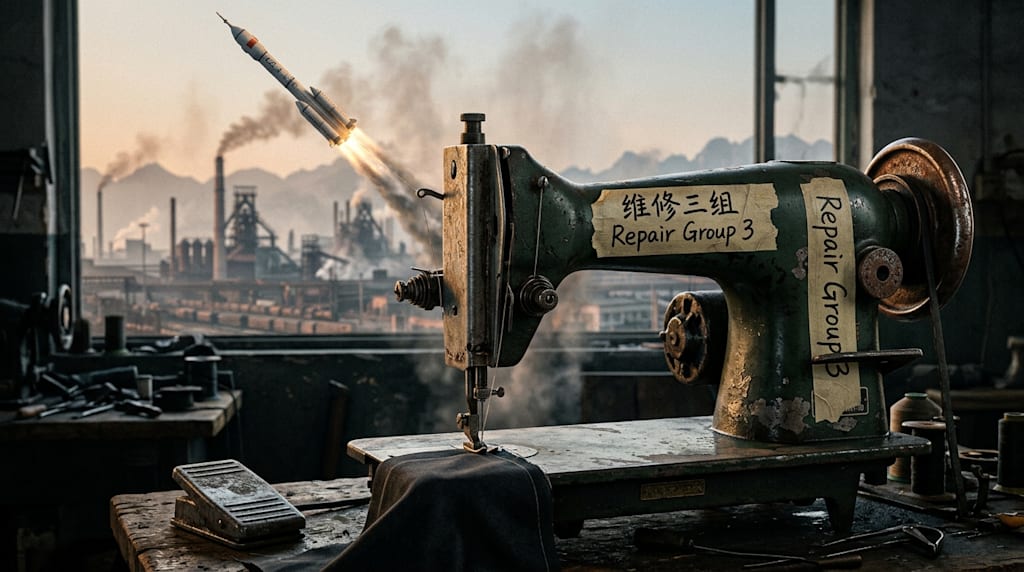
In October 2003, the Shenzhou V re‑entry capsule touched down. On the live broadcast, Yang Liwei waved to the cameras as he emerged. Few noticed one detail: in the workshop where the parachute had been sewn, the sewing machine was a 1972 model from the Shanghai No. 2 Sewing Machine Factory. On its faceplate was a piece of adhesive tape, hand‑lettered “Repair Group 3.” The tape was curling at the edges, revealing worn‑white paint beneath.
That machine bore serial number 724195. In April 1972, it was assigned to a parachute factory under a military logistics command. Over the next thirty years, it stitched canvas covers for shotguns, military tents, helicopter rescue slings, and finally the canopy that brought the astronaut back to Earth.
In 2005, the old machine was replaced by a new computerised unit. It was not sent to a museum. It was sold to a private factory in Zhuji, Zhejiang Province, that produced shoe uppers. According to the purchasing clerk who handled the transaction, the final price was 280 yuan.
From the day it was built until the day it left service, that machine never did anything except sew. The things it sewed changed—from military canvas to spacecraft components to shoe uppers. The machine itself never knew the difference. It only ran the thread.
And so, after the last truly industrialised nation in human history had sent its last astronaut home, what remained was a sewing machine. Sold for 280 yuan.
About the Creator
Jin
Writer of reamstories
https://reamstories.com/jin
Enjoyed the story? Support the Creator.
Subscribe for free to receive all their stories in your feed. You could also become a paid subscriber, letting them know you appreciate their work.
Comments
There are no comments for this story
Be the first to respond and start the conversation.