
The Label Meant to Shame Germany Became Its Greatest Advertisement: How “Made in Germany” Was Born
The words “Made in Germany” are now associated with precision, reliability and high-quality engineering. But that was never the intention. When Britain introduced the label in the late 19th century, it was meant as a warning — a way of telling British consumers to think twice before buying cheap German goods. Instead, it became one of the most powerful quality marks in the world.
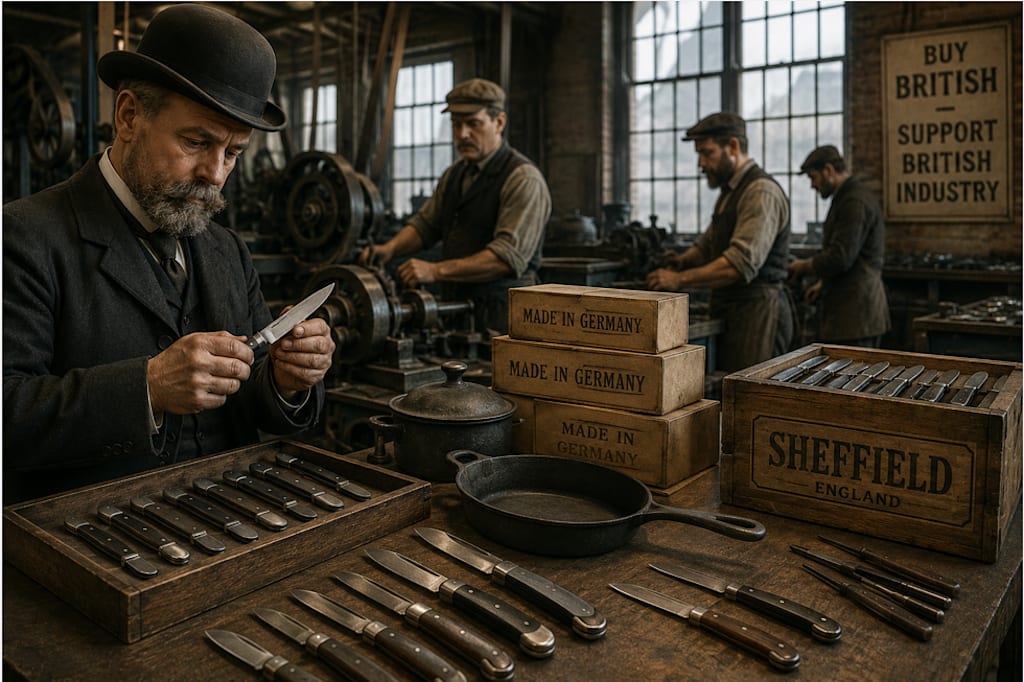
In the second half of the 19th century, Britain was at the height of the Industrial Revolution. The country proudly considered itself the “workshop of the world”, producing machinery, textiles, steel and tools that were exported across the globe.
But Britain's industrial dominance was beginning to face a serious challenge.
The newly unified German Empire was rapidly developing its own industrial base. German manufacturers were becoming increasingly aggressive competitors, offering goods at considerably lower prices and, in some cases, producing remarkably close copies of established British products.
Sheffield's famous cutlery industry was particularly affected.
British manufacturers complained that German producers were flooding the market with inexpensive goods that could easily be mistaken for British-made products. They demanded government action, arguing that consumers were being misled and domestic industry was being unfairly undercut.
The British Parliament responded.
A warning label for British shoppers
In August 1887, Britain passed the Merchandise Marks Act.
Among other provisions, the legislation required imported goods to be marked with their country of origin.
The intention was hardly flattering toward Germany.
British lawmakers expected that a patriotic British shopper seeing Made in Germany stamped on a pocketknife, tool or cast-iron pan would immediately understand what it supposedly meant: cheap foreign goods, inferior quality and a product that was not worth buying.
The label was effectively intended to be a warning.
The thinking seemed straightforward.
If consumers knew that a product had been made in Germany, they would reject it and spend their money on British-made goods instead.
What British politicians could not predict was what German industry would do next.
Germany turned an insult into a challenge
German manufacturers did not retreat from the British market.
Instead, the new label became a challenge.
German industrialists and engineers began investing heavily in modern factories, new technologies and systematic quality control. Rather than accepting the reputation of producing cheap imitations, they set out to prove that German products could compete with — and eventually surpass — British goods.
The transformation was remarkable.
Over the following decades, German manufacturing developed a reputation for precision, durability and technical sophistication.
And something completely unexpected happened.
The label that had been designed to damage German exports began to acquire a very different meaning.
“Made in Germany” stopped being a warning and became a recommendation.
British consumers gradually discovered that products carrying the supposedly embarrassing label could be reliable, well engineered and built to last.
The attempt to protect British industry had inadvertently helped create one of Germany's most recognizable commercial identities.
The label that conquered the world
The irony did not end there.
During the 20th century, country-of-origin markings became a normal part of international trade. Consumers everywhere became accustomed to seeing labels such as Made in Britain, Made in Japan, Made in Italy or Made in the USA.
And Germany was not the only country to experience a similar transformation.
Japan provides perhaps the most striking parallel.
After the Second World War, Japanese products were initially associated in many Western markets with inexpensive mass production and, in some sectors, questionable quality. But Japanese manufacturers invested heavily in engineering, manufacturing processes and quality control.
Within a few decades, Japanese automobiles, cameras, electronics and other products had become symbols of technological excellence and reliability.
The same basic lesson appeared again and again:
A reputation for quality cannot be created simply by a label — but a label can eventually become powerful when the products behind it live up to the name.
The British government had introduced Made in Germany because it wanted consumers to avoid German products.
Instead, Germany transformed the label into a badge of quality.
Perhaps the greatest irony of the story is that Britain did not merely fail to stop its German competitors.
It helped give them a brand.
About the Creator
Enjoyed the story? Support the Creator.
Subscribe for free to receive all their stories in your feed.
Comments
There are no comments for this story
Be the first to respond and start the conversation.