
The Kohinoor of Hyderabad
Princess of hearts Princess Niloufer
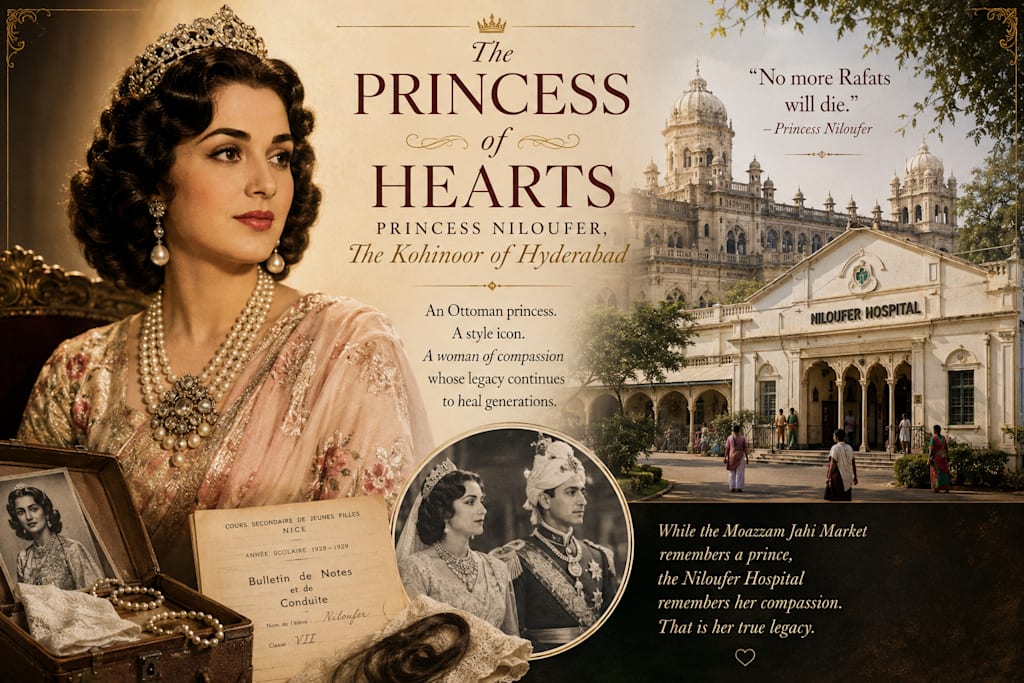
Chapter 1: Introduction: The Woman Behind the Portrait.
She was born into one of the world’s greatest empires, lost her homeland before she turned ten, became one of the most photographed women of her generation, married into India’s richest royal family, and yet today, thousands in Hyderabad remember her not for her beauty or royal title, but for her compassion, for a hospital bearing her name continues to serve generations of mothers and children.
This is the remarkable story of Princess Niloufer.
Princess Niloufer was far more than a royal figurehead; she was a woman who successfully straddled the cultures of the Ottoman Empire, the French Riviera, and the princely state of Hyderabad.
Although she became a global sensation and was often listed among the world’s most beautiful women, the glitter of public admiration concealed a private life marked by loneliness, heartbreak, and quiet resilience.
Yet, her journey from the palaces of Turkey to the courts of the Deccan was shaped by the cold logic of international diplomacy.
Chapter 2: The Royal Marriage.
The journey of the Ottoman princess to the Deccan was not paved with romance, but with the pragmatic negotiations of a falling empire and a rising dynasty. Initially, the leaders of the Khilafat movement, including Maulana Shoukat Ali, proposed a marriage between the Khalifa’s daughter, Durru Shehvar, and the Nizam’s eldest son. However, the Nizam of Hyderabad found the required marriage settlement, or Mehr , to be exorbitant for a single union. By agreeing on a single financial settlement covering both royal marriages, the Nizam secured an arrangement that united the Ottoman and Hyderabad dynasties through two simultaneous alliances.
Chapter 3: Exile, Elegance, and Loneliness.
Niloufer’s journey to India began with a forced exile from Turkey at age eight, following the abolition of the Ottoman Caliphate and Mustafa Kemal Atatürk’s sweeping reforms. From the domes of Istanbul she found herself on the sunlit Mediterranean coast of Nice, learning French while carrying memories of a vanished empire.
She developed a cosmopolitan sensibility that she eventually brought to the Hill Fort Palace in Hyderabad. She became a pioneer of fashion, famously blending Eastern and Western aesthetics into a signature style.
Her influence was so profound that her European outfits were discussed in the New York Times as late as 1961, and she famously turned down multiple offers for Hollywood film roles. Despite the “glittering” evenings filled with poets and musicians, the emptiness of her private life grew as she struggled with the inability to conceive.
Every evening she dazzled royal banquets dressed in shimmering silks and diamonds. Newspapers celebrated her elegance. Photographers chased her across Europe.
Yet when the guests departed and the music faded, she returned to a palace where the silence grew heavier with every passing year.
Chapter 4: The Tragedy That Changed Hyderabad.
She became one of the most celebrated women of her generation. . Yet the event that would define her legacy happened not in a palace...
but inside a modest maternity ward.
The sorrow of her childlessness was a constant shadow, especially as her cousin Durru Shehvar gave birth to the future heirs of the Nizam. Niloufer took every precaution, even bringing a French midwife with her to Hyderabad “just in case,” and consulting various doctors across Europe. This personal pain, however, was eventually sublimated into a profound commitment to public service.
Her evolution toward healthcare was evidenced early on when she obtained training as a nurse to help with relief efforts during World War II.
The turning point came in 1946 when her maid, Rafatunnissa Begum, died during childbirth due to a lack of specialized medical facilities. Niloufer is supposed to have said ‘no more Rafats will die.’ Vowing to prevent similar tragedies, Niloufer channeled her efforts into creating the Niloufer Hospital in 1953. This landmark institution for women and children in Red Hills remains her most enduring legacy in the city.
Chapter 5: Leaving her Beloved Deccan.
The geopolitical shifts of Indian Independence and the 1948 “Police Action” changed Niloufer’s life forever. As the Nizam’s power faded to a shadow of its former glory, she found herself at a crossroads.
Following the dissolution of her marriage to Prince Moazzam Jah in 1952, she made the pivotal decision to leave India. She returned to Paris to live in a flat with her mother, continuing to attract global attention at the age of 36. In France, she remained a figure of fascination, surrounding herself with famous friends and eventually finding happiness in a second marriage to an American, Edward Pope. She lived in the city until her death in 1989, never once returning to the shores of India.
6. Suitcases of Memory
Decades after her departure, a collection of Niloufer’s private artifacts was discovered in New York, preserved in suitcases by the wife of her second husband.
These items, later entrusted to management consultant Arvind Acharya, offered a rare, intimate glimpse into the woman behind the title.
The collection included her first shaved lock of hair, a string of pearls used to tie her hair, and her class VII progress report from her school in Nice. These mundane items serve to humanize a woman often remembered only as a “glittering” public figure. They reveal the private individual who kept her childhood memories close even as she moved between continents and cultures.
Chapter 7: A Tale of Two Cities.
Today, Princess Niloufer rests in a grave in Bobigny, near Paris, far from the palaces of Istanbul or the Deccan. Yet, her name is spoken daily in the city of Hyderabad, where her impact is felt in the halls of the hospital she founded. It is a striking geographic irony that the Moazzam Jahi Market, named for her husband, stands just yards away from the Niloufer Hospital. While one commemorates a prince, the other preserves the health of thousands of mothers and children.
Her story invites us to reconsider how we define a royal legacy: is it measured by the titles held in life, or by the lives saved long after the titles have faded?
About the Creator
Akram Mohammed
From a four-decade IT career to storytelling, I write about South Indian Islamic history, memoirs, faith, philosophy, cultural heritage, and nature, uncovering overlooked perspectives and meaningful human connections.
Enjoyed the story? Support the Creator.
Subscribe for free to receive all their stories in your feed.
Comments
There are no comments for this story
Be the first to respond and start the conversation.