
The Key to Long-Term Economic Success May Be in a Lost Mediaeval Village
Dr. Green highlighted the connection between significant historical occurrences and the depletion of resources.

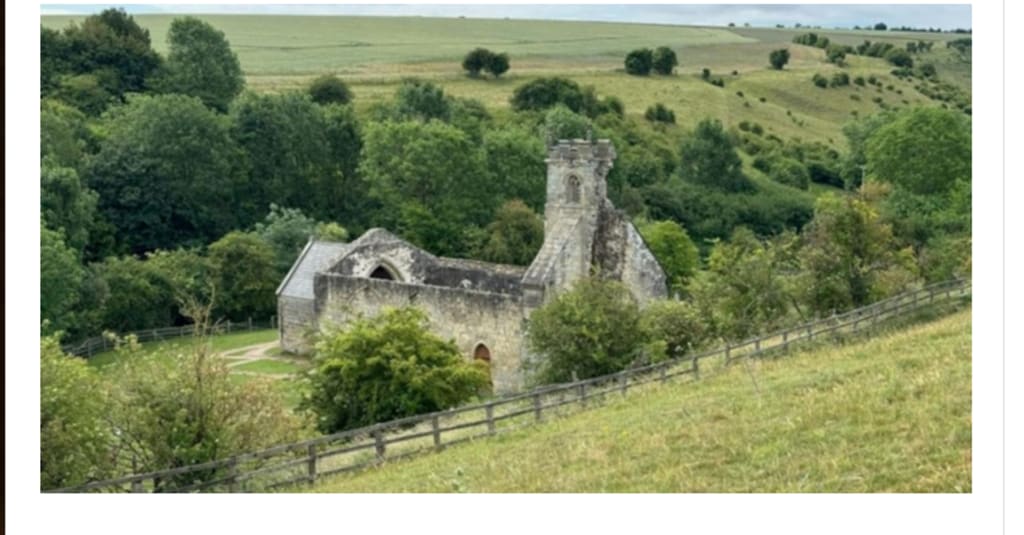
According to recent research, the "rubbish" left behind in a defunct mediaeval village in a remote part of Yorkshire may provide insights into how cultures attain sustained "green" success. Wharram Percy, a once-thriving village on a steep chalk hillside, is reduced to a grassy mound and a destroyed stone church.
But according to a recent research, the commonplace objects its citizens left behind—like broken cooking pots—show an economy that expanded, changed, and eventually contracted, providing new insight into how human societies might thrive without depleting their resources.
Centuries of archaeological evidence from Wharram Percy, including a vast database of shattered pottery sherds and chalk walls now conserved by the Archaeology Data Service, were examined by researchers from the University of York.
Using a technique from ecological economics called Material Flow Analysis (MFA), these objects assisted researchers in tracking the movement of resources like stone and pottery into and around the hamlet throughout time. Since 1948, Wharram Percy has been the subject of significant research, making it one of the most researched abandoned mediaeval villages in Britain.
Long-Term Development in a Mediaeval Environment
The results, which were published in the Journal of Archaeological Science, indicate that the settlement went through periods of steady expansion with rising infrastructure and building expenditure. The long-held belief that mediaeval economies were essentially stationary is called into question by this.
Using historical data from the site's most thoroughly excavated contexts, the research team modelled stocks and flows and discovered that, although building area and pottery volumes were statistically unconnected within various spatiotemporal contexts, their flows were statistically associated.
The results' relevance was described by Dr. Adam Green of the University of York's Department of Archaeology and Department of Environment and Geography.Because Wharram Percy was located in what is now a very remote area, it would have required a great deal of labour to transport supplies in and around the area, especially at a time when there were no fossil fuel-powered equipment to facilitate moving materials around easier," he said.
At its height, the community, which flourished under the Percy family between the 12th and early 14th centuries, would have had about 200 residents, with about 40 peasant homes dispersed throughout the chalk slope.
Reevaluating Contemporary Economic Approaches
The modern world economy has grown quickly, but frequently at the expense of growing inequality and mounting strain on the planet's resources. The researchers contend that incorporating archaeological evidence into discussions on long-term sustainability today is necessary to gain a better understanding of what happens as economies expand.
The dynamics of emerging rural settlements today are comparable to the patterns seen at Wharram Percy, where stocks peaked around 1350 AD and subsequently stabilised for a long time. The Wharram Percy data shows that pre-modern economies were significantly more complicated and dynamic than previously thought, much like the Roman economy's boom and fall.
The importance of this historical viewpoint was highlighted by Dr. Simon Mair of the University of York's Department of Environment and Geography.We must reconsider how our economies and environments interact if we are to achieve long-term sustainability. This is difficult since so many facets of our lives are shaped by our contemporary economy," he said. "Looking at past economies and their relationships to the environment can help us reflect critically on the way things are today and how they might be different."
The Black Death's Effects
However, this expansion phase was short-lived. The village's material supply began to decrease about the middle of the fourteenth century. It has long been disputed whether the horrific Black Death epidemic, changes in farming practices, or politics around land ownership were to blame for this fall.
The manor's lord, Walter Heslerton I, died of the Black Death in 1349, according to English Heritage archives, and the village's population dropped from about 67 to 45. According to recent studies, the Black Death had a significant impact on remote rural settlements like Wharram Percy even though it did not completely halt urban growth throughout England.
"In the case of Wharram Percy there was a decline in the flow of resources that is correlated with a variety of substantial social and economic disruptions, including the Black Death, a devastating period of disease that appears to have hit the countryside just as it did the cities," he stated.
The settlement eventually vanished entirely, leaving only remnants in the surrounding area. However, it continues to be a great illustration of how economies have always been dynamic, able to grow and shrink in reaction to shifting circumstances. The long-abandoned village on the Yorkshire hill serves as a heartbreaking reminder that civilisations' ability to manage their resources well may be more important for long-term prosperity than unending growth.
About the Creator
Enjoyed the story? Support the Creator.
Subscribe for free to receive all their stories in your feed.
Comments
There are no comments for this story
Be the first to respond and start the conversation.