
The History of the Golden Peacock: The Rise and Fall of a Legendary Throne
The Golden Peacock is not a bird of myth, but a symbol of imperial power, unimaginable wealth, and lost splendor. Known historically as the Peacock Throne (Takht-e-Tavus), it was one of the most luxurious and mysterious royal treasures ever created. Crafted during the height of the Mughal Empire, the Golden Peacock represented absolute authority, divine kingship, and artistic brilliance. Though the throne itself no longer exists, its legend continues to fascinate historians and treasure seekers alike.

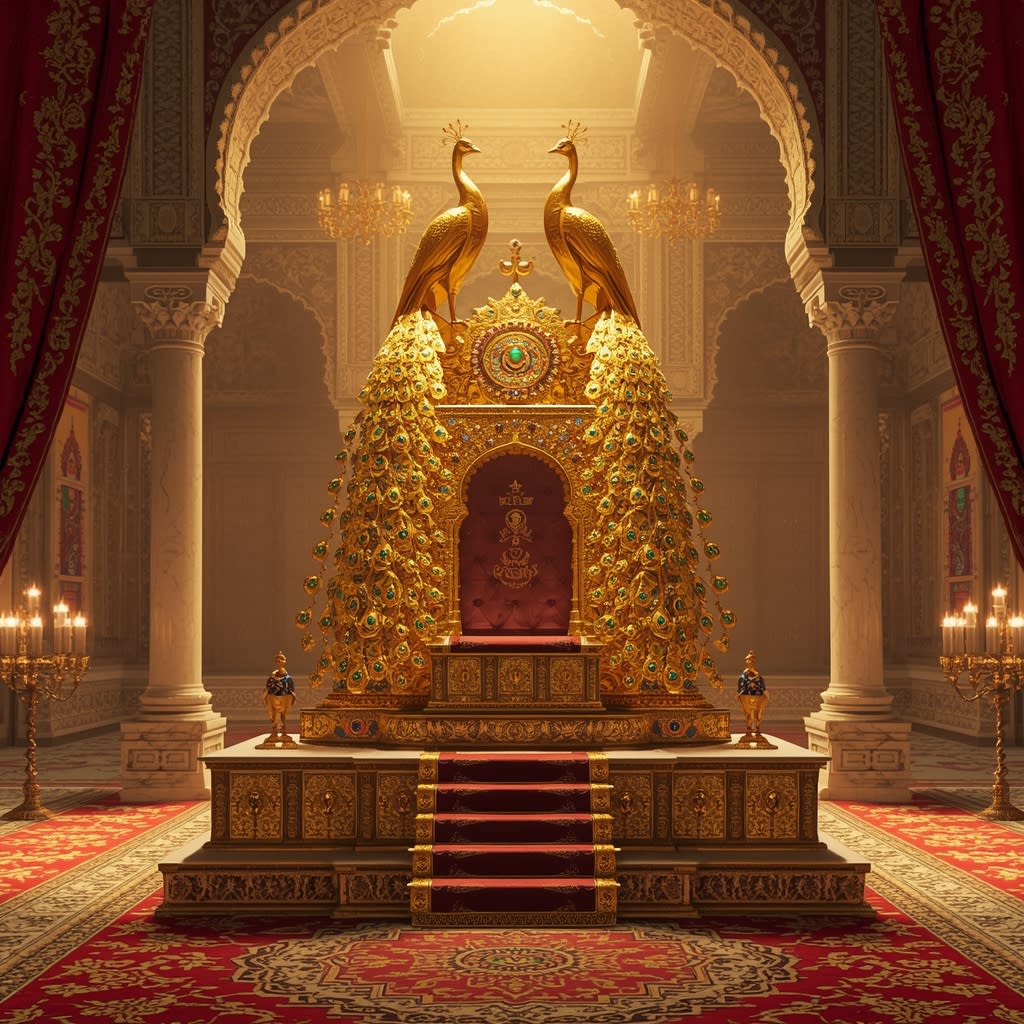
Origins of the Golden Peacock The story of the Golden Peacock begins in 17th-century India, during the reign of Emperor Shah Jahan—the same ruler who built the Taj Mahal. Shah Jahan envisioned a throne that would surpass all others in the world, reflecting not only material wealth but also cosmic order and royal divinity. Construction of the Peacock Throne began around 1628 CE and took several years to complete. The throne was made primarily of solid gold and encrusted with some of the world’s most precious gemstones: diamonds, rubies, emeralds, sapphires, and pearls. At its center stood two magnificent golden peacocks, their tails raised and spread, covered in jewels—hence the name Golden Peacock. Symbolism of the Peacock In Indian and Persian culture, the peacock symbolized royalty, immortality, beauty, and divine protection. By placing peacocks at the heart of the throne, Shah Jahan declared himself not merely a king, but a ruler chosen by heaven. Above the throne was a jeweled canopy representing the sky, while the throne itself symbolized the earth—placing the emperor at the center of the universe. This symbolism made the Golden Peacock more than furniture; it was a cosmic statement of power. A Throne Beyond Imagination Contemporary accounts describe the Peacock Throne as one of the most valuable man-made objects in history. European travelers who witnessed it claimed its value exceeded that of entire kingdoms. The throne reportedly contained: Over 100 kilograms of gold The legendary Koh-i-Noor diamond The Darya-i-Noor diamond Hundreds of rubies, emeralds, and pearls Historians estimate that, in today’s value, the Golden Peacock may have been worth $2–3 billion USD, making it arguably the most expensive throne ever built. The Golden Age of the Mughal Court For over a century, the Golden Peacock stood in the Mughal court as a symbol of stability and dominance. Emperors including Aurangzeb sat upon it while issuing royal decrees. Foreign ambassadors were deliberately awed by its brilliance—diplomacy conducted through spectacle. The throne embodied the peak of Mughal power, when the empire controlled much of the Indian subcontinent and commanded enormous economic resources. The Invasion That Changed History The fate of the Golden Peacock changed forever in 1739, when Nader Shah of Persia invaded India and captured Delhi. Shocked by the wealth he encountered, Nader Shah looted the Mughal treasury. When he saw the Peacock Throne, he reportedly exclaimed, “This is a mountain of light,” giving rise to the phrase Koh-i-Noor. Nader Shah seized the throne and transported it to Persia along with massive quantities of gold and jewels. This single event drained the Mughal Empire of its greatest treasure and marked the beginning of its irreversible decline. Disappearance and Destruction After Nader Shah’s assassination in 1747, the Peacock Throne vanished from historical records. Most historians believe it was dismantled, its gold melted down and gemstones redistributed among Persian rulers. No verified fragments of the original Golden Peacock throne have ever been recovered. Its disappearance elevated it from history into legend. Influence on Later Empires The Peacock Throne inspired later rulers across Asia and Europe. Persian, Ottoman, and even Russian courts attempted to replicate its splendor. Several later “Peacock Thrones” were built, but none matched the original in scale or symbolism. The throne also influenced colonial fascination with Indian wealth, reinforcing the idea of India as a land of unimaginable riches. Myth, Mystery, and Cultural Legacy Today, the Golden Peacock occupies a powerful place in historical imagination. It represents: Lost imperial glory The fragility of power The danger of concentrated wealth The transition from Eastern dominance to colonial rule Writers, historians, and filmmakers continue to reimagine the throne, often blending fact and legend. Some treasure myths even claim parts of the throne remain hidden—but no evidence supports these claims. Conclusion: A Throne That Outlived Its Empire Though the Golden Peacock no longer exists, its legacy endures. It was not merely a throne—it was a declaration of supremacy, artistry, and divine kingship. Its destruction reminds us that even the greatest symbols of power are temporary. The Golden Peacock’s true treasure today lies not in gold or gems, but in its story—a story of ambition, beauty, conquest, and loss that continues to captivate the world centuries later.
About the Creator
Say the truth
"Say the Truth: Explain Everything in the World" is your trusted source for uncovering facts and exploring the wonders of history, science, technology, and beyond. We simplify complex ideas and reveal truths to inspire curiosity .
Enjoyed the story? Support the Creator.
Subscribe for free to receive all their stories in your feed.
Comments
There are no comments for this story
Be the first to respond and start the conversation.