
The Forgotten Muslim Explorer of America.
Mustafa Azemmouri
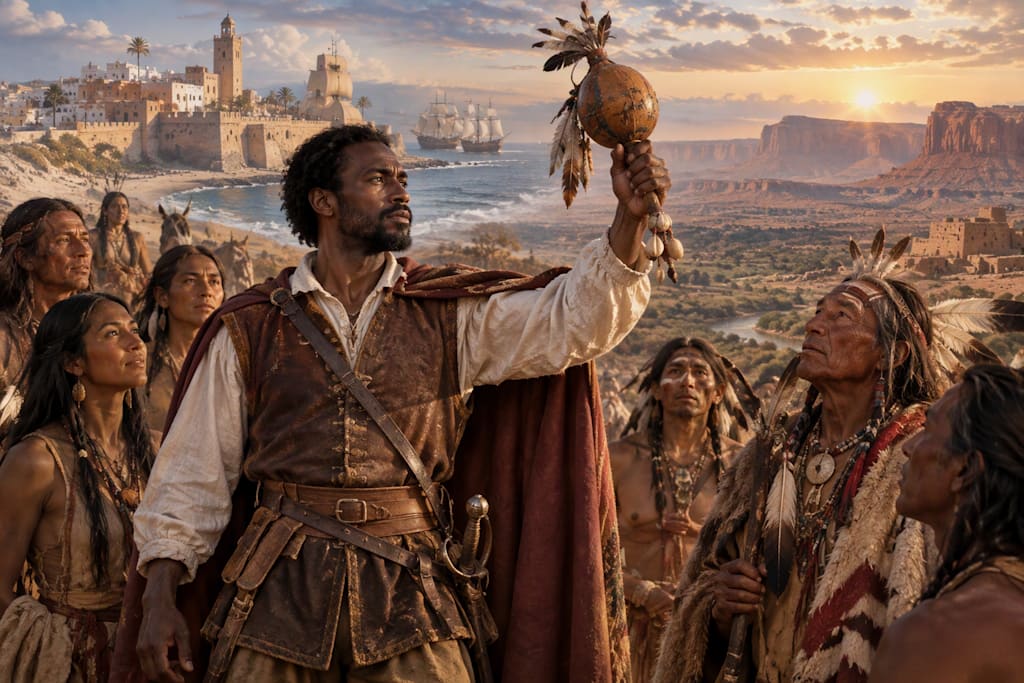
History is often written by those who hold the power and pen, and for centuries, Spanish chroniclers masked Mustafa Azemmouri behind the diminutive moniker Estebanico.
Restoring his birth name Mustafa Azemmouri does more than correct a footnote in a 16th-century logbook. It forces us to broaden the history of early America. The first non-Indigenous explorer to cross the American heartland was not a Spanish conquistador seeking gold, but a Moroccan Muslim whose intellect, diplomacy, and resilience allowed him to bridge two worlds.
Reclaiming Mustafa’s Azemmouri Name
History remembers him as Estevanico, Esteban the Moor, or Estevan de Dorantes. Yet behind these Spanish names may have stood a man known in his homeland as Mustafa Azemmouri, a Muslim from Azemmour on Morocco's Atlantic coast. He was an African whose remarkable journey across North America deserves far greater recognition.
What fascinates me is not merely that he survived. Many people survive disasters. Mustafa survived the impossible.
The Narváez expedition began with hundreds of men seeking conquest and glory. It ended in catastrophe. Storms, starvation, disease, and shipwreck reduced the expedition to only four survivors. Among them was Mustafa, an enslaved African.
Yet the true story begins after the shipwreck.
The three Spanish survivors found themselves stripped of authority, wealth, and power. In a strange reversal of fortune, the enslaved African became the indispensable man. As they journeyed through what are now Florida, Texas, northern Mexico, and the American Southwest, Mustafa demonstrated extraordinary abilities. He learned Indigenous languages, communicated across cultural boundaries, served as interpreter and mediator, and gained the trust of Native communities.
How did he do this?
I believe part of the answer may lie in his African roots. Mustafa came from a world rich in ancestral traditions, oral knowledge, and healing practices. He may have carried some of that knowledge with him, adapting to the customs of the Indigenous peoples he encountered. To survive and earn their trust, he had to learn their ways of life and become familiar with their traditions.
Mustafa also became associated with healing. Accounts of his journey describe him carrying a gourd decorated with bells and feathers, which he used to announce his arrival at Indigenous settlements. The rattle and gourd remind me of traditional healing practices found in different African societies, where such objects could have ceremonial and spiritual significance. Perhaps some of Mustafa's ancestral knowledge helped him connect with the people he met in this unfamiliar land.
For eight grueling years, he crossed landscapes unknown to Europeans, relying not on military force but on trust, communication, and adaptability. The man who had begun his journey as a slave had become a guide and a bridge between cultures.
A slave became the guide.
A captive became the leader.
A man whose identity had been obscured became central to one of the earliest recorded journeys across North America.
The Spanish chronicles preserved his story, but they also buried part of his identity beneath the name Estevanico. In the religious and political climate that followed the events of 1492, a Muslim African's original identity was hardly something the Spanish authorities would have been eager to preserve. His name changed, and his story entered history through the people who held power over him.
Today, many people view the Muslim presence in America as a relatively recent immigration story. Mustafa's journey reminds us that the connections between Muslims and this land stretch much further back. Long before the founding of the United States, a Moroccan African crossed vast portion of North America and became part of the early history of its exploration.
What happened at Hawikuh?
The accepted Spanish account tells us that Mustafa died in 1539 near Hawikuh, a Zuni pueblo in present-day New Mexico. He had been sent ahead of an expedition led by the Franciscan friar Marcos de Niza in search of the fabled cities of Cíbola.
But there is another part of this story that has always intrigued me.
Among the Zuni, a black ceremonial figure known as Chákwaina, also spelled Chaiwaina, has been associated with Estevanico. The figure is sometimes depicted carrying a gourd rattle, recalling the object Mustafa carried during his travels.
I find this connection fascinating. The Spanish account says Mustafa died at Hawikuh, yet the association of Estevanico with a figure preserved in Zuni ceremonial tradition invites us to consider another possibility:
what if Mustafa's story did not end as the Spanish reported?
Perhaps he survived and remained among the Indigenous peoples he had come to know. Perhaps he found a place among them, far from the Spanish authorities who had enslaved him. The black figure may preserve a memory of his presence in a way that the Spanish narrative does not fully explain.
I cannot say with certainty what happened to him after his encounter at Hawikuh. But I find the Indigenous tradition an intriguing reason to revisit the accepted ending rather than simply close his story with the Spanish account.
After surviving shipwreck, disease, hunger, captivity, and years of travel, perhaps Mustafa finally found freedom in the world he had learned to understand so well.
Perhaps he was remembered not as a slave, but as a traveller and healer who had come from a distant land.
A story worth remembering
Mustafa Azemmouri's story deserves a fresh look, not because it overturns history, but because it expands it. His life reminds us that the exploration of America was not solely a European story. It was also an African story, an Indigenous story, and a story connected to the Muslim world.
He survived the shipwreck.
He survived the disease.
He survived slavery.
And perhaps, in the end, he found a place among the people whose lands he had crossed.
History remembers him by a Spanish name. I prefer to remember him as Mustafa Azemmouri, the African traveller whose life crossed cultures and whose final chapter may not be as settled as we have been led to believe.
Clarify what is established and speculative
References
Texas State Historical Association, The Journey of Estevanico: The First African in Texas. [tshaonline.org]
Encyclopaedia Britannica, Estéban de Dorantes (Estevanico). [britannica.com]
Historical summary of the Narváez Expedition and the four survivors. [en.wikipedia.org]
Estevanico Foundation, historical background and cultural legacy. [estevanicolegacy.org]
Modern scholarship emphasizing his role as interpreter, guide, and cultural bridge.
About the Creator
Akram Mohammed
From a four-decade IT career to storytelling, I write about South Indian Islamic history, memoirs, faith, philosophy, cultural heritage, and nature, uncovering overlooked perspectives and meaningful human connections.
Enjoyed the story? Support the Creator.
Subscribe for free to receive all their stories in your feed.
Comments
There are no comments for this story
Be the first to respond and start the conversation.