
The Fly, the Hoe, and the Emperor
Why Central Africa’s development story runs through tsetse belts, slave caravans, French rubber quotas, and one orphan who learned to fight before he learned to read.
1. First, a Fly
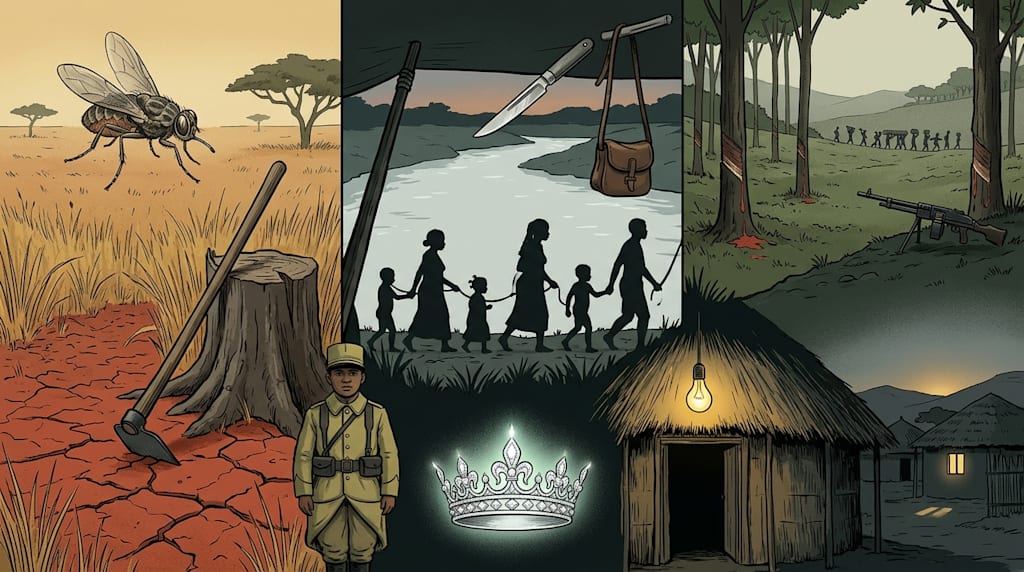
Across large parts of sub-Saharan Africa that are otherwise suitable for farming, one insect shaped history. The tsetse fly bites livestock and transmits trypanosomiasis. Cattle and horses weaken, collapse, and die within weeks. Historians overlay maps of tsetse infestation with maps of agricultural suitability and find heavy overlap. Economists have quantified the consequence: in tsetse-affected areas, precolonial African groups were significantly less likely to own large livestock, less likely to use the plow, and less likely to develop political centralization.
The choice was not cultural. A farmer who watches his cattle die for three years after plowing one season will not buy a fourth ox. He goes back to the hand hoe. A hand hoe feeds a family. It does not produce a surplus. It does not feed people who do not farm. It does not feed tax collectors.
Soil is the second constraint. Many tropical African soils are acidic red loams with low organic matter. Heavy rain washes away topsoil. Dry heat cracks and hardens the ground. The Central African Republic is an extreme case: annual rainfall of 1,000 to 1,600 mm, concentrated in five months; the remaining seven months get less than 100 mm; only about 3 percent of the country is arable. You cannot grow wheat or rice here. You grow cassava and yams, and cassava’s protein content is roughly zero.
Then there is metal. The CAR has no shallow copper or iron deposits. No copper, no iron, no plow, no axe, no weapons. A society is locked in the Stone Age not because it does not want out, but because the crust has no key.
These three things, tsetse, poor soil, and scarce metal, created a底层 structure: land was relatively abundant, labor was scarce. Under those conditions, power was not about controlling land. It was about controlling people. Whoever had people could clear land, fight, and sell to Arab merchants. The prevalence of slavery within Africa follows from this constraint.
2. The Lion Model: An Extreme Case
Before the eleventh century, the Banda society of what is now the CAR developed a structure the source material calls the “lion model.” A band of 20 to 150 people: one chief, a dozen or more wives, each wife bearing two to four children. Sons are driven out when they reach adulthood and become wanderers. The chief has one to five male confidants who share sexual access to the women. Larger bands have a five-man council of elders.
The structure came from labor control. Women were treated as carriers of reproductive labor. Excision was invented to manage their bodies. It ran there for three thousand years. The society did not enter the Metal Age.
Then Arab merchants arrived.
3. Business on the Nile
In the eleventh century, the Egyptian merchant Ahmad ibn Ibrahim al-Ja‘fari set out from Aswan, went up the Nile, crossed Darfur and Wadai, reached Lake Chad, and went south into the Ubangi River basin. He brought back ivory and ostrich feathers. He also brought back a story: that land was overflowing with beautiful women, and anyone who reached it could “automatically collect seventy-two virgins.”
Cairo paid attention. The merchant Abu Sa‘d Abdullah ibn Abu Bakr mapped a fixed route. These self-styled “Jabali” merchants, upon reaching the CAR, did the first thing first: a decapitation plan. Kill the chief, chain up a hundred women, castrate adolescent males, and ship them down the Nile, boat after boat, to the Muslim world. The surgeon traveled with the caravan. He cut. The wound was sealed with a heated blade and date sugar. The severed testicles went into a leather bag hung from the caravan flagpole.
Ann Brower Stahl’s research gives the numbers: 8,000 to 12,000 slaves exported annually from the Ubangi basin. Thirty-four percent of Banda men castrated. The patrilineal line nearly snapped. Clan names vanished in large numbers. European explorers later recorded “villages of women and children, with no elder.”
4. Thirty Years of the French
In 1894 French troops reached the Ubangi River and drove off the Arabs. In 1920 French Equatorial Africa was formally established. In 1958 France granted the CAR a high degree of autonomy. Actual colonial rule lasted about thirty years.
The French found that the acidic soil was poor for grain but good for rubber and coffee. They forced locals to harvest without pay and held their families hostage until quotas were met. Then they discovered something: Central Africans made excellent slaves. In Guinea and Algeria, slaves revolted constantly. French overseers were killed in successive waves. Central Africans had been slaves to their chiefs, slaves to the Egyptians. They served the French without complaint.
In the 1930s, large numbers of Banda were sent across French Africa to build roads and railways. During railway construction through 1934, more than 17,000 workers died, from industrial accidents and disease including malaria. After the harvest, the French sent Central Africans thousands of miles away to build roads.
In 1931, a Banda shaman named Kongo Wara produced a sacred hoe and announced that it made Black men bulletproof, that white men’s guns would shoot only water. Three hundred fifty thousand people rose. The French set up machine guns on high ground. The Hoe Handle War has the highest casualty ratio of any war in human history: French dead, zero; Central African dead, 110,000.
During the uprising, a chief named Mindogon was co-opted by the French to organize slaves for the French Forest Company. When he heard that a nationwide uprising had begun, he released some slaves the company had taken as hostages. The company detained him, chained him, and brought him to the colonial governor. On November 13, he was beaten to death in the square outside the provincial government building.
Mindogon was Bokassa’s father.
5. A Résumé of an Orphan
Bokassa became an orphan at six. His mother hanged herself a week after his father’s death. He was sent to his uncle’s house. His aunt sent his cousin to the best school to learn French. Bokassa was sent to feed pigs. He was 1.58 meters tall. At ten he looked like a six-year-old. At the church school he was mocked for being an orphan and for his size. He fought, built a thick, hard body, and no one dared provoke him. He was fluent in French and could read French originals. He loved heroic biographies. Father Gruner took him to the city, hoping to make him a priest or a doctor. The priest soon found that the boy had no interest in knowledge, loved only heroic epics, had a violent temper, and could not listen to others. At seventeen, the priest sent him home.
A young man 1.58 meters tall, with dead parents, no degree, no connections, too slow to learn medicine, raised on heroic stories but in reality an unemployed waste. The army was the remaining option.
On May 19, 1939, he enlisted in the French army. In World War II, fighting Vichy France, he volunteered four times for suicide squads, led charges on fortifications, knocked out machine-gun nests, and was first to plant the flag on positions the enemy thought impregnable. At the Provence landing in 1944, he carried two wounded French soldiers out through explosions. He received nine French honor medals in his life. Four times a suicide-squad leader.
In 1950 he went to Vietnam, tasked with clearing Viet Minh guerrillas, skilled at using his skin color to ambush in darkness, fog, and rain. In 1956 he went to Algeria, was promoted to second lieutenant, and two years later to lieutenant, the highest rank then attainable by a man of color in the French army.
6. Five Hundred and Seventy Thousand
The CAR became independent in 1960. His cousin David Dacko became president. Dacko called the CAR “an antelope with four knives at its heart”: to the north, Islamic extremists from Chad and Egypt; to the south, a pro-Congo separatist force; to the east, a People’s Liberation Army of Sudanese herdsmen; to the west, in the rainforest, “pygmy” cannibal tribes of unknown range. Beyond that, chiefs large and small dotted the country. The president’s orders did not leave the capital.
Dacko’s method was compromise. He allowed anyone to mine diamonds. Seventy percent were smuggled out, and local chiefs used the money to buy arms and become warlords. He created a huge parliament so every faction could speak. Civil servants sent from the center could not communicate with locals, so they embezzled the money allocated from the center and inflated budget requests. Dacko told Bokassa: what do you know, you are a rough man who never went to university.
Bokassa trained five hundred soldiers in the European manner. At 3 a.m. on December 31, 1965, he launched a coup. Five hundred men entered Bangui. The central government’s seventy thousand troops scattered, stripped off their uniforms, and ran bare-chested pretending to be civilians. Bokassa caught his shivering cousin at the western border. Dacko had already prepared a fake ID and was ready to flee to France. Bokassa embraced him and said: “I tried to warn you, but now it is too late.”
7. Early Reforms and What Came After
Bokassa signed the Marriage Reform Law. Polygamy was immediately invalid. Men with multiple wives had twelve months to register “one retained spouse.” Overdue cases were taxed 5,000 CFA francs per month. Female excision was classified as intentional injury, punishable by one to five years. In 1967 the first forty-two village midwives were sent to the Bangui medical school for three months of sterile-delivery training. A 1970 UN Population Fund report found that the excision rate in the CAR fell from 90 percent to 38 percent. The Bride Price and Dowry Prohibition Law capped gifts at 5,000 CFA francs. Excess was “illegal transfer of property,” punishable by six months’ hard labor. In 1968 rural circuit courts ruled on 673 high-bride-price cases. They confiscated 1,200 cattle and 3,400 goats and returned them to the groom’s family. Proceeds from confiscated livestock went to the Rural Roads Fund.
In 1968 the first asphalt road, Bangui to Mbaïki, 103 km, opened. In 1969 the Bangui to Gabon border road, 256 km, was hard-surfaced. In 1970 the city’s first concrete bus line put twelve buses into service, flat fare 30 CFA francs. In 1971 the first motorized ferry terminal on the Ubangi opened. Rainy-season crossing time fell from six hours to forty-five minutes.
Then he went to Libya. Gaddafi lined up 12,000 people in forty columns at the airport. Bokassa was frightened. He asked Gaddafi: I have fought and risked death for thirty years, and the loyal people I can actually mobilize number only a few hundred. How do you make so many people obey you? Gaddafi said: you run capitalist market economics. You cannot control many people no matter how hard you struggle. Do not try to control people through personal charisma. Build a system. The economy is driven by plans. You are the planner. You can mobilize the country’s economic resources. The economic base determines the superstructure. Do you not then acquire unmatched political power?
Bokassa came back and imposed a planned economy, confiscated private property, and centralized allocation. After two years he felt something was off and went to Romania for advice. He returned, convened the national congress of the only party, and used bayonets to force delegates to name him president for life. In 1974 he promoted himself to marshal, held fourteen ministerial posts including defense and agriculture, chaired eight companies, and took the country’s most luxurious hotel, airline, cotton company, coffee company, and diamond company.
On December 4, 1977, the coronation. Crown, scepter, and ring used 13,000 diamonds, 2,000 carats total, the largest 138.32 carats. One hundred horsemen on Chadian horses and one hundred on French Norman horses led the way. Two hundred BMW motorcycles and two thousand Mercedes and Peugeot cars carried guests past the citizens. The coronation cost $30 million, half the CAR’s 1977 revenue. Treasury reserves were down to $50,000.
In January 1979 a major drought caused food riots. Bokassa sent the army. France, worried he was tilting toward the Soviet camp, executed Operation Barracuda on September 19 and 20. French commandos took Bangui airport with almost no resistance. Bokassa’s elite troops surrendered without a fight. Bokassa was on a state visit to Libya. Gaddafi immediately turned on him and told him to get out. Switzerland refused him as a criminal against humanity. Gabon, Togo, and Zaire were not interested. Côte d’Ivoire’s President Houphouët-Boigny took him in.
On October 23, 1986, sick and old, Bokassa appeared at Bangui airport. He wanted to see the country one more time. He was arrested on arrival. Fourteen charges, including treason, murder, cannibalism, illegal use of property, assault, and embezzlement. His lawyer, Francis Szpiner, said in court: “I gave you your first train. In 1970 I used three years of budget surplus, 12 billion CFA francs, to build 215 km of the Bangui to Berbérati line. When the first train whistled, I stood at the carriage door and saw an old man who had never left his village weep. I told them: this is our own iron snake. I gave you your first light bulb at night. In 1971 I mortgaged 30 percent of the country’s expected diamond exports, borrowed $100 million, and built the Boali to Bangui hydroelectric station, so the people could see that darkness can be pushed back by our own hands.”
On June 12, 1987, he was convicted on at least twenty counts of murder and sentenced to death. Supporters rioted. On February 29, 1988, the sentence was commuted to twenty years, then repeatedly reduced. He was released on August 1, 1993. He lived in a palace with seventeen wives and more than fifty children. On November 3, 1996, he died of a heart attack at seventy-five.
8. A Village in Ethiopia
In 2005, a village in Ethiopia got electricity for the first time. A farmer stood at the door of his thatched house and watched the bulb above his head light up. He did not applaud. He did not weep. He did not say, “This marks our nation’s development.” He reached out and touched the bulb. It was hot. He pulled his hand back and turned to the technician: “How much will the electricity cost this month?”
The technician told him: free for the first three months, then metered. If he lit only one bulb, it would cost about two kilograms of coffee beans per month. The farmer calculated. His family had four coffee trees. Enough.
The country this village belongs to had GDP growth above 10 percent in most years from 2004 to 2016, and poverty fell significantly. It has no abundant oil, no seaport. It went through a socialist regime and a long civil war. In the 1990s its per capita income was lower than the CAR’s. Its methods included state-led agricultural extension, industrial parks, export-oriented policies borrowed in part from East Asia, and at key moments allowing the private sector in.
It did not “reverse heaven’s decree.” It made a series of concrete policy choices under ecological conditions where the tsetse fly was less rampant, the soil less poor, and the highland climate relatively suitable for agriculture. Some choices worked. Some failed. Some are still being argued over. The farmer’s hand touching the bulb was real. His calculation in coffee beans was real.
9. An Ending Without a Conclusion
Bokassa’s statue now stands in the People’s Square of the CAR: three meters tall, in uniform, wearing nine medals. Young people come with wooden guns they have made themselves, to honor the country’s most controversial leader, imagining another Bokassa who will lead them to storm Brazzaville first.
The Ethiopian farmer finished touching the bulb, went back inside, and went on sorting coffee beans. The next morning he put two kilograms of beans in a sack and walked three kilometers to the cooperative buying station. A world map was pasted on the wall. He could not read, but he knew where Ethiopia was on the map, because the technician had circled it in red. He put down the beans, took the money, and went home. On the way he passed his neighbor’s house. The neighbor asked how the bulb was.
He said: hot.
The neighbor said: of course it’s hot.
He said: no, I mean, it’s bright.
The neighbor said: then let me come see it tonight.
He said: fine. Bring beans.
The two men went home. The sun had not yet set. The bulb did not shine in daylight, but the switch was mounted on the doorframe, within reach.
About the Creator
Jin
Writer of reamstories
https://reamstories.com/jin
Enjoyed the story? Support the Creator.
Subscribe for free to receive all their stories in your feed. You could also become a paid subscriber, letting them know you appreciate their work.
Comments
There are no comments for this story
Be the first to respond and start the conversation.