
The Flop That Became a Phenomenon: How the World Resisted the Invention of the Zipper
Every morning, we perform a series of automatic actions without spending a single second thinking about them. We pull up a pair of jeans, slide a metal slider up a winter jacket, or secure a modern boot. The zipper is arguably one of the most ubiquitous, overlooked mechanical marvels of the modern world
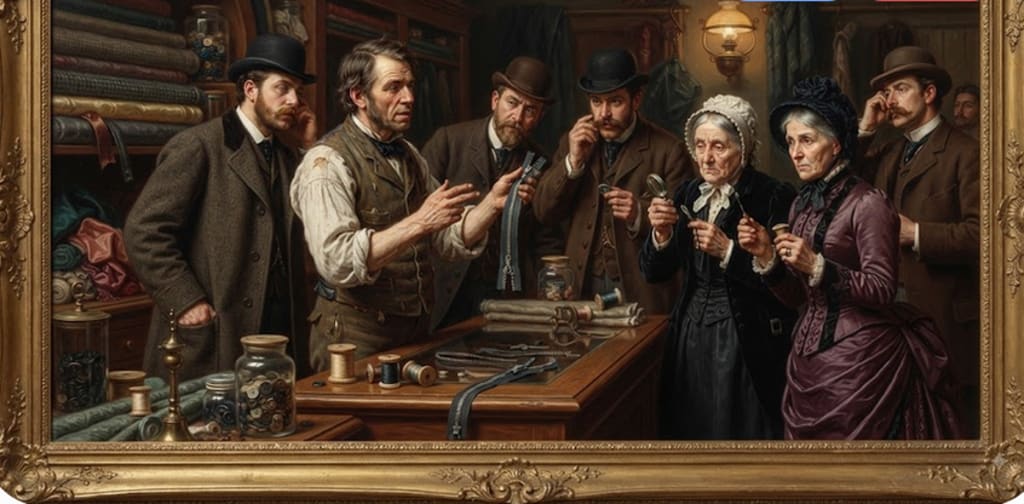
Yet, it took more than two long, frustrating decades of absolute failure, public skepticism, and technical disasters before a clumsy, unreliable system of hooks and eyes evolved into a global manufacturing standard. For a long time, the world simply looked at this revolutionary device and decided that old-fashioned string was infinitely better.
Before the widespread adoption of the zipper, the simple act of getting dressed or putting on footwear required significantly more time, dexterity, and patience than it does today. Undergarments, heavy tailored dresses, and thick winter coats were secured using long, exhausting rows of bone buttons, tiny metal hooks, or incredibly complex lacing systems. The worst situation by far was found in the footwear industry. The high, elegant leather boots worn by both men and women during the late Victorian era routinely featured dozens of microscopic metal eyelets. A person had to manually thread a long string through each individual hook every single morning—a tedious task that we now complete in a fraction of a second. Back then, simply putting on your shoes was a stressful daily ritual that took several minutes of intense bending and pulling.
The very first inventor who attempted to accelerate this annoying process was an American named Elias Howe. Famous as the creator of the modern sewing machine, Howe patented an "automatic continuous clothing closure" in 1851. However, because his sewing machine was already generating massive commercial success, he never spent the time or energy to market his closure system.
Forty years later, in 1891, a brilliant mechanical engineer named Whitcomb Judson stepped forward in Chicago to showcase an improved version of this concept, which he officially called the "clasp locker." Judson’s intricate system was specifically engineered for fastening high leather boots. It consisted of a parallel track of hooks and loops that were pressed together by a sliding metal guide. While the clever invention generated massive curiosity and excitement at the famous Chicago World's Fair in 1893, its practical real-world application was an absolute catastrophe. The heavy metal tracks routinely burst open while people were walking down the street. The tiny hooks easily bent out of shape under pressure, and the primitive slider jammed constantly. Tailors and shoemakers staged a widespread boycott of the product, flatly refusing to install an unpredictable component on expensive garments that routinely tore customers' fingers and ruined their luxury fabrics.
The true corporate and technological savior of the zipper was a Swedish-American engineer named Gideon Sundback. Hired as the chief designer for Judson’s rapidly bankrupting company, Sundback possessed the vision to realize that the flaw lay not within the slider itself, but within the layout of the teeth. In 1913, he patented a revolutionary system built on a completely new principle: interlocking metal teeth. Instead of bulky, clumsy hooks, Sundback arranged dozens of tiny identical metal profiles along flexible cloth tapes. Each profile featured a miniature valley on one side and a matching ridge on the other. As the slider moved along this track, it seamlessly forced the opposing teeth to nest into one another, creating a tight, continuous lock. This classic model, patented legally in 1917 as the Hookless No. 2, was light, exceptionally flexible, and completely secure under immense physical tension.
Yet, even though Sundback’s updated design was flawless, the conservative textile industry completely ignored his invention for another full decade. People were deeply comfortable with traditional buttons and viewed the metal slider as a passing gimmick.
The first massive commercial breakthrough for the zipper happened entirely by accident in 1923. An American rubber enterprise, the B.F. Goodrich Company, decided to install Sundback’s patented fastener onto their new line of heavy rubber galoshes designed for rainy weather. The president of the company, Bertram Work, was so captivated by the distinct, satisfying mechanical sound the slider made—zip!—that he officially christened the device the "zipper." By the early 1930s, the zipper finally shattered the walls of haute couture. Innovative French fashion designers began sewing the metal sliders onto children's clothing and men's trousers, celebrating the invention because it completely eliminated the embarrassing risk of buttons popping open on trouser flies.
Twenty long years of deep public mistrust were instantly replaced by a global manufacturing triumph. Even today, the history of the zipper serves as absolute proof that even the most brilliant, time-saving idea will fail to catch on until it successfully overcomes human habit and finds its perfect time, perfect audience, and perfect place.
Sources:
National Inventors Hall of Fame – Detailed biographical profiles of Whitcomb Judson and Gideon Sundback, archiving the original Hookless Fastener patents (1913–1917).
Hagley Museum and Library – Historical corporate records of the Talon Zipper Company (originally the Hookless Fastener Company) and research on early textile marketing strategies in the 1920s.
About the Creator
Enjoyed the story? Support the Creator.
Subscribe for free to receive all their stories in your feed.
Comments
There are no comments for this story
Be the first to respond and start the conversation.