
The Fascinating History of Radio: From Invisible Waves to a Global Revolution
Discover the incredible journey of radio—from scientific experiments and wireless communication to becoming one of the world's most powerful media platforms.

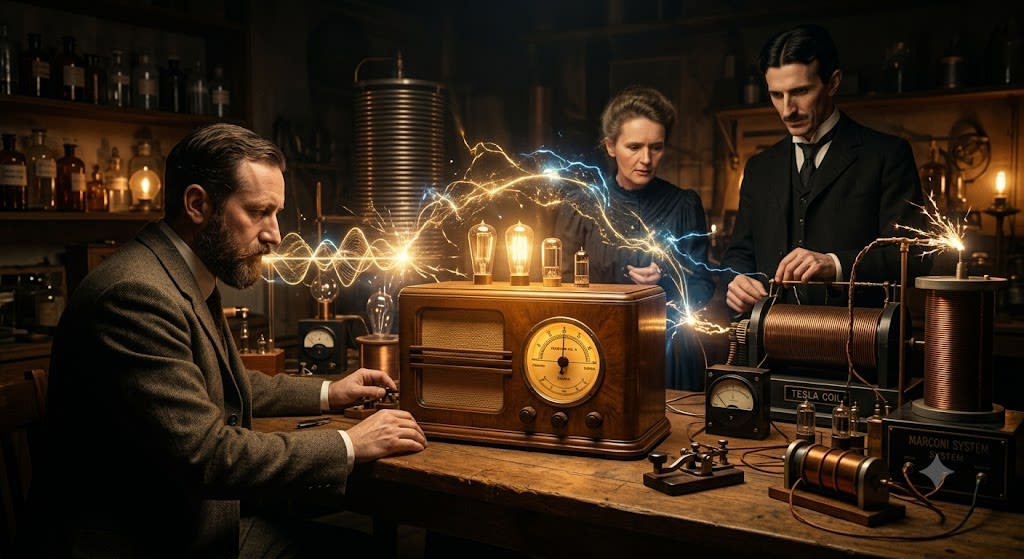
For many of us, radio is something we associate with music, news, and entertainment. Even today, stations like Radio Mirchi, Radio City, and FM Tadka continue to entertain millions of listeners. But have you ever wondered how radio was invented and how it became one of the most powerful communication tools in human history?
Before television became common, radio was the primary source of information and entertainment. Families gathered around radio sets to listen to news, songs, dramas, and important announcements. Owning a radio was once considered a matter of pride.
The Science Behind Radio
The story of radio did not begin with a single inventor. Instead, it was the result of the efforts of many brilliant scientists over several decades.
The foundation of radio technology was laid by British physicist James Clerk Maxwell, who proposed the existence of electromagnetic waves. His theories suggested that invisible waves could travel through space carrying energy.
Later, scientists such as Oliver Heaviside and Heinrich Hertz expanded upon Maxwell’s work. Hertz successfully demonstrated the existence of electromagnetic waves through experiments, proving that Maxwell’s theories were correct. His discoveries inspired researchers around the world.
Jagadish Chandra Bose and Early Wireless Experiments
One of the pioneers in wireless communication was Indian scientist Jagadish Chandra Bose. After studying Hertz’s work, Bose conducted groundbreaking experiments using electromagnetic waves.
In 1895, he demonstrated wireless communication by remotely ringing a bell and igniting gunpowder without using wires. Many historians believe Bose made significant contributions to the development of radio technology, and some even argue that he deserves greater recognition for his achievements.
Guglielmo Marconi: The Father of Radio
While Bose was conducting his experiments in India, an Italian inventor named Guglielmo Marconi was pursuing a similar dream.
Marconi believed that electromagnetic waves could be used to send messages over long distances without wires. Through years of experimentation, he successfully developed a practical wireless communication system.
His early demonstrations amazed audiences. Bells rang from a distance, signals crossed hills, and messages traveled farther than ever before without physical connections. By the late 1890s, Marconi had achieved wireless transmissions over increasingly large distances.
In 1896, he patented his wireless telegraph system, and his work earned him worldwide recognition. For this reason, Marconi is often officially credited as the inventor of radio.
The First Radio Broadcast
The next major milestone came in 1906 when Canadian inventor Reginald Fessenden made one of the first radio broadcasts.
On Christmas Eve, he transmitted music and speech through radio waves to ships in the Atlantic Ocean. Sailors who expected to hear only Morse code were astonished to hear a violin performance and a human voice coming through their receivers.
This historic moment marked the beginning of radio broadcasting as we know it today.
Radio’s Growing Importance
As radio technology improved, it became essential for communication, especially in the military and maritime industries. During times of war, radio played a critical role in transmitting information quickly across great distances.
Soon, broadcasting companies recognized radio’s potential. Organizations such as the BBC began using radio to deliver news, educational programs, and entertainment to the public.
Radio was transforming society.
The Birth of Radio in India
India’s radio journey began in the 1920s.
In 1924, the Madras Presidency Radio Club started one of the country's earliest radio broadcasting services. Although financial difficulties eventually forced the club to shut down, radio broadcasting continued to grow.
In 1927, a group of businessmen launched the Indian Broadcasting Company in Bombay and Calcutta. A few years later, the Government of India took control of broadcasting operations.
In 1936, the service was renamed All India Radio, which later became known as Akashvani in 1957.
Radio and India’s Freedom Movement
Radio also played an important role during India’s struggle for independence.
Leaders used radio broadcasts to spread messages and inspire people. The medium helped connect citizens across vast distances during one of the most significant periods in Indian history.
Its ability to reach large audiences quickly made radio an influential tool in shaping public opinion and spreading awareness.
The First Radio Stations
The world's earliest radio stations emerged in the early twentieth century. Experimental broadcasts gradually evolved into organized broadcasting networks.
By the 1920s, radio stations were operating legally and attracting growing audiences. Radio ownership expanded rapidly, and in some countries, people even needed licenses to own radio receivers.
What began as a scientific experiment had become a global communication revolution.
Radio in the Modern World
Although streaming services, podcasts, and social media dominate today's digital landscape, radio remains surprisingly resilient.
Millions of people still listen to FM stations while driving, working, or relaxing. In rural communities around the world, radio continues to provide news, education, weather updates, and entertainment.
Its simplicity, affordability, and accessibility have allowed radio to survive technological revolutions that replaced many other forms of media.
Conclusion
The history of radio is a remarkable story of curiosity, innovation, and human ingenuity. From Maxwell’s theories and Hertz’s experiments to Bose’s demonstrations and Marconi’s practical inventions, radio emerged through the contributions of many brilliant minds.
More than a century later, radio continues to connect people, share stories, and deliver information across the globe. It remains one of humanity’s most influential inventions—a technology that transformed communication forever.
About the Creator
parwinder singh
🎬 Movie & Entertainment Writer sharing reviews, ending explanations, story breakdowns, plot twists and hidden details from Bollywood, Hollywood, South Indian cinema, Korean dramas and OTT releases.
Enjoyed the story? Support the Creator.
Subscribe for free to receive all their stories in your feed.
Comments
There are no comments for this story
Be the first to respond and start the conversation.