
The CIA’s Most Genius Invention: How They Rigged the World’s “Secure” Secrets for Decades
Inside Operation Rubicon - the breathtaking intelligence coup where a humble Swiss encryption company became the ultimate Trojan horse for Western spies.

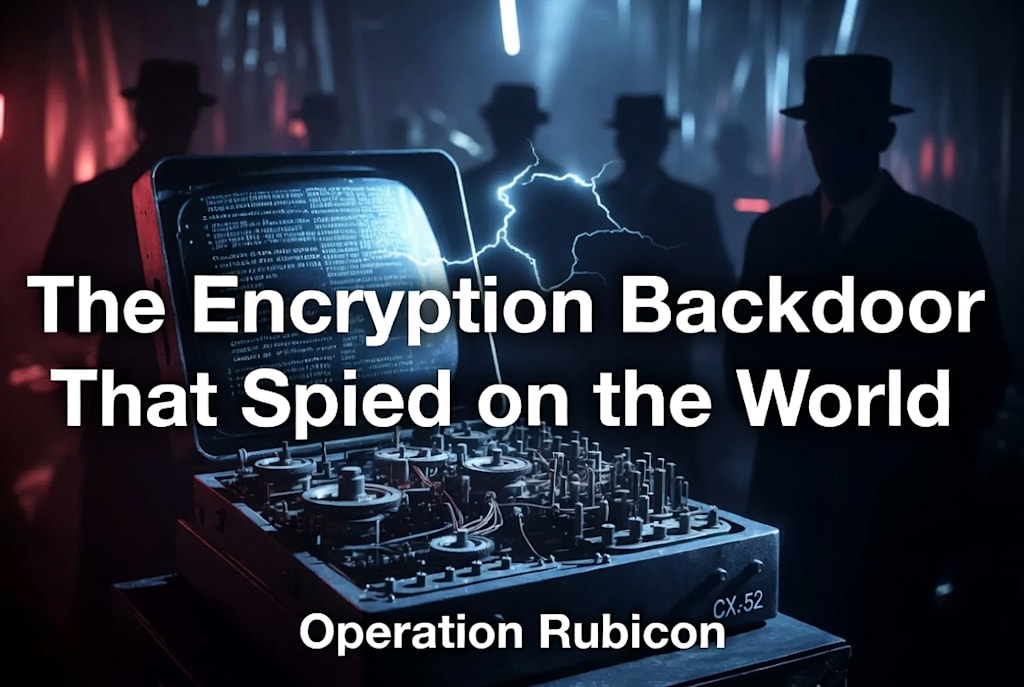
Ever sat there staring at your phone, wondering just how safe your “encrypted” messages really are? Now imagine entire governments feeling that same false sense of security… only to discover decades later that their most trusted encryption tools were quietly whispering every secret straight to the CIA.
It’s 1979. The Iranian Revolution is in full chaotic swing. Students have stormed the U.S. Embassy in Tehran, taking 52 Americans hostage in a crisis that drags on for 444 agonizing days. President Jimmy Carter is burning the midnight oil, negotiating through Algerian mediators. Every sensitive backchannel message between Algeria and Iran is supposedly locked tight with state-of-the-art encryption. Yet time after time, Carter seems to know exactly what the Iranians are thinking, what they’re bluffing about, and where they might bend. How?
The answer wasn’t a mole inside the embassy or some Hollywood-style bug. It was something far quieter, far more elegant. A Swiss company called Crypto AG had sold “unbreakable” cipher machines to Iran and half the world. But those machines had a secret. A very intentional one. Welcome to Operation Rubicon - quite possibly the smartest, longest-running intelligence play of the entire 20th century.
You know, stories like this always leave me with this weird cocktail of emotions. Part of me feels this grudging admiration - damn, that’s clever. Another part feels a chill. Because if they could do this to governments with billions at stake, what does it say about the systems we trust today?
The Handshake That Started It All
Let’s go back to 1951. Washington D.C., the exclusive Cosmos Club. Two men sit across from each other over dinner: William Friedman, America’s legendary cryptologist, and Boris Hagelin, a brilliant Swedish inventor who’d already made a fortune selling cipher machines to the U.S. during World War II.
Hagelin’s M-209 was a tough little mechanical marvel - no batteries, compact enough for soldiers to carry into battle. It worked brilliantly. But after the war, business dried up. Hagelin wanted new markets. Friedman saw the nightmare scenario immediately: What if this guy starts selling his best stuff to the Soviets, to neutral countries, to anyone with cash? America would suddenly be deaf to the world’s most important conversations.
So Friedman made a proposal on behalf of the emerging intelligence community. Sell your strongest machines only to countries the U.S. approved. Everyone else gets deliberately weaker versions. In exchange? A nice payout - reportedly around $700,000 - and continued prosperity. Hagelin eventually moved operations to Switzerland and founded Crypto AG. On paper, a neutral Swiss firm. In reality? A masterpiece of strategic infiltration.
How the Machines Actually Worked (And How They Were Broken)
I have to admit, there’s something almost beautiful about these old mechanical cipher devices.
Take the famous CX-52. You’d set a daily key, then a message-specific key. Feed in letters one by one, crank the handle, and out comes a strip of seemingly random gibberish. The recipient, with identical settings, reverses the process. Simple in concept, fiendishly complex in execution.
But here’s the thing with mechanical systems - they aren’t truly random. They follow intricate but predictable patterns if you understand the internals. And the CIA and Germany’s BND (after they secretly bought half the company in 1970) understood them perfectly. They designed in subtle weaknesses. They controlled the algorithms. They even sent “maintenance” teams that could tweak machines during service calls.
There was a one-time pad version using truly random perforated tape that was basically unbreakable. But most customers never got that model. They got the ones with built-in doors.
The Global Reach and Real-World Impact
For over 50 years, this gave the U.S. and West Germany an insane advantage.
During the Falklands War in 1982, Britain (and its allies) gained crucial insights. In the bloody Iran-Iraq War, both sides were using Crypto AG gear - imagine the strategic edge that provided. Dictators, terrorists, allies, and rivals alike were unknowingly broadcasting their plans. Even the Vatican’s communications reportedly helped the U.S. track Manuel Noriega.
Greg Miller, the Washington Post journalist who helped expose the story in 2020, said some intelligence veterans were annoyed when it came out. Others just smiled and said, “Yeah… that’s what we do.” You can almost hear the pride mixed with the shrug.
The Moral Tightrope
Here’s where I pause and get reflective. On one level, this operation was brilliant. It likely prevented attacks, saved lives, and helped navigate the Cold War without things spiraling into something far worse. Intelligence work like this can be the difference between peace and catastrophe.
But on another? Trusted “neutral” Swiss technology turned out to be a global backdoor. How many diplomatic missteps, lost battles, or innocent people suffered because leaders thought they were speaking privately? It’s the classic intelligence dilemma - ends versus means. When does protecting your side justify undermining trust on a planetary scale?
It makes you wonder about our modern world. We argue endlessly about encryption backdoors, government access, and tech company cooperation. History shows that when agencies really want in, they often find creative ways. Sometimes they just own the lock factory.
The Legacy That Still Echoes
Eventually the operation wound down. Leaks, investigations, and changing times forced changes. Crypto AG rebranded and changed hands, but the damage to blind trust in “secure” systems was permanent. Switzerland’s image of pristine neutrality took a hit too.
Yet the core lesson remains powerfully relevant: Technology is never neutral. The people who design it, control it, and sell it shape what can truly be hidden.
So tell me - where do you draw the line? In a dangerous world full of real threats, is something like Operation Rubicon justifiable? Or does building systematic deception into global infrastructure ultimately make everyone less safe? The next time you hear promises about “military-grade encryption” or “unbreakable security,” remember this story. Sometimes the most genius inventions aren’t the ones that protect secrets. They’re the ones that steal them so quietly, so elegantly, that it takes generations to notice.
And honestly? That’s both terrifying… and kind of brilliant.
About the Creator
KWAO LEARNER WINFRED
History is my passion. Ever since I was a child, I've been fascinated by the stories of the past. I eagerly soaked up tales of ancient civilizations, heroic adventures.
https://waynefredlearner47.wixsite.com/my-site-3
Enjoyed the story? Support the Creator.
Subscribe for free to receive all their stories in your feed.
Comments
There are no comments for this story
Be the first to respond and start the conversation.