
The Battle of Alesia: Caesar vs. Rome, Gaul vs. The Vercingetorix
The actual Battle of Alesia

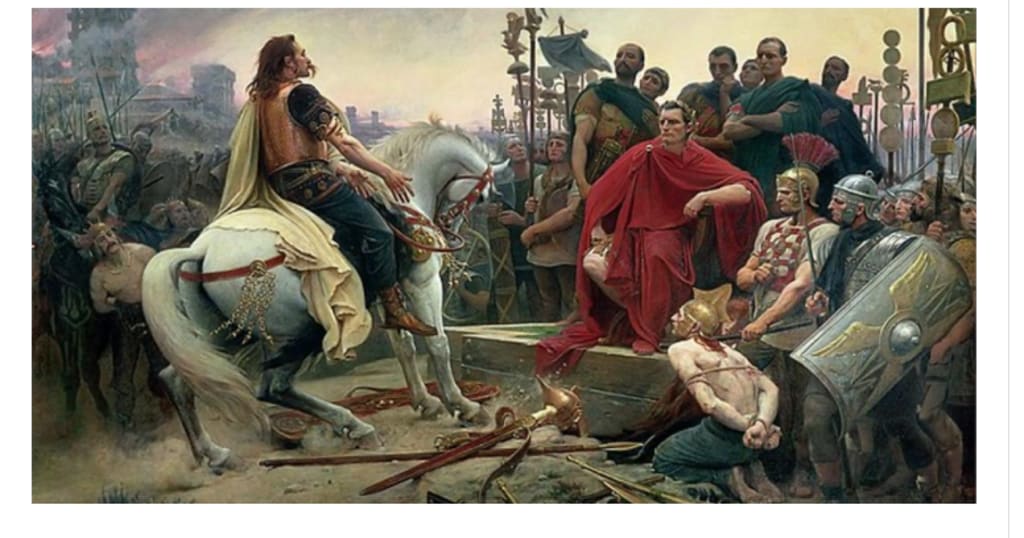
An important turning point in Julius Caesar's conquest of Gaul was the Battle of Alesia, which took place in 52 BC. In this battle, the Gallic tribes led by Vercingetorix faced off against Caesar's Roman armies. Caesar's strategic acumen was tested throughout the conflict, which was fought close to the fortified hilltop town of Alesia.
Caesar defeated a numerically superior foe using a combination of siege warfare and tactical manoeuvres, which ultimately resulted in Roman dominance of Gaul. Caesar's military reputation was solidified by the victory at Alesia, which also greatly increased the area of the Roman Republic.
In Gaul, Julius Caesar
Some history is necessary before we move on to the actual conflict. In 58 BC, Julius Caesar launched his campaign in Gaul. It was motivated by both political ambition and the ongoing desire to increase Roman influence, as like many of Rome's conflicts. Gaul, which included sections of Belgium, Switzerland, Italy, and modern-day France, was home to a number of problematic Celtic tribes. The region was ripe for Roman involvement since the tribes fought each other as much as they did strangers.
Caesar first became involved in response to the Helvetii, a Gallic tribe, migrating, but his goals soon expanded. Caesar carried out a number of military expeditions throughout the ensuing years, conquering the Belgae and the Nervii, among other Gallic tribes. His campaigns were characterised by a mix of brutal efficiency, force, and diplomacy.
He was mostly successful in subduing Gaul under Roman rule by 52 BC. But there was still turmoil. Vercingetorix, a chieftain of the Arverni tribe who had become the head of a large-scale Gallic uprising, was in charge of that disturbance.
He had succeeded in bringing the Gallic tribes together in a desperate attempt to fend off Roman rule, something that a few chieftains had done before him. Vercingetorix attempted to repel Caesar's army and end the Roman rule over Gaul during the siege of Alesia, which marked the end of this uprising.
The Preparation
Caesar found himself on the defensive as the uprising swiftly gathered traction under Vercingetorix. Vercingetorix's preferred plan was to pull the Romans into unfavourable territory and deny them supplies by using scorched earth policies and guerilla tactics. It was an effective strategy, as Vercingetorix withdrew to the fortified town of Alesia following a number of skirmishes, including a pivotal battle at Gergovia where Caesar suffered a rare defeat.
Alesia was picked due to its advantageous position. It was perched on a high plateau encircled by the Ose and Ozerain rivers and steep hills. The Gallic leader thought he could withstand a protracted siege until reinforcements could arrive thanks to these natural defences and the size of his army.
Caesar naturally chose to lay siege to Alesia because he enjoyed a good siege and understood how crucial it was to smash this final major opposition. As both leaders readied themselves for the approaching battle, the stage was set for one of the most remarkable military encounters in ancient history.
The Siege of Alesia by Caesar
Many people consider the siege of Alesia to be the ideal example of what a siege ought to be. Caesar chose the gradual, deliberate approach after realising that he had little chance of capturing Alesia by force due to its strong natural defences. He would subdue the city's defenders by starvation.
The Roman commander gave the order to build a double line of fortifications around the town, a strategy known as contravallation and circumvallation. The outside barrier, which was about 21 kilometres (13.04 miles) long, was intended to repel any Gallic reinforcements, while the inner line, which was roughly 18 kilometres (11.18 miles) long, was intended to keep the besieged Gauls from fleeing. The citizens of the city were totally cut off from Vercingetorix and his soldiers.
Caesar's defences featured watchtowers, palisades, and ditches that were carefully designed to stave off attacks. The Roman soldiers had to travel great distances to collect the timber, making it an enormous task. Despite persistent harassment from the Gauls, who attacked the labourers in sorties, the Roman legions put up endless effort to finish these defences.
Ultimately, the siege was short-lived. Despite having few resources, Alesia was able to support an additional 80,000 warriors in addition to its regular population. Vercingetorix rationed all of the grain that was brought to him from the city. It was resolved during a committee that the soldiers come first. The sick and elderly were told to leave the town. The ladies and children trailed behind them.
Vercingetorix foolishly thought the Romans would be merciful. Caesar instead left the villagers stranded in no man's land by refusing to let them to cross his recently constructed fortifications. Vercingetorix, for his part, left his own people to perish in the open after refusing to offer them any pity. Morale suffered as a result.
Vercingetorix dispatched emissaries to mobilise a relief force from the Gallic tribes during this time. An enormous Gallic army, thought to number up to 250,000 fighters, was raised in retaliation. Vercingetorix was running out of time, even though the siege had just lasted a month. In order to prevent Roman annexation of Alesia, he had to hope that his relief force might breach Caesar's outer defences.
The actual Battle of Alesia
Early in October of 52 BC, the Battle of Alesia began. When Vercingetorix's enormous Gallic relief force came and swiftly encircled Caesar's outer defences, his prayers were heard. Caesar was now caught between two opposing forces. Vercingetorix took advantage of this by launching a concerted attack from inside Alesia as the rescue force attacked the Roman walls from the outside.
Caesar's army was dangerously small and outnumbered. He hardly had enough soldiers to protect two fronts, much less one. The constant Gallic attacks put the Roman defences to the test time and time again, but Caesar's disciplined and seasoned soldiers held their position. Caesar personally advanced along the lines, encouraging his soldiers and leading vital counterattacks.
Caesar was on the verge of catastrophe at the height of the conflict when the Gallic forces focused their efforts on breaching his western defences. Caesar personally led a reserve force, which included his superior Germanic cavalry, to strengthen the position after realising the threat. This bold move changed the course of the conflict. After fending off the assault, the Roman cavalry launched a counteroffensive against the Gallic relief army.
attacking from behind and frightening the Gauls.
Alesia's defenders' morale was destroyed when Vercingetorix's relief force broke up. The next day, their leader gave up after realising that resistance was pointless. The battle of Alesia became a pivotal point in Caesar's ascent to power, and his surrender signalled the end of organised Gallic resistance to Roman rule.
Consequences
Both Julius Caesar's career and the Gallic Wars underwent a sea change following the Battle of Alesia. Vercingetorix's capitulation essentially put an end to the Gallic revolt and solidified Roman rule over Gaul. Caesar was able to fully annex the area and incorporate it into the Roman Republic as a result of the victory. Roman power and territory were greatly increased by this conquest, which also brought enormous wealth and
After being captured, Vercingetorix was publicly humiliated by being exhibited during Caesar's victory in Rome. In the end, he was put to death, signifying the finality of Rome's triumph over the Gauls. The Roman soldiers who had fought in the conflict received the majority of his men as slaves.
Caesar's status as one of Rome's finest military leaders was strengthened by the victory at Alesia. Additionally, it prepared the way for his ultimate return to Rome, where his increasing influence and authority would kick off a chain of events that resulted in the fall of the Roman Republic and the establishment of the Roman Empire.
The Battle of Alesia was undoubtedly one of Julius Caesar's greatest military triumphs. It demonstrated not only his tactical skill and military prowess but also the great loyalty and power of his Roman legions. In addition to securing Roman dominance over Gaul, this resounding triumph profoundly changed the trajectory of Roman history.
Caesar's reputation as one of the greatest military commanders in history was cemented by his strategic acumen throughout the siege and battle. Gaul's assimilation into Roman society was made possible with the defeat of Alesia, which signalled the end of organised Gallic opposition. Caesar was also pushed toward the political power battles that would ultimately transform the Roman Republic into an empire by the outcome of the conflict.
About the Creator
Enjoyed the story? Support the Creator.
Subscribe for free to receive all their stories in your feed.
Comments
There are no comments for this story
Be the first to respond and start the conversation.