World History
Five Titanic Disasters Before The Iceberg
Titanic will remain one of the most infamous sea disasters ever. Many documentaries, films and books exist on the subject. However, there are five other disasters that occurred to the fated ship, before it hit the iceberg. Here are the five, not so famous problems, Titanic had.
By Sam H Arnold3 years ago in History
Britain's Enduring Presence in Aden
Introduction: Aden, a coastal city in southern Yemen, bore witness to decades of British occupation that left an indelible mark on its history. The motivations behind Britain's prolonged presence in Aden are multifaceted, reflecting a complex interplay of geopolitical, economic, and strategic considerations. In this article, we delve into the reasons why Britain chose to occupy Aden for such an extended period.
By xbroken_hearted3 years ago in History
The Day That JFK was Assassinated Changed My Opinion on 22 November 1963
I really can’t believe that its 60 years since John F Kennedy was assassinated — I remember that day so well. But it was an article written around the 30th anniversary after that fateful day, that got me ‘Hooked’ into Astrology.
By Pamella Richards3 years ago in History
Palestine. The story
alestine and Israel - it’s complicated. Many people want us to believe that it's just a tit for tat conflict of rockets, a real estate dispute, or a centuries-old religious feud. However, there is much more to the story that we all should understand. So, how did we get to this point? Let's go back to the beginning. It all started with the end of World War I, internal conflicts within the Muslim community, and a promise made by the Western powers just a century ago. In 1916, the first World War was in full swing. The 617-year-old Ottoman Empire was on the verge of collapse. The British and the French had promised the Arabs sovereignty and Arab leadership over the Arabian peninsula and the Levant if they helped them defeat the Ottomans. And so the Arab’s said ‘Ok’… and so they helped them defeat the Ottomans. I understand your concern, but let's focus on the historical context. After the British and the French emerged victorious, the Arabs sought the land promised to them. However, unbeknownst to them, the British and the French had a clandestine meeting. During this meeting, they planned to divide the captured Ottoman province into areas of their control and influence. The British were to receive Palestine, Jordan, and Southern Iraq, while the French would control southeastern Turkey, northern Iraq, Syria, and Lebanon under the Sykes-Picot agreement. When the Arabs discovered this agreement, they were astonished and felt deceived. They had fought to overthrow their non-Arab Muslim rulers, only to be ruled by European colonial powers instead. Meanwhile, as the British occupied Palestine, a significant development unfolded in Europe. The Zionist movement had gained influence and advocated for the mass migration of Jews to Palestine, asserting a Jewish claim to the land. In 1917, Britain unexpectedly announced its plan to establish a national home for the Jewish people in Palestine. This decision resulted in the transfer of control of Palestine, a land predominantly inhabited by Palestinians, to European Zionists. The reasoning behind Britain's decision continues to be a topic of debate among historians. Despite the fact that the Jewish population in Palestine was less than 10 percent at the time, the British facilitated the immigration of European Jews to the region between 1922 and 1935, resulting in a significant increase in the Jewish population to 27 percent. As the British Mandate was enforced, the influx of European Jewish immigrants led to the seizure of more land, causing growing concern among the native Palestinian population. Despite their protests to the British authorities, the settlement of European Jews continued to escalate. The British proposed the partition of Palestine and even suggested the forced removal of the Arab population from their homes. Their intention was to resolve the issue, but the Palestinians rejected and revolted against the British. The revolts led to violent suppression, resulting in the deaths of thousands of Palestinians. Despite this, the Palestinians persisted in their fight for independence, leading the British to transfer their responsibility for Palestine to the United Nations in 1947. The UN proposed the partition of Palestine into Jewish and Arab states, with the Jewish population, constituting only one-third of the total population, being allocated 55% of the land. The Arabs rejected the proposal, feeling unfairly treated, while the Zionists accepted it but contested the proposed borders and sought additional land. By 1948, Zionist militias captured Palestinian villages and cities, displacing thousands of Palestinians. Upon the official withdrawal of British forces, Israel was declared a state, leading to the mass displacement of Palestinians. The United States and the Soviet Union swiftly recognized the new state of Israel. May 15, 1948 marked the Nakba, or the catastrophe, as millions of Palestinians lost their country and were subjected to ethnic cleansing and near-total destruction. The creation of Israel not only resulted in the forced displacement of 1.9 million Palestinians and the loss of 78% of historic Palestine, but also led to the destruction of 530 villages and the killing of 15,000 Palestinians in mass atrocities. This marked the beginning of over 70 years of occupation, home demolitions, arrests, displacements, Israeli expansion, military checkpoints, walls, discrimination, massacres, and bombings of innocent civilians. The Palestinians have endured oppression, loss of homes, and ongoing suffering, underscoring the significance of reflecting on this history to prevent its repetition. Because god knows we don’t need it to happen again in another part of the world. May Allah lift the pain and the struggles from our Palestinian borthers and sisters. Ameen.
By omar mkram3 years ago in History
Shipwrecks of Ocean Island / Banaba: PART TWO
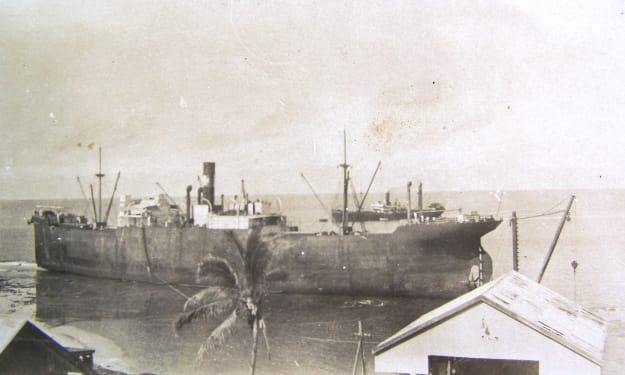
The following information was provided by Captain Brant, Master of SS ROWANBANK, which loaded phosphate at Ocean Island (Banaba) on 20 April 1967. It was a sentimental journey recalling his time as serving as second mate aboard SS TITENBANK which sailed from Nauru to Ocean Island to stand by at the time SS KELVINBANK went on the reef 14 years before. Captain Brant supervised the salvaging of Bank Line stores from the stricken ship." [1]
By Stacey King3 years ago in History
Shipwrecks of Ocean Island / Banaba: PART ONE
The following information was provided by the late British Phosphate Commission (BPC) employee, Roger Anderson. The original article was written by Captain John Marine Fisk. Captain Fish had been Master of one of the BPC charter ships, KOMATA, which was sun at Nauru by the German Raiders in December 1940. He became the master of the RIVER BURDEKIN that liberated Nauru and Banaba after the War. [1]
By Stacey King3 years ago in History
India and Pakistan – the transformation of their border today
The Golden Temple, a radiant symbol of Sikhism situated in the heart of Amritsar, serves as a magnetic force attracting devotees from diverse corners of the globe. Pilgrims undertake profound journeys to immerse themselves in the sanctifying waters surrounding the temple, to behold the sacred pages of the Holy Book housed within its golden walls, and to absorb the palpable holiness exuding from every corner of this spiritual haven. This revered place stands as the epicenter of Sikhism, a faith steeped in history and tradition.
By Punove Powae 3 years ago in History
A Bollywood star who falls in love with a Hollywood actress, but has to deal with cultural differences and media scrutiny.. Content Warning.
The sprawling city of Mumbai lay beneath me as I stepped out onto the balcony of my penthouse apartment. The vibrant energy of Bollywood pulsed through the streets, but my thoughts were elsewhere. I had just returned from a Hollywood film shoot, and amidst the glitz and glamour, an unexpected twist awaited me—an encounter that would redefine the boundaries of love and challenge the very essence of cultural differences.
By Nexus Narrator3 years ago in History