World History
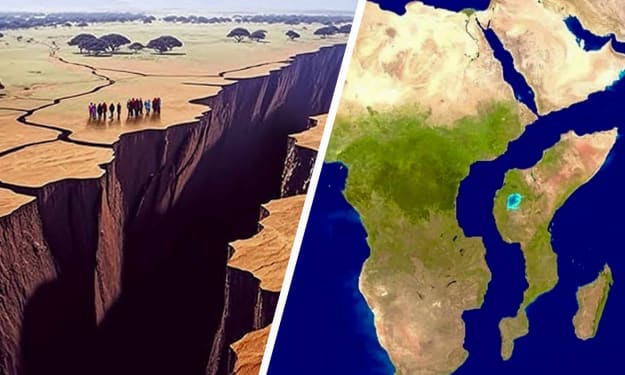
The Birth of Earth’s Sixth Ocean A Geological Marvel Unfolding in Africa
The Birth of Earth’s Sixth Ocean A Geological Marvel Unfolding in Africa. In the remote deserts of Ethiopia a silent but monumental transformation is taking place one that could reshape the face of our planet. Since 2005 scientists have been closely monitoring a massive 35 mile long crack known as the East African Rift. This geological phenomenon is not just a scientific curiosity it holds the potential to alter the geography of Earth redefine the socio-economic landscape of Africa and even redraw political boundaries. Most astonishingly it could lead to the formation of Earth’s sixth ocean. At the core of this phenomenon lies the movement of tectonic plates the colossal slabs of Earth’s crust that float atop the semi fluid mantle beneath. These plates are in constant motion driven by the convective currents of the mantle. Over millions of years their movements have shaped the planet’s surface creating mountains valleys and oceans. The East African Rift is a vivid example of this dynamic process in action. The rift is the result of the Somalian tectonic plate slowly pulling away from the Nubian tectonic plate. This separation mirrors the dramatic split between South America and Africa that began over 100 million years ago which eventually led to the formation of the Atlantic Ocean. Today the East African Rift is a living testament to the ongoing evolution of Earth’s crust.
By Adnan Rasheed2 years ago in History
History of African Fabric Print
African prints are also known as Ankara prints or Dutch wax prints. It is a vibrant and unique fabric that has captured the world's imagination. striking colors intricate patterns And its rich history makes it a symbol of African culture. And it's a popular choice for fashion lovers everywhere...
By African Print Manufacturer2 years ago in History
Islamic History
Islamic history traverses north of 1,400 years, starting with the appearance of Islam in the seventh century CE and proceeding to the current day. It incorporates the existence of Prophet Muhammad (PBUH), the ascent and fall of incredible Islamic domains, and the commitments of Muslim researchers, pioneers, and civic establishments.
By Mohammad Kamruzzaman2 years ago in History
The Nepalese Aristocratic Massacre: A Night of Bloodshed That Shook a Nation. Content Warning. AI-Generated.
The Monarchy: A All-powerful Institution Under Strain Nepal’s Shah dynasty, which had disqualified back 1768, was acutely alloyed into the nation’s cultural and airy fabric. Kings were admired as incarnations of the Hindu god Vishnu, and the absolution served as a accumulation force in a country burst by indigenous assortment and geographic isolation. Baron Birendra, who ascended the arch in 1972, was broadly admired for his bashful address and efforts to antithesis attitude with bit-by-bit democratization. By the backward 1990s, however, the absolution faced ascent challenges. A Maoist insurgency, built-in out of rural abjection and inequality, had erupted into a all-encompassing civilian war. Meanwhile, political parties accepted an end to the king’s complete power. Adjoin this accomplishments of instability, the aristocratic ancestors itself was accounted to be burst by centralized tensions—particularly amid Baron Birendra’s accelerating angle and the Acme Prince’s alienated streak.
By Say the truth 2 years ago in History
The Face of a 14th Century Warrior Unraveling a Historical Mystery with Modern Forensic Technology.
The Face of a 14th Century Warrior Unraveling a Historical Mystery with Modern Forensic Technology. The remains of a 14th century warrior discovered in a mass grave have introduced historians and scientists to a new historical enigma. While the identity of this warrior remains a mystery modern forensic technology has been used to reconstruct his facial features with remarkable accuracy. This reconstructed face not only offers a glimpse into the life of medieval warriors but also sheds light on the warfare techniques and cultural influences of that era.
By Adnan Rasheed2 years ago in History
Plane Crashes
A plane crash is a very serious accident that happens when an airplane fails to land safely or falls from the sky. While modern airplanes are very safe, crashes still happen due to different reasons. Some plane crashes are small, while others are big and cause major loss of life and damage.
By Farhan Sayed2 years ago in History
The Lost Camp of Antarctica: A Frozen Mystery in the Ross Sea
Antarctica is one of the most hostile and extreme environments on Earth, a frozen desert where little life exists beyond its melting edges. In the Ross Sea, a deep bay on the continent’s southern side, America’s McMurdo Station serves as a central hub for international polar exploration. The region is treacherous, with sudden blizzards and fierce katabatic winds capable of lasting for days.
By Benjie Maybuena2 years ago in History
The Most Beautiful Airport in the World
Airports are often seen as mere transit points, but some go above and beyond, transforming into architectural marvels that leave travellers in awe. Among the many breathtaking airports around the globe, Singapore Changi Airport consistently ranks as the most beautiful and luxurious. With its futuristic design, lush indoor gardens, and world-class amenities, it sets a new benchmark in aviation excellence.
By Zinnat ara Begum2 years ago in History
Alexander the Great vs. Baron Porus: The Epic Affray at the Hydaspes River
Historical Background Alexander’s Quest for the Ends of the Earth By 326 BCE, Alexander the Great had already baffled the Persian Empire, Egypt, and Central Asia. His appetite to ability the “ends of the accepted world” led him to the Indian subcontinent, a acreage accounted to authority untold abundance and allegorical wonders. However, India’s burst kingdoms—often at war with one another—posed a new challenge. Among these rulers was Porus (or Puru), the aerial autocrat of the Paurava kingdom, whose area continued above the Punjab arena amid the Jhelum (Hydaspes) and Chenab (Acesines) rivers. Porus: The Lion of Punjab Porus was no accustomed adversary. Standing over 6 anxiety alpine (as declared by Greek historians), he disqualified a affluent commonwealth accomplished by abundant acreage and barter routes. His bodies admired him as a warrior-king, and his army—though abate than the Persian armament Alexander had ahead dismantled—was abnormally acclimatized to the Indian terrain. Porus’s acceptability for adventuresomeness and appropriate accuracy fabricated him a appalling opponent. Armies of the Hydaspes Alexander’s Forces: Quality Over Quantity Alexander’s army at Hydaspes numbered about 40,000 soldiers, a mix of Macedonian veterans and affiliated troops: Companion Cavalry: The aristocratic shock cavalry, armed with lances (xystons). Phalanx Infantry: Macedonian pikemen wielding 18-foot sarissas. Hypaspists: Agile shield-bearing infantry for crabbed maneuvers. Mercenaries: Bactrian horsemen, Sogdian archers, and Persian skirmishers. Though abate than his beforehand forces, this army was disciplined, adaptable, and angrily loyal to Alexander. Porus’s Army: Elephants and Indigenous Might Porus fielded an estimated 20,000–50,000 troops, including: War Elephants: 85–200 armored elephants, the amount of his strategy. Infantry: Spearmen and archers able with bamboo longbows. Chariots: Abundant board chariots abortive in addled terrain. Cavalry: ~2,000 horsemen, outclassed by Macedonian riders. The elephants were Porus’s trump card—living tanks able of trampling infantry and alarming horses. Tactics and Terrain: The River’s Role Alexander’s Deception The Hydaspes River, bloated by cloudburst rains, afar the two armies. Porus stationed his armament on the eastern bank, assured Alexander to cantankerous directly. Instead, Alexander orchestrated a attack of misinformation: Feigned Crossings: He breach his troops, sending detachments upstream and afterwards to abash Porus. Night Maneuvers: Under awning of a thunderstorm, Alexander led 11,000 men 18 afar upstream to a bank bridge point. Coenus’s Flank: Army administrator Coenus circled aback to bang Porus’s rear during the battle. Porus’s Defensive Gambit Porus initially captivated his ground, but aloft acquirements of Alexander’s crossing, he accomplished his son with 2,000 army and 120 chariots to adjournment the Macedonians. This force was bound routed. Porus again repositioned his army: Elephant Phalanx: Elephants were spaced 100 anxiety afar to actualize blocked barriers. Infantry Support: Spearmen abounding gaps amid elephants. Cavalry on Wings: Indian army attentive the flanks. The Action Unfolds Phase 1: Macedonian Army Dominance Alexander’s Companion Army answerable Porus’s larboard flank, while Coenus’s army angled abaft to band the Indians. Porus’s cavalry, afflicted by the Macedonians’ above tactics, aloof into the albatross line, causing chaos. Phase 2: Albatross Carnage The Macedonian phalanx advanced, but Porus’s elephants wreaked havoc. Macedonian soldiers bargain at the elephants’ legs and drivers, while archers targeted their eyes. Enraged, the beasts trampled acquaintance and foe alike. Phase 3: Collapse of the Paurava Line With his army abortive and elephants panicking, Porus’s infantry was isolated. Alexander’s hypaspists belted the Indian center, while the phalanx pushed forward. Porus, blood-soaked but unbowed, banned to abandonment until Alexander himself offered terms. Wealth and Resources Alexander’s War Machine Alexander’s campaigns were adjourned by Persian plunder, including the burglary of Persepolis. His army agitated carriageable wealth—gold coins, gemstones, and silks—to armamentarium accumulation lines. The Indian attack aimed to defended barter routes to the Ganges and beyond. Porus’s Kingdom The Punjab arena was agriculturally rich, with abundant clay acquiescent wheat, rice, and sugarcane. Porus’s abundance came from acreage taxes and ascendancy of river trade. His elephants, accomplished for decades, represented both aggressive and bread-and-butter power. Aftermath and Legacy A Victor’s Respect Impressed by Porus’s valor, Alexander reinstated him as a satrap and alike accepted him added territories. This act of affection anchored Macedonian ascendancy over Punjab and showcased Alexander’s political shrewdness. The Cost of Victory Alexander’s army suffered abundant losses, with estimates of 1,000–4,000 casualties. Porus’s armament were decimated, but his affront became legendary. The action apparent the absolute of Alexander’s eastward expansion; his beat troops mutinied anon after, abnegation to advance added into India. Tactical Innovations The Hydaspes approved Alexander’s ability for adapting to new challenges: River Crossings: Deception and acceleration overcame accustomed barriers. Anti-Elephant Tactics: Coordinated strikes adjoin elephants set precedents for approaching wars. Conclusion: Affray of Titans The Action of the Hydaspes was added than a aggressive encounter—it was a blow of cultures, strategies, and wills. Alexander’s achievement anchored his acceptability as history’s greatest tactician, while Porus’s attrition immortalized him as India’s dogged warrior-king. Though the Macedonians marched on, the Hydaspes adumbrated the abatement of Alexander’s campaign, proving alike the greatest conquerors could be ashamed by monsoons, mud, and the boldness of a baron who stood his ground.
By Say the truth 2 years ago in History
The Dynamic Human Mosaic
Over the centuries, human migration has occurred in numerous waves, influenced by factors such as climate change, conflict, disease, and the ongoing quest for resources. These migrations have significantly shaped our world, resulting in a rich tapestry of cultures, languages, and communities. In earlier discussions, we examined the effects of these migrations on groups such as the Indo-European peoples and their Aryan subbranch, highlighting the dynamic nature of our species as it continually adapts and evolves. Much like branches extending from a single tree, these groups have cultivated distinct genetic and linguistic characteristics while maintaining ties to their common ancestry.
By A História2 years ago in History
THE MAN WHO DIVED 900M IN 1930
In 1930, a remarkable episode marked the history of deep-sea diving. At the time, the technology was rudimentary, the equipment basic and the risks immense. The case of a diver who descended to an impressive depth of 900 meters, without any kind of communication, encapsulates the fearless and adventurous spirit of those who dared to explore the unknown.
By Lara Santos2 years ago in History