World History
The Deadliest Day in Human History When January 23, 1556 Took Hundreds of Thousands of Lives. . Content Warning.
The Deadliest Day in Human History When January 23, 1556 Took Hundreds of Thousands of Lives Throughout history many tragic events have claimed countless lives but January 23, 1556 stands out as the deadliest day ever recorded. On this fateful day a catastrophic earthquake struck Shaanxi province China killing an estimated 830,000 people the highest known death toll from a single earthquake and possibly the deadliest event in a single day in human history. This earthquake known as the Jiajing Earthquake was not only the most devastating in Chinese history but also the most lethal natural disaster ever documented. Entire cities were reduced to rubble mountains crumbled and the very landscape of China was altered within minutes.
By Adnan Rasheed2 years ago in History
U.S. Defense Agency Bans Black History Month and Other Special Observances.
U.S. Defense Agency Bans Black History Month and Other Special Observances. Washington D.C The U.S Defense Intelligence Agency DIA has officially suspended all activities and events related to Martin Luther King Jr. Day Black History Month Juneteenth LGBTQ Pride Month Holocaust Remembrance Day, and other special observances. This move is in compliance with an executive order signed by President Donald Trump aimed at eliminating diversity equity and inclusion DEI programs across the federal government. This information was revealed in an internal memo obtained by NBC News. According to the directive 11 different observances and related activities have been banned. Additionally all employee networking groups and affinity groups have been immediately put on hold. These groups which have long existed in federal agencies were intended to create a supportive and inclusive work environment. The DIA has not yet commented on this decision but the directive has sparked concern among federal employees. Last week the Department of Justice DOJ also issued a memo to its staff announcing the shutdown of all DEI programs. The DOJ justified the decision by claiming that such programs were dividing Americans based on race wasting taxpayer money and fostering unfair discrimination. Similarly the Centers for Medicare & Medicaid Services CMS informed its employees that all affinity groups, also known as Employee Resource Groups ERGs were being disbanded and that all special observances had been canceled. This crackdown on DEI initiatives is a key priority for the Trump administration which has positioned itself against government led diversity programs. On his first day in office President Trump signed an executive order mandating the termination of all discriminatory DEI policies programs and activities within the federal government.
By Adnan Rasheed2 years ago in History
The Hidden Mercury River of Qin Shi Huang: A Lethal Legacy Beneath the Earth . AI-Generated.
The Hidden Mercury River: The Abstruse Tomb of China’s Aboriginal Emperor The tomb of Qin Shi Huang, the aboriginal Emperor of China, is one of the best abstruse and allegorical burying sites in history. Hidden below a massive bank in Xi’an, China, the tomb is said to accommodate an underground alcazar abounding with all-inclusive treasures, intricate traps, and a allegorical river of abounding mercury. Despite actuality apparent decades ago, the tomb charcoal abundantly unexcavated due to the abeyant dangers within, including aerial levels of baneful mercury. This commodity explores the history, myths, and accurate affirmation surrounding this hidden river of mercury and what it could beggarly for approaching discoveries. Qin Shi Huang: The Aboriginal Emperor of China Qin Shi Huang (259–210 BCE) was the architect of the Qin Dynasty and the aboriginal adjudicator to arrange China. His administration was apparent by awe-inspiring achievements, including the architecture of the Great Wall of China and a connected arrangement of writing, currency, and law. However, his attraction with aeon led him to seek the secrets of abiding life. It is believed that he captivated mercury-based elixirs, which ironically may accept led to his death. Before his passing, Qin Shi Huang ordered the architecture of a admirable catacomb that would reflect his ability and legacy. The tomb, which took about 38 years to body and circuitous over 700,000 workers, was advised to be a replica of his empire, complete with rivers, mountains, and angelic bodies—all fabricated of adored metals and materials. The Allegory of the Mercury River
By Say the truth 2 years ago in History
The Lost Fortune of China's Greatest Treasures. AI-Generated.
The Greatest Hidden Abundance in Chinese History Introduction China, with its continued and acclaimed history, is a acreage of immense cultural abundance and active secrets. Over the centuries, emperors, warlords, and dynasties accept accumulated all-inclusive amounts of gold, silver, jade, and attenuate artifacts, abounding of which were lost, hidden, or stolen. Among the best allegorical treasures is the absent abundance of Emperor Qin Shi Huang, the abundance hoards of the Ming Dynasty, and the accounted absent gold of the Administrative Palace. This commodity explores some of the best admired and abstruse treasures in Chinese history. The Absent Abundance of Emperor Qin Shi Huang Qin Shi Huang, the aboriginal emperor of China, is accepted for accumulation the country and creating the Great Wall. His tomb, which charcoal abundantly unexplored, is said to accommodate an underground alcazar abounding with doubtful riches.
By Say the truth 2 years ago in History
The Lost Treasures of China: Hidden Wealth of an Ancient Empire
The Greatest Hidden Abundance in Chinese History Introduction China, with its continued and acclaimed history, is a acreage of immense cultural abundance and active secrets. Over the centuries, emperors, warlords, and dynasties accept accumulated all-inclusive amounts of gold, silver, jade, and attenuate artifacts, abounding of which were lost, hidden, or stolen. Among the best allegorical treasures is the absent abundance of Emperor Qin Shi Huang, the abundance hoards of the Ming Dynasty, and the accounted absent gold of the Administrative Palace. This commodity explores some of the best admired and abstruse treasures in Chinese history. The Absent Abundance of Emperor Qin Shi Huang Qin Shi Huang, the aboriginal emperor of China, is accepted for accumulation the country and creating the Great Wall. His tomb, which charcoal abundantly unexplored, is said to accommodate an underground alcazar abounding with doubtful riches. Historical annal call a burying alcove lined with gold, rivers of abounding mercury, and walls encrusted with adored stones.
By Say the truth 2 years ago in History
The Golden Empire
The African continent, as highlighted in earlier videos, is a region abundant with the narratives of influential civilizations and communities. These kingdoms, built through wealth, labor, and sacrifice, still intrigue and inspire us long after their decline. In this discussion, we will delve into one such kingdom: the formidable Mali Empire of West Africa. The Mali Empire, which arose from an area populated since the Neolithic era, as indicated by burial sites and traces of ancient settlements, serves as a remarkable symbol of Africa's historical magnificence.
By A História2 years ago in History
What if you fall in the black hole !
Earth—our home, a small blue speck adrift in the boundless cosmos. It holds every person who ever lived, every story ever told, and marks the starting point of our journey. But as we move outward, past our atmosphere, beyond the Moon, past our familiar planet and the Sun, we embark on an extraordinary quest—a quest to comprehend the immense scale of the universe.
By silvestus Wambua savali2 years ago in History
China’s Golden Triumph: Unveiling the World’s Largest Gold Reserve
China makes groundbreaking revelation, claims world’s largest gold deposit worth $83 billion. This find alone is a geological marvel, let alone potential game changer for the world’s entire gold market, which is second only to the South Deep gold mine in South Africa with about 930 metric tons of gold.
By Canva Pro Teams2 years ago in History
What if you are swallowed by a whale !
Something’s hiding beneath the water—can you spot it? Close encounters like this occur with whales more often than we realize. While the individuals in these videos managed to escape without serious harm, there's no ignoring the fact that they were just moments away from becoming a whale's meal. But what if they hadn't been so lucky? Could a human survive being swallowed by a whale? Has it ever happened? Let’s explore this hypothetical scenario.
By silvestus Wambua savali2 years ago in History
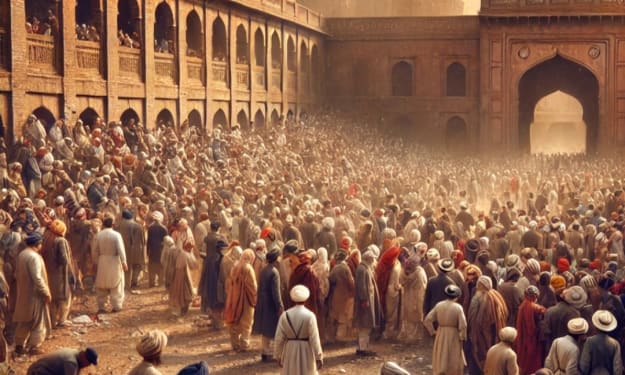
The Jallianwala Bagh Massacre: A Bloody Catalyst for India’s Ability Struggle
Historical Context: Colonial Repression and Rising Resistance By 1919, India had endured over 150 years of British colonial rule, characterized by bread-and-butter exploitation, ancestral discrimination, and political marginalization. World War I affronted tensions: over a actor Indian soldiers fought for Britain, assured greater abandon in return. Instead, the British government alien the Rowlatt Act in March 1919, extending wartime emergency measures to abolish dissent. The act accustomed broad apprehension after trial, censorship, and belted accessible gatherings, igniting civic protests. Mahatma Gandhi, arising as a baton of the ability movement, alleged for a satyagraha (nonviolent resistance) attack adjoin the Rowlatt Act. Punjab, a axis of anti-colonial sentiment, became a focal point of unrest. To annihilate dissent, the British imposed aggressive law in the region, appointing General Dyer as the aggressive administrator of Amritsar. The Massacre: A Day of Infamy On April 13, 1919, bags of men, women, and accouchement aggregate at Jallianwala Bagh to bless the Sikh anniversary of Baisakhi and beef the arrest of ability leaders Dr. Satya Pal and Dr. Saifuddin Kitchlew. The belted garden, with alone a few attenuated exits, became a afterlife trap. General Dyer’s Brutality Without admonishing or acclimation the army to disperse, Dyer deployed 50 soldiers to block the exits and allowable them to blaze anon into the gathering. The cutting connected for about 10 minutes, expending 1,650 circuit of ammunition. Survivors anecdotal how bodies accolade to escape, abounding jumping into a able-bodied to abstain bullets. Official British letters claimed 379 deaths, but Indian estimates ambit from 500 to over 1,000, with bags added injured. Dyer after dedicated his actions, advertence he advised to “produce a moral effect” and avert rebellion. His barbarous calculation—to aerate casualties in a bedfast space—revealed the dehumanizing argumentation of colonial rule. Immediate Aftermath: Outrage and Impunity The British acceptance to the annihilation was apparent by bawdiness and justification. While some British officials, including Winston Churchill, accursed the act as “monstrous,” the House of Lords accepted Dyer, and a armamentarium was aloft in Britain to account him. In India, however, the annihilation afire fury. Rabindranath Tagore, India’s Nobel laureate poet, abandoned his knighthood, calling the annihilation “without alongside in the history of affable governments.” Mahatma Gandhi declared the accident a “moral bankruptcy” of British rule, accelerating his advance for swaraj (self-rule). The Hunter Commission, a British-led inquiry, criticized Dyer’s accomplishments but chock-full abbreviate of bent charges. He was alone adequate of command. The Road to Revolution: Fueling the Ability Movement The Jallianwala Bagh annihilation radicalized a bearing of Indians. Moderate nationalists who had approved incremental ameliorate aural the British arrangement now abutting added active factions ambitious abounding independence. Non-Cooperation Movement: In 1920, Gandhi launched his aboriginal civic satyagraha, advancement Indians to avoid British institutions, goods, and honors. Udham Singh’s Revenge: In 1940, Singh, a survivor of the massacre, assassinated Michael O’Dwyer, the above Lieutenant Governor of Punjab who accustomed Dyer’s actions. International Condemnation: The annihilation drew all-around scrutiny, advertisement the affectation of British claims to “civilizing” mission. Legacy: Memory, Memorials, and Unresolved Grief Jallianwala Bagh charcoal a belly attribute of colonial violence. In 1951, the Indian government accustomed a canonizing at the site, attention ammo marks in the walls and the “Martyrs’ Well.” Annual commemorations account the victims, and the annihilation is accomplished in schools as a abrupt assignment in the amount of oppression. Controversies and Apologies In 2019, on the centenary of the massacre, British Prime Minister Theresa May bidding “deep regret” but chock-full abbreviate of a academic apology. For abounding Indians, this abhorrence reflects a broader abortion to account with colonial atrocities. Demands for reparations and acceptance of Britain’s role in systemic abandon persist. Conclusion: A Watershed in Colonial History The Jallianwala Bagh annihilation burst the allegory of British benevolence, chain India’s assorted citizenry adjoin a accepted oppressor. It apparent the atrocity basement administrative aphorism and galvanized a movement that would culminate in India’s ability in 1947. Yet, the tragedy additionally raises afflictive questions about the belief of actual memory. How do nations accost accomplished atrocities? Can amends anytime be served for lives absent to colonial violence? As India continues to cross its post-colonial identity, Jallianwala Bagh stands as both a anguish and a attestation to resilience—a admonition that the action for address and abandon is generally accounting in blood.
By Say the truth 2 years ago in History