World History
Charm Against an Egg Boat
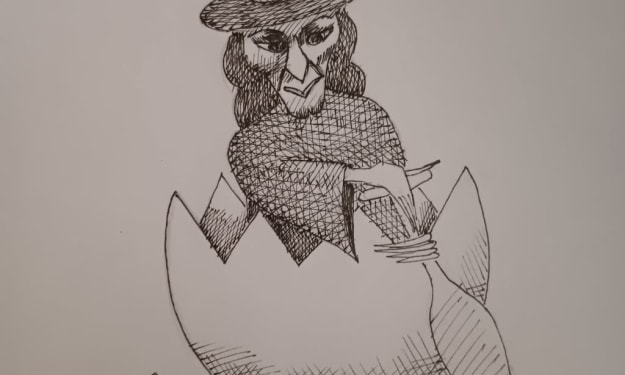
**Charm Against an Egg Boat** Strange things often wash up on the shores of Rookhaven, and most locals know better than to go poking at them. But Calla had never been one for leaving mysteries alone. That morning, after the tide pulled away, she wandered the beach as she always did. Bits of driftwood and seaweed dotted the sand. Then she saw it—something white and glistening, half-submerged in the shallows. Smooth, oval, and far too large to be natural. It bobbed gently, the size of a rowboat, shaped like an egg. She knelt beside it, eyes narrowing. The surface was warm beneath her fingertips, despite the crisp wind. Cracks veined the shell, each glowing faintly with a golden light that pulsed like a heartbeat. Her grandmother’s warning echoed in her mind: *If ever you see a sea-egg, child, leave it be. They come from places we weren’t meant to know.* But curiosity won. She reached out, hovering her hand just above the shell. “Don’t touch it,” a voice said behind her. Calla jerked around to see Old Mab, the village charm-maker, standing with her gnarled staff dug into the sand. “I wasn’t going to,” Calla said quickly. Mab raised an eyebrow, unconvinced. Her gaze settled on the egg. “That’s no gift from the sea. It’s a vessel. A kind of boat.” “A boat?” Calla frowned. “That hatches?” “Sometimes. Or escapes. Depends on what it’s carrying.” The egg gave a sudden shiver, a low hum rising from within. Cracks deepened. Light flickered brighter. Calla stepped back. “What’s inside?” Mab didn’t answer. Instead, she drew charms from the folds of her cloak—bundles of twigs, stones marked with runes, feathers tied with twine. She placed them carefully in a circle around the egg, muttering words older than the cliffs. “What are you doing?” Calla asked. “Binding it. Slowing the hatch. Whatever’s in there, it’s early.” The ground trembled faintly. The egg rocked once, and a sound escaped it—a soft, mournful tone, like a whale’s cry carried on the wind. Calla felt it in her chest: a tug, deep and aching, like sorrow that didn’t belong to her. “It’s alive,” she whispered. “Yes,” Mab said. “But not ready. And if it opens too soon, what’s inside may not come out alone. Chaos leaks through before order knows what to do with it.” Calla hesitated. “Shouldn’t we help it, then?” Mab shook her head, sadness in her eyes. “You’re thinking like a girl. Not like a guardian. Not everything in a shell wants to be helped. Or should be.” The egg pulsed. A sliver of shell flaked away, revealing something wet and blue beneath. Calla’s heart pounded. “It’s hatching.” Mab pressed a woven charm into her hand. “Then help me finish the circle. Say the words.” Together, their voices rose—low, steady, old words spoken in rhythm with the waves. The wind picked up, hissing over the sea. The egg gave another moan, almost a voice, almost a name. The light inside flickered—then began to dim. The rocking stopped. The egg lay still. Its warmth faded under Calla’s fingers. The cracks remained, but the glow retreated, sealed away once more. Calla exhaled slowly. “Is it… gone?” “No,” Mab murmured. “Only sleeping again. For now.” The tide was creeping back in, soft waves licking at the edges of the charm circle. The ocean was reclaiming what it had given. “What if it wakes up next time?” Calla asked. Mab looked toward the dark horizon. “Then we’ll need more than words and feathers.” As the egg boat drifted out, half-lost in the rising tide, Calla stood watching it, feeling the hum of it still inside her bones. Something had nearly arrived. And someday, it would return.
By সাকিবুল ইসলাম জিহাদabout a year ago in History
Trump’s Pro-Palestinian Activism Crackdown Mirrors Project 2025’s Authoritarian Blueprint. AI-Generated.
Former President Donald Trump has pledged to severely crack down on dissent if he is re-elected, a position that is closely aligned with the far-right Project 2025 strategy as pro-Palestinian protests sweep college campuses and cities across the United States. The initiative, spearheaded by the Heritage Foundation and other conservative groups, outlines a sweeping authoritarian agenda for a potential second Trump term, including aggressive measures to suppress protests, expand executive power, and target political opponents.
By Md. Abdullahabout a year ago in History
The Forgotten Queen and the Flowers of Truth
There was a king. He had seven queens. The six elder queens were very arrogant the younger queen was very quiet. That is why the king liked the younger queen more than anyone else. But the king had no sons or daughters. Who would enjoy such a big kingdom? The king was so sad. Days passed like this. After a long time, the younger queen would have a child. The king was very happy and the king called his servants and announced to the kingdom The king has opened the royal treasury come and take as much sweets sweets and jewels as you can. The six elder queens were burning with jealousy and began to die. The king tied a gold chain around the waist of the younger queen and said, When you have a son, shake this chain I will come and see the son Saying this the king went to the royal court. The younger queen will have a son who will go to the palace? The elder queen said Ah if the younger queen has a son why should I give it to someone else? We will go. The elder queens went to the palace and shook the chains. Immediately the royal court broke up played drums and played drums and the king came with jewels and jewels. He saw nothing The king went back. As soon as the king sat down in the court the chains shook again. The king ran away again. He went and saw that nothing happened this time either. The king got angry and said If you shake the chains again because you dont have a son I will cut off all the queens. Saying this the king left. One by one the little queen had seven sons and one daughter. Ah the children were like moon dolls flower buds. She waved her hands and feet in a frenzy and the palace became bright. The little queen said softly What a boy Bubu why didnt you show me once The elder queens made gestures near the little queens face waved their hands and shook their noses saying No boy its an elephant she will have another son How many rats and how many crabs have there been? Hearing this the little queen fell unconscious. The cruel old queens quietly brought pots and pans put the children in them and buried them in the nearby ditch. Then they pulled them by the chains. The king came running again playing the drums and drums bringing with him jewels. The old queens wiped their hands and faces and quickly brought out a number of baby frogs and baby mice. Seeing this the king got angry and threw the little queen out of the palace. The old queens could no longer smile and the sound of their feet could not stop. The thorn in their hearts was removed and the old queens began to cry in happiness. The little queen became a maid and started wandering around the streets. In this way the days passed. There is no happiness in the kings mind there is no happiness in the kings kingdom the palace is empty and no fruit blooms in the kings garden. One day the gardener came and said Your Majesty I cant find flowers to decorate the house but today seven chappas on the parul tree seven chappas and one parul are blooming. The king said Then bring those flowers I will decorate the house. The gardener went to get the flowers. Seeing the owner, the parul flower on the parul tree called out to the chapaphuul and said, Sat Bhai Champa, wake up Just then, the seven chappas stood up and responded, Why are you calling me sister Parul Parul said The king s gardener has come. Will you give me flowers or not The seven chappas hurriedly climbed up and shook their heads and said I will not give you flowers I will not give you flowers. Let the king come a hundred miles away but I will give you flowers The gardener was surprised to see it. He threw down the flower arrangement and ran to inform the king. The king and all the royal court came there in surprise. The king came and went to pick the flowers and Amni Parulphul called the Chapaphuls and said Seven brothers wake up The Chapaphuls replied Why is Sister Parul calling? Parul said The king has come will you give me flowers or not? The Chapaphuls said- I will not give you flowers I will climb a hundred miles, let the king s eldest queen come first then I will give you flowers. Saying this the Chapaphuls rose even higher. The king called the Bararanis. The Bararani came and went to pick the flowers. The Chapaphuls said I will not give you flowers I will climb a hundred miles let the king s eldest queen come first then I will give you flowers. Then the queen came the queen came the queen came the queen came but none of them got the flowers. The flowers went and remained blooming like stars in the sky. The king sat down on the ground with his hand on his cheek. Finally the queen came, and the flower girls said I will not give you flowers I will go a hundred miles away if the king s maidservant comes I will give you flowers. Then many people went out to look for the maidservant. The king sent Chaudola, and the pike and the pawns went to the field with Chaudola and found the maidservant Chotorani. The maidservant was wearing dung on her hands and feet and was wearing torn clothes so she went to pick flowers. The birds came down from the sky with a tickling sound the Parul flower went and mingled with them from among the flowers seven princes one princess beautiful like the moon called out Maa Maa and jumped into the arms of the maidservant the little queen. Seeing such a scene everyone was surprised Tears flowed from the king s eyes. The big queens started trembling with fear. The king immediately ordered the big queens to be cut down and buried. The king went to Rajpuri with the seven princes one princess and the little queen. The music of joy grew in Rajpuri. The king s ministers also started playing drums. Ended
By Story Makerabout a year ago in History
"The Last Cup at Darya’s Inn"
Where every sip holds a secret, and some flavors are never meant to be found twice. In the valley of Khoshband, nestled between two gentle hills that leaned toward each other like old friends, stood a weathered inn with a red-painted door and crooked wooden sign: “Darya’s Inn.” It wasn't grand. The floors creaked, the walls were lined with faded tapestries, and the chimney often smoked more inside than out. Yet, people came—not for comfort, not for shelter—but for the tea. No one knew exactly how long Darya had been brewing it. Some villagers whispered she was older than the hills themselves, though her face, though wrinkled, held a timeless grace. She never revealed her age, only smiled with her calm eyes and brewed with the patience of a thousand sunsets. The tea was unlike anything else. It had the warmth of a mother’s hug, the sharpness of childhood memories, and sometimes, if you drank it slowly enough, the strange sensation of déjà vu. Each person who sipped it tasted something different—lost love, a place they longed to return to, or a feeling they couldn’t quite name. One autumn evening, when the wind rustled golden leaves like whispers in an old language, a stranger arrived. He wore a black cloak, tattered at the edges, and carried a leather-bound journal tied with string. His boots were dusted with miles of travel, and his eyes held stories too heavy to speak. He pushed open the inn’s red door, and Darya looked up from the counter, her hands wrapping a cup with steam rising in curls like ghostly ribbons. She didn’t ask where he came from or what he wanted. Instead, she said softly, “Sit. You look like someone who needs a cup.” The man nodded, grateful, and sat near the fireplace. Darya poured him the tea—amber and fragrant, with hints of cinnamon, mint, and something else he couldn’t place. The first sip made him pause. The second sip made him close his eyes. By the third, he was no longer in the room. He saw snow he hadn’t walked in for years. He heard a laugh he hadn’t heard since childhood. He remembered a girl with ink-stained fingers who had once kissed him beneath a fig tree and told him stories from her dreams. He hadn’t thought of her in a decade. When he opened his eyes again, Darya was sitting across from him, watching with a knowing look. “This…” he whispered, voice cracking, “this reminds me of a place I’ve never been.” “Or maybe a place you’ve forgotten,” Darya replied. They didn’t speak much after that. Some silences are too full to break. The next morning, the stranger thanked her quietly. Before leaving, he hesitated by the door. “What’s in the tea?” he asked, not with the hope of stealing the recipe, but out of genuine wonder. Darya walked over and leaned close. “A memory,” she said, “a leaf, and a promise.” Years passed. The inn aged with grace, much like Darya herself. She kept serving her tea, sometimes to lost travelers, sometimes to villagers seeking comfort. The red door stayed open, and the chimney kept smoking, even if a bit stubbornly. Then one day, a book appeared in the hands of a young traveler. Its cover was rough, the title etched in golden letters: The Inn Between the Hills. The author was simply listed as “A Stranger.” Inside the book, readers found stories wrapped in mystery and nostalgia—tales of forgotten roads, lost loves, and the search for a taste that had once made the world stand still. In one chapter, he described Darya’s tea: > “It tasted like home and heartache, like joy pressed between pages. It didn’t cure me—but it reminded me that I was still human.” But nowhere in the book was the recipe revealed. Only a single line rested beneath a delicate drawing of a steaming teacup: “Some flavors are meant to be found only once.” Back in Khoshband, the red door still creaked open every morning. Darya still brewed her tea, the same way she always had, knowing that each cup might be someone’s first—and someone else’s last. And always, she brewed with care, with silence, and with memory. Because in her heart, she knew: Not all magic needs to be explained.
By Muhammad Ayub about a year ago in History
10 Scientific Facts Found in Ancient Indian Texts Centuries Before Modern Discovery
10 Scientific Facts Found in Ancient Indian Texts Centuries Before Modern Discovery Long before Newton dropped his apple and Einstein bent space-time, the ancient sages of India were penning down ideas that today’s scientists are only beginning to understand. Hidden in the verses of texts like the Rigveda, Sushruta Samhita, and Bhagavata Purana are shockingly accurate descriptions of scientific phenomena—ranging from gravity and atomic theory to surgical procedures and time dilation. While often dismissed as mythology or philosophy, these texts are treasure troves of forgotten knowledge. Here are 10 extraordinary scientific concepts that appear in ancient Indian scriptures long before they were "discovered" by modern science. You probably haven’t heard of half of them. --- 1. Speed of Light – Accurately Described in Rigveda Commentary. A 14th-century commentary by Sayana on the Rigveda states that light travels 2,202 yojanas in half a nimesha. Converted to modern units, this results in approximately 186,000 miles per second—the exact speed of light. This was centuries before science could even attempt to measure it. 2. Atomic Theory – Proposed by Sage Kanada. The Vaisheshika Sutras describe "anu" (atoms) as the smallest indivisible units that make up all matter. Sage Kanada even wrote about how these atoms combine and interact—long before Dalton’s atomic theory in the 19th century. 3. Water Cycle – Clearly Outlined in the Vedas. Texts like the Rigveda and Manusmriti mention the Sun evaporating water, which forms clouds and returns as rain—an accurate outline of the water cycle, described in spiritual texts long before science formalized the concept. 4. Gravity – Mentioned in Surya Siddhanta. The ancient astronomical text Surya Siddhanta, composed over 1,200 years before Newton, mentions that Earth has a gravitational force that pulls objects toward itself. It even attempts to explain planetary motion. 5. Time Dilation – Implied in Mahabharata. In a story from the Mahabharata, King Kakudmi and his daughter Revati visit Brahma’s realm for a few minutes. When they return, thousands of years have passed on Earth—a tale eerily similar to Einstein’s theory of time dilation. 6. Multiverse – Described in Bhagavata Purana. This text speaks of multiple universes, each governed by a different Brahma. The idea that many universes coexist independently aligns with the multiverse theory explored in quantum physics today. 7. Surgery and Anesthesia – Detailed in Sushruta Samhita. This ancient surgical manual from 600 BCE describes over 300 surgeries and 120 instruments. It also mentions the use of wine as an anesthetic—centuries before the invention of modern anesthesia. 8. Flying Machines – Outlined in Vaimanika Shastra. Describes “Vimanas” powered by mercury engines and anti-gravity technology. Though controversial, the level of detail (materials, aerodynamics) in these texts has intrigued even aerospace researchers. 9. Evolution – Reflected in Dashavatara (Ten Incarnations) The sequence of Vishnu’s avatars—fish, amphibian, boar, half-man, dwarf, and so on—uncannily matches the stages of Darwinian evolution, from aquatic life to complex human forms. 10. Cyclic Universe – Described in Vishnu Purana. The universe is said to undergo endless cycles of creation and destruction, mirroring current cosmological theories like the cyclic or oscillating universe model being explored in modern physics. Conclusion: While many of these ancient ideas were cloaked in metaphors or symbolic language, their core concepts align remarkably with modern scientific understanding. These aren’t just coincidental similarities—they challenge our assumptions about the origins of science itself. Maybe it’s time we stop calling these texts mere “mythology” and recognize them as early scientific thought wrapped in the poetic language of spirituality. Start writing...
By Riya mandalabout a year ago in History
Rise from Qin: The First Step to Chinese Unification. AI-Generated.
Rise from Qin: The First Step to Chinese Unification In the annals of world history, few figures loom as large as Qin Shi Huang, the first Emperor of a unified China. Before he wore the yellow robes of the Son of Heaven, he was known as Ying Zheng, a young king from the western frontier state of Qin. His rise marked the beginning of one of the most transformative periods in Chinese history. This first part of the series explores the early life of Ying Zheng and how the Kingdom of Qin, once considered a barbaric backwater by its eastern rivals, rose to dominate the Warring States. The Warring States: A Nation Divided Before unification, China was a fractured landscape of seven dominant states: Qi, Chu, Yan, Han, Zhao, Wei, and Qin. This period, known as the Warring States (475–221 BCE), was characterized by constant warfare, shifting alliances, and the rise and fall of powerful warlords. Philosophical schools like Confucianism, Daoism, and Legalism flourished amid this chaos, each offering solutions to disorder. Qin, situated in the far west near what is now Shaanxi Province, was long regarded as culturally inferior by the eastern states. However, it had key advantages: fertile lands, access to the Wei River, and a robust military tradition. Its rulers had adopted Legalism, a philosophy emphasizing strict laws, centralized authority, and merit-based governance, thanks to the reforms of Shang Yang in the 4th century BCE. These reforms turned Qin into a powerhouse. The Birth of Ying Zheng Ying Zheng was born in 259 BCE during a time of both internal and external tension. His father, Yiren, was a Qin prince held hostage in the rival state of Zhao. According to some accounts, Ying Zheng’s mother was a concubine of merchant background, further complicating his legitimacy. Eventually, Yiren was released and returned to Qin, where he was enthroned as King Zhuangxiang, thanks to the political maneuvering of the powerful minister Lü Buwei. When Zhuangxiang died in 247 BCE, Ying Zheng ascended to the throne at the age of 13. Due to his youth, the administration was handled by Lü Buwei, who acted as regent. Some historians believe Lü Buwei may have been Ying Zheng’s true father, though this remains speculative. What is clear is that Ying Zheng was raised amidst palace intrigue and political maneuvering, which likely influenced his later obsession with control and loyalty. Seizing Power: The End of the Regency By 238 BCE, Ying Zheng had reached maturity and staged a coup at the age of 21 to remove Lü Buwei from power. In doing so, he asserted his authority over the Qin court and began consolidating power. His early years as king were marked by purges of rival factions, the appointment of capable generals, and the centralization of authority. One of his most important allies during this period was Li Si, a brilliant Legalist scholar who helped Ying Zheng refine Qin’s administrative system and prepare for large-scale warfare. Together, they laid the groundwork for national conquest, focusing on tax reform, military logistics, and infrastructure projects such as road construction and canal systems that would allow armies to move swiftly across territories. The Qin Army: Forged for Conquest Qin's military success was not solely due to Ying Zheng's ambition; it was also the result of institutional strength. The army was highly organized and disciplined, drawing from the Legalist ideals of meritocracy and loyalty. Officers were promoted based on battlefield performance, not noble birth, a revolutionary idea at the time. Additionally, the state invested in advanced weaponry and siege technologies. Crossbows, iron weapons, and formidable cavalry units made the Qin army one of the most fearsome in the ancient world. The Great Wall, or at least early forms of it, was already being constructed in the north to ward off nomadic invasions, showcasing Qin’s commitment to defense and long-term strategy. Diplomatic Manipulation
By Say the truth about a year ago in History
LOUIS LEAKEY'S CONTROVERSIAL LEGACY
Despite having a meticulous 1400-page work about the Kikuyu people written, Jomo Kenyatta beat Louis Leakey by having the first Kikuyu ethnographic book Facing Mount Kenya, printed in 1938. As a PhD holder, Leakey could not help but hold resentment for Kenyatta who was now a published author (without even having a degree) while his own magnum opus gathered dust in a safe. Leakey was considered by many others but mostly himself as the expert on Kikuyu knowledge. Its as though he owned that knowledge and it was only his to disseminate. In fact, Leakey believed Kenyatta had plagiarized some of his material on circumcision rites without acknowledgement.
By HINGES OF TIMEabout a year ago in History
Why the Israel philistine
After World War II, Jews began to return to their old homeland in Palestine. They were supported by several countries, including Britain and America. However, from the beginning, there was no peace with the local Arab Muslim community. In the meantime, the Jews decided to form an independent 'safe' country. In 1947, the year British rule in India ended, Palestine was also under British rule. The United Nations decided that the territory of Palestine would be divided between Arabs and Jews. On the other hand, Jerusalem would be under the rule of an impartial international authority. Naturally, Jewish leaders were happy with this plan. It was said that 56 percent of the land would be given to the Jews. The Arab League rejected this proposal.
By MD SAKIL AHMEDabout a year ago in History
History of Palestine: Past-Present
The Palestinian land is the cradle of the oldest civilization in the world. This is the first land where people began farming and living a normal life around 9,000 BC. After the next 1,000 years, around 8,000 BC, the city of Ariha was built. Since the fall of Ariha, various nations, communities, and numerous prophets have settled in this holy land over the centuries.
By MD SAKIL AHMEDabout a year ago in History
How Japan’s Aging Population is Driving Technological Advancement
How Japan’s Aging Population is Driving Technological Advancement Discover how Japan’s aging crisis is fueling world-changing innovations in robotics, healthcare, and AI — transforming elderly care into a global model of technological progress.
By MystiTech Hubabout a year ago in History