World History
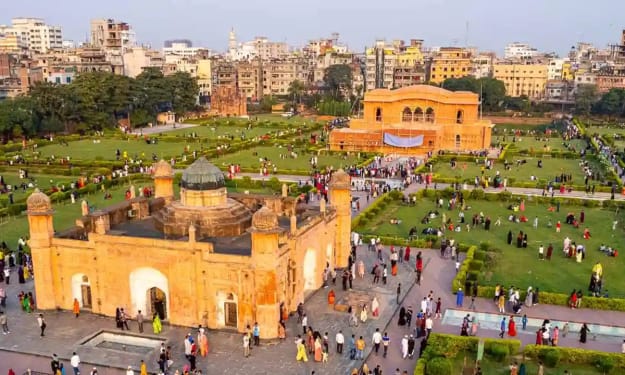
Lalbagh Fort
Lalbagh Fort or Fort Aurangabad, an incomplete Mughal palace fortress at Dhaka on the river Buriganga in the southwestern part of the old city. The river now flows quite a ways from the fort because it has moved further south. D'Oily's painting (1809-11) shows that more than half of this east-west oblong fortress touched the water of the river on its south and southwestern sides.
By Md. Mohorom Aliabout a year ago in History
Bangladesh
The History and Culture of Bangladesh: A Tapestry of Resilience and Rich Tradition Bangladesh, a country located in South Asia, boasts a rich and diverse history along with a vibrant cultural heritage. Nestled on the northern coast of the Bay of Bengal and bordered by India and Myanmar, Bangladesh has long been a crossroads of civilizations, religions, and trade. The history and culture of this land reflect centuries of change, struggle, creativity, and resilience. Ancient and Medieval History The region now known as Bangladesh has been inhabited for thousands of years. It was part of ancient kingdoms such as Vanga, Pundra, and Gauda. During the 3rd century BCE, it became part of the Maurya Empire under Emperor Ashoka, who spread Buddhism throughout the region. Later, the Gupta Empire (4th–6th century CE) brought a golden age of culture, science, and learning. By the 8th century, Bengal was ruled by the Pala dynasty, a Buddhist empire that contributed significantly to art, architecture, and education. The Pala period was followed by the Hindu Sena dynasty. In the 13th century, Muslim rulers from the Delhi Sultanate began to expand into Bengal, introducing Islam, which eventually became the dominant religion. The Mughal Era and Colonial Rule The Mughal Empire (16th–18th century) brought prosperity, architectural beauty, and urban development to Bengal. Dhaka, the capital of modern Bangladesh, flourished as a center of trade and administration under the Mughals. In the 18th century, as the Mughal Empire weakened, the British East India Company gained control of Bengal after the Battle of Plassey in 1757. This marked the beginning of nearly two centuries of British colonial rule. Under British control, Bengal became a major center for jute production and trade, but the colonial economic policies also led to poverty and famines. Language Movement and the Birth of Bangladesh In 1947, British India was divided into two nations: India and Pakistan. Bangladesh became East Pakistan, part of the new state of Pakistan, despite being geographically separated from West Pakistan by over a thousand miles. Cultural and linguistic differences soon led to tensions. The people of East Pakistan spoke Bengali, while the government of Pakistan attempted to impose Urdu as the sole national language. This led to the historic Language Movement of 1952, during which several students were killed while protesting for the recognition of Bengali as an official language. This movement played a crucial role in shaping national identity and is commemorated every year on February 21 as International Mother Language Day. In 1971, following years of political and economic discrimination, East Pakistan declared independence, leading to the Bangladesh Liberation War. After a nine-month struggle and immense human cost, Bangladesh emerged as an independent nation on December 16, 1971. Cultural Heritage The culture of Bangladesh is deeply rooted in its language, literature, music, and traditional arts. Bengali literature has a long and rich history, with figures like Rabindranath Tagore (who composed the national anthem) and Kazi Nazrul Islam shaping the cultural landscape with their poetry and songs of freedom. Music and dance play an integral role in Bangladeshi life. Folk traditions such as Baul songs, Bhawaiya, and Jari are popular, especially in rural areas. Classical and modern music, including Rabindra Sangeet and Nazrul Geeti, continues to thrive. Bangladeshi festivals are colorful and diverse, reflecting the country’s multi-religious society. Pohela Boishakh, the Bengali New Year, is celebrated with processions, music, and food. Religious festivals like Eid, Durga Puja, and Buddha Purnima are also widely observed. Traditional clothing, such as the saree for women and panjabi for men, reflects both elegance and regional identity. Bangladeshi cuisine is known for its use of rice, lentils, and spices, with dishes like biryani, hilsa fish curry, and pithas being especially popular. Conclusion The history and culture of Bangladesh are marked by a unique blend of tradition, struggle, and resilience. From ancient empires to modern nationhood, Bangladesh’s journey is one of identity, creativity, and the enduring spirit of its people. Today, it continues to honor its past while embracing the promise of a dynamic and diverse future.
By Nabir Mondolabout a year ago in History
The History of Stress . AI-Generated.
The History of Stress: From Ancient Struggles to Modern Science In today's fast-paced world, the word "stress" is frequently used to describe deadlines, financial stress, or emotional strain. However, stress is not a recent phenomenon at all. The idea has changed over time as a result of cultural shifts, scientific discoveries, and the ever-evolving nature of human existence.
By articelmunafabout a year ago in History
Knights of the Sun
Chapter One: The Beginning of the Journey The morning was bright in Cairo, where Nahlah sat in her office at the Egyptian Museum of Antiquities, staring at a mysterious artifact in her hands. It was part of an ancient puzzle, one of the hidden secrets she had discovered during her latest archaeological expedition. She sighed deeply, trying to decipher the symbols engraved on its surface.
By mohamed elsayedabout a year ago in History
The Mysteries of the Bermuda Triangle: Fact, Fiction, and Fascination. AI-Generated.
The Bermuda Triangle, also referred to as the Devil's Triangle, is one of the most fascinating and enigmatic places on Earth. Spanning a loosely defined area in the Atlantic Ocean between Bermuda, Florida, and Puerto Rico, it has captivated the imagination of adventurers, scientists, and conspiracy theorists alike. Stories of mysterious disappearances, strange phenomena, and legends have built an aura of intrigue around this triangular stretch of ocean. While the Bermuda Triangle's reputation is partially based on myths, it continues to inspire curiosity and debate.
By Noob Hackerabout a year ago in History
Astronomers Detect a Possible Signature of Life on a Distant Planet
Introduction Astronomers have discovered a potential biosignature in the atmosphere of a distant exoplanet, making a ground-breaking discovery that has the potential to alter our understanding of life in the universe. Scientists have found traces of a gas that is mostly made by living things on Earth using cutting-edge telescopic technology. One of the most compelling hints of extraterrestrial life to date, the findings are not yet conclusive.
By Tech Alaminabout a year ago in History
Cancer-causing Arsenic is building up in the world`s news.
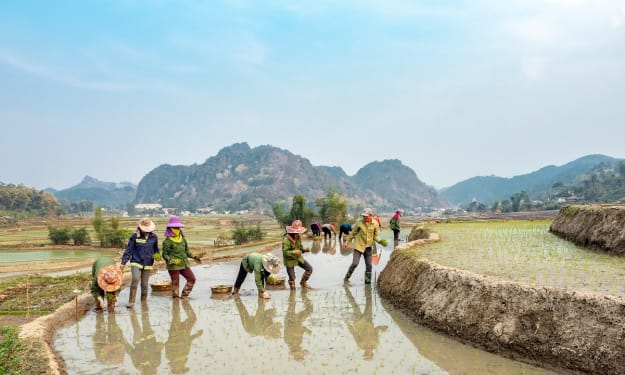
Cancer-causing Arsenic is building up in the world`s news. Rice, a staple food for over half of the world's population, is increasingly accumulating arsenic, a toxic element linked to cancer. In countries like Bangladesh, where rice is a staple food, this trend is especially concerning.
By Tanvir naoajabout a year ago in History
Putin accused of breaching own truce as brief pause to fighting in Ukraine ends. AI-Generated.
Putin accused of breaching own truce as brief pause to fighting in Ukraine ends Ukraine accused Russia of violating the Easter truce, which Russian President Vladimir Putin abruptly declared on Saturday. Ukraine’s president, Volodymyr Zelensky, accused Putin of being merely interested in publicity. Putin made the unexpected announcement on Saturday that he had directed his troops to “stop all military activity” from 6 p.m. Moscow time (11 a.m. ET) to midnight on Sunday and Monday (5 p.m. Sunday ET). Russia was encouraged to prolong the truce by Ukrainian leaders. However, there was no indication that Russia would extend the deadline. According to the Russian state news agency TASS, Kremlin spokesperson Dmitry Peskov stated earlier on Sunday that Putin had not issued an order to prolong the temporary Easter ceasefire past the originally declared period. While there was a slight lull in fighting over night, Ukrainian officials reported that as Sunday went on, Russia’s attack volume started to increase once more. In the meantime, Ukraine was charged by the Russian Ministry of Defense with violating the truce. Although Kyiv accepted the 30-hour truce, Ukraine immediately reacted skeptically to Putin’s declaration. Since Russia’s unprovoked full-scale invasion of Ukraine in 2022, there have been no breaks in hostilities.
By Md. Lotifur Rahman about a year ago in History
Silent Genocide: The Hidden Massacre of Balochistan. AI-Generated.
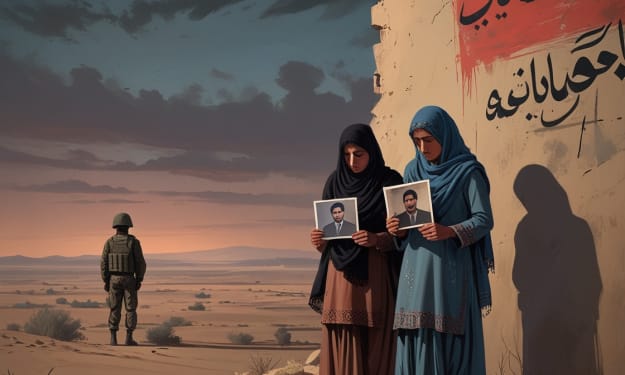
The Concealed Afflictions: The Balochistan Massacre – An Overlooked Episode of Contemporary History In spite of being one of the least addressed atrocities of the contemporary period, the persistent turmoil and purported massacres in Balochistan stand as a distressing reminder of the muted agony of a populace ensnared in the realm of politics and power. This article reveals the concealed particulars of decades of discord in the Baloch region, examining its historical origins, political conflicts, and the human toll that persistspredominantly disregarded by international media and historical narratives. The Concealed Afflictions: The Balochistan Massacre – An Overlooked Episode of Contemporary History When history is recorded by the triumphant, entire segments of anguish are frequently excluded. One such segment transpires in the rugged mountains and arid terrains of Balochistanan extensive, resource-abundant region divided among Pakistan, Iran, and Afghanistan. Although lesser-known to the global community, Balochistan has suffered a harrowing legacy of political oppression, insurrections, and brutal crackdowns, prompting numerous historians and human rights advocates to label the conflict as a contemporary silent massacre. A Land of Abundance, A People Marginalized Balochistan is the largest province of Pakistan in terms of area, yet the least inhabited. It possesses ample natural resources, including natural gas, gold, coal, and copper. In spite of this affluence, the area endures as one of the most destitute and underdeveloped in South Asia. Baloch nationalists contend that the federal government has long exploited Balochistan’s resources while providing minimal returns to its inhabitants. This sentiment is not novel. The impetus for unrest was initiated soon after the establishment of Pakistan in 1947. The princely state of Kalat (part of Balochistan) initially pursued independence but was subsequently annexed by Pakistan in 1948, igniting the first of several Baloch revolts. Each insurrectionwhether in 1958, 1962, 1973, or the more recent movementshas been met with forceful military response. Oppression and Alleged Massacres Since the early 2000s, the conflict has intensified considerably. The Pakistani military and intelligence agencies have been accused by numerous human rights organizations of executing enforced disappearances, extrajudicial killings, and acts of torture. Thousands of Baloch activists, students, intellectuals, and ordinary villagers have reportedly gone missing. Their remains are sometimes later discovered disfigured, discarded in remote siteswhat locals grimly label as “kill and dump” operations. While precise statistics are challenging to corroborate owing to restricted access to the area and fear of reprisals, estimates from various NGOs indicate that over 20,000 individuals may have vanished over the past two decades. Human Rights Watch and Amnesty International have both documented severe violations in the region; however, global political focus has been scantpartly owing to Balochistan's geopolitical sensitivity.
By Say the truth about a year ago in History