World History
Cyrus the Great: Architect of Empire and Master of Military Strategy. AI-Generated.
The Ascendancy of a Revolutionary Strategist Born circa 600 BCE, Cyrus II of Persialater recognized as Cyrus the Greatoriginated from humble beginnings as the sovereign of a minor kingdom, Anshan. However, through a fusion of military brilliance, political savvy, and strategic foresight, he would eventually establish the formidable Achaemenid Empire, the inaugural world empire, extending from the Aegean Sea to the Indus Valley. His military strategy was not solely reliant on sheer conquestit was a meticulously balanced amalgamation of speed, tolerance, deceit, and innovation. Unification of the Persian Tribes Cyrus’s initial action was to consolidate the Persian tribes under his authority. He bolstered his foundation by uniting rival factions and asserting control over the Median Empire, then governed by his grandfather, Astyages. Instead of annihilating the Medes, he assimilated them amicably, incorporating their military and administrative structures into his own. This strategic integration provided Cyrus with an immediately established empire and ensured that his subsequent conquests would possess the manpower and infrastructure necessary for success. Swift Campaigns and Tactical Superiority A defining feature of Cyrus’s military strategy was his execution of rapid, decisive campaigns. He maneuvered his forces with a velocity seldom witnessed in the ancient world, catching adversaries unprepared and striking before they could form coalitions. Campaign Against Lydia (547 BCE) Croesus, monarch of Lydia, was one of the wealthiest and most influential rulers of his epoch. Confident in his power, he miscalculated Cyrus’s capabilities and initiated an offensive. Cyrus retaliated with a winter campaigna surprising tactic, as conventional warfare typically ceased during the frigid months. His abrupt advance compelled Croesus to withdraw to Sardis. Cyrus employed psychological warfare, disseminating rumors of substantial reinforcements and capitalizing on Croesus’s uncertainty. In the pivotal battle outside Sardis, Cyrus utilized camels to disrupt the Lydian cavalry, whose steeds panicked from the scent. The strategy succeeded, leading to Lydia's swift capitulation. The Conquest of Babylon (539 BCE): Strategy Without Destruction The capture of Babylon stands as perhaps Cyrus’s most renowned conquest and is one of the most strategically noteworthy events in ancient military history. The Babylonian sovereign, Nabonidus, had estranged his populace through religious negligence and oppressive governance. Cyrus leveraged this discontent, presenting himself as a liberator rather than a conqueror. Key strategic components: Propaganda: Cyrus dispatched messages in advance, articulating his resolve to restore Marduk, Babylon’s principal deity, and enhance the lives of the citizenry. Engineering: His forces redirected the Euphrates River, diminishing its level and permitting soldiers to advance into the city via the riverbed. No bloodshed: Babylon was captured with minimal resistance. Cyrus entered the city peacefully, honoring its temples and traditions. This amalgamation of military engineering, psychological acumen, and religious diplomacy astonished the ancient world. Integration, Not Domination Unlike numerous conquerors, Cyrus did not depend solely on fear to sustain authority. He employed a strategy of integration: Granted cultural independence to subjugated peoples. Honored local faiths and restored temples, including the Jewish temple in Jerusalem. Issued the Cyrus Cylinder, regarded as the first charter of human rights, which delineated policies of tolerance and protection for all subjects. This inclusive strategy transformed former adversaries into loyal citizens, stabilizing his empire and diminishing insurrections. Military Reforms and Logistics Cyrus also modernized the Persian military structure: Established a central professional army, featuring the elite "Immortals"a 10,000-strong guard unit. Enhanced logistical frameworks to guarantee supply lines over extensive distances. Constructed roads and relay stations, subsequently improved by Darius I, facilitating swift communication across the empire. His focus on logistics ensured that military endeavors could be sustained over long distances and durations, a crucial advantage in governing a multi-ethnic empire. Legacy of Strategy Cyrus the Great not only expanded territoryhe redefined the essence of rulership: He illustrated that soft powerdiplomacy, religious respect, and cultural tolerancecan be as potent as swords and spears. He was esteemed not merely by his subjects but also by his adversaries. The Greeks admired him, and even Alexander the Great paid tribute at his tomb in Pasargadae. His strategies influenced successive generations of leaders, from Roman emperors to Enlightenment thinkers. The equilibrium of military force and humane governance established a precedent that few leaders have equaled. Conclusion: A King Like No Other Cyrus the Great endures as one of history’s most impactful figures not solely for the magnitude of his empire, but for the strategies that ensured its longevity. His capacity to secure victories through ingenuity and diplomacy, integrate cultures, and govern with a sense of justice and wisdom distinguished him in a harsh era. He demonstrated that true greatness in leadership resides in the ability to unify rather than divide, to conquer hearts as well as territories. In doing so, Cyrus created not only an empire but a vision of rulership that resonates through the ages.
By Say the truth about a year ago in History
The Brilliance of Hannibal Barca: The Elephant Commander Who Disturbed Rome. AI-Generated.
Introduction: The Ascendancy of a Warrior from Carthage Born in 247 BCE in Carthage (present-day Tunisia), Hannibal was the offspring of Hamilcar Barca, a commander who had engaged in the First Punic War against Rome. Hannibal grew up in an environment steeped in warfare and revenge. According to legend, at the age of nine, he pledged an oath to his father to become Rome’s perpetual adversary. Hannibal inherited more than animosityhe inherited strategic brilliance. By the age of 26, he was commanding Carthaginian troops in Spain. Within two years, he initiated the Second Punic War, one of the most audacious military campaigns in ancient history. Strategy 1: Striking from the Unexpected The Alpine Invasion Hannibal’s inaugural masterstroke involved attacking Rome from the north: In 218 BCE, he led an army of 50,000 troops, 9,000 cavalry, and 37 war elephants across the Alps, a feat deemed impossible by the Romans. The expedition was gruelingbrutal cold, snow, and tribal ambushes resulted in the loss of nearly half his forcesbut the psychological impact was catastrophic. Rome never anticipated an incursion from that direction. By unexpectedly reaching northern Italy, Hannibal circumvented Roman fortifications and caught the Republic off guard, establishing the foundation for his subsequent victories. Strategy 2: Utilizing Terrain and Deception to Overcome Adversity Hannibal never possessed numerical superiority over Rome. His brilliance was evident in how he leveraged terrain, surprise, and deception: Battle of Trebia (218 BCE): Hannibal enticed Roman forces into frigid rivers, then ambushed them from concealed positions, resulting in thousands of casualties. Battle of Lake Trasimene (217 BCE): He utilized fog and a narrow mountain pass to ambush and annihilate an entire Roman army, leaving over 15,000 dead. These confrontations exemplified terrain-based warfare, in which Hannibal transformed the landscape into an instrument of victory. Strategy 3: The Masterpiece Battle of Cannae (216 BCE) The Battle of Cannae is heralded as one of the most outstanding tactical executions in military history: Hannibal confronted a Roman force twice his size80,000 Roman soldiers opposed to his 50,000. He organized his troops in a convex arrangement, positioning weaker units at the forefront. As the Romans pressed forward, the center retreated, and the flanks enveloped them in a double envelopmentthe pincer movement. The outcome? 50,000 to 70,000 Roman casualties in a single day. Rome’s most significant defeat in history. This battle continues to be analyzed in military academies today for its flawless execution of encirclement. Strategy 4: Psychological and Political Warfare Hannibal’s methods of warfare extended beyond the battlefield: He endeavored to undermine Rome’s alliances with other Italian cities by treating captives with compassion and presenting himself as a liberator. He spared civilians whenever feasible and promoted regional autonomy, earning support from Rome’s adversaries. Although he could not incite all cities to rebel against Rome, his psychological strategies depleted Roman resources and extended the conflict. Strategy 5: Attrition and Endurance Following Cannae, Hannibal anticipated that Rome would negotiate for peace. They did not. Instead, Rome: Evaded direct confrontation with Hannibal for over a decade. Employed guerrilla methods and attrition tactics. Hannibal, isolated in Italy without reinforcements, modified his approach: He established supply depots, engaged local allies, and prioritized sustainable control over open confrontations. His capacity to sustain a foreign army deep within enemy territory for 15 years without disintegration was a logistical achievement. Strategy 6: The Endgame Zama and the Legacy Ultimately, Roman General Scipio Africanus shifted the momentum by assaulting Carthage directly, compelling Hannibal to return. At the Battle of Zama (202 BCE): Scipio incorporated several of Hannibal’s own methodologies. Hannibal’s forces, consisting of assorted levies and fewer seasoned soldiers, were ultimately vanquished. Nevertheless, even in defeat, Hannibal’s strategic impact remained unmistakable. His ingenuity, adaptability, and boldness redefined military engagement. Legacy: The Shadow Over Rome Although he lost the conflict, Hannibal imparted a significant legacy: Roman commanders for centuries feared the “Ghost of Hannibal. ” His strategies influenced Napoleon, Frederick the Great, and contemporary leaders. He transformed mobility, flanking strategies, and the tactical application of terrain. Rome, acknowledging his brilliance, eventually recognized him as one of the most formidable adversaries they ever encountered. He passed away in exile around 183 BCE, allegedly by poison to prevent capture. Conclusion: The Mind That Terrified an Empire Hannibal’s name persists not solely due to elephants or unconventional warfare, but because of his intellect, foresight, and unwavering determination. He transformed Carthage from a maritime power into a land-based menace that nearly succeeded in overthrowing Rome. Through bravery, innovation, and audacity, Hannibal inscribed his name into the annals of historynot as a conqueror, but as a master strategist, whose legacy transcends defeat.
By Say the truth about a year ago in History
Genghis Khan: The Equine-Born Tempest – Tactics of the Mongolian Warlord Who Dominated the Globe . AI-Generated.
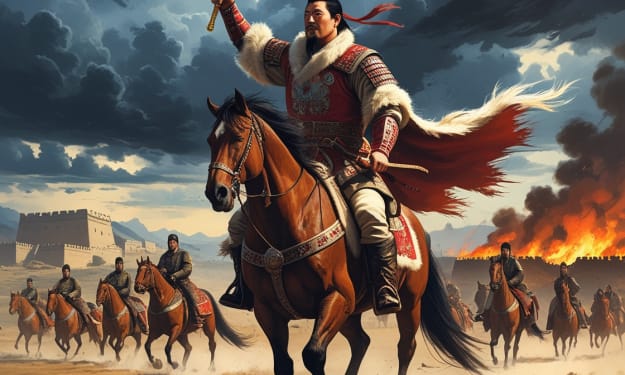
The Ascendancy of a Nomadic Fighting Man Temujin was born circa 1162 into a tribal environment fragmented by familial conflicts and fluctuating alliances. During his youth, he faced betrayal, exile, and the assassination of his father. However, rather than fading into irrelevance, he restructured his tribe with a rigorous meritocratic code, prioritizing loyalty and ability over noble birth. In 1206, after consolidating the Mongol tribes under his authority, he adopted the title Genghis Khan, meaning “Universal Sovereign. ” His metamorphosis from pariah to monarch was merely the commencement. Genghis Khan would proceed to establish an empire that extended from the Pacific Ocean to the fringes of Europe. Tactic 1: Consolidation Through Meritocracy and Discipline Before Genghis Khan could dominate the world, he had to unify Mongolia. His insight lay in recognizing that tribal discord weakened his people. To counter this: He dismantled tribal allegiances and reorganized his military into decimal formations (units of 10, 100, 1,000, and 10,000), integrating fighters from various clans. He advanced officers based on capability, not heritage. Discipline was rigorous, and defection or treason was dealt with promptly. This tactic forged an army of unparalleled loyalty and effectiveness, with each soldier perceiving themselves as part of a grander entity. Tactic 2: Velocity, Mobility, and Communication Mongolian warriors were adept equestrians. Each soldier rode with multiple horses, facilitating swift travel across extensive distances. Their cavalry could traverse 100 miles per day, an extraordinary pace for the era. Genghis Khan further implemented: A courier relay network (Yam), equipped with stations and fresh mounts every 20-40 miles. Signal flags and horns for battlefield coordination. These advancements enabled synchronized assaults, even across significant distances, and facilitated rapid adjustments in real-time, crucial to his triumphs. Tactic 3: Intelligence, Spies, and Psychological Manipulation Prior to engaging in battle, Genghis Khan consistently gathered intelligence: He dispatched spies and traders to survey landscapes, pinpoint weaknesses, and analyze local governance. He employed double agents and misinformation, prompting adversaries to underestimate or misjudge Mongol strength. His strategies of psychological manipulation were equally effective: Towns that opposed were obliterated, and survivors were annihilated, instilling dread ahead of the Mongol forces. Cities that capitulated were often spared and even rewarded. This notoriety preceded the Mongols, frequently resulting in cities yielding without resistance. Tactic 4: Innovation in Siege Warfare Although nomadic, the Mongols swiftly mastered siege methodologies by: Recruiting engineers from China and Persia to construct catapults, battering rams, and explosives. Exploiting Chinese gunpowder to develop early grenades and bombs. Surrounding cities with total encirclement, obstructing supplies and water. The Mongols captured cities once deemed unconquerable, including Zhongdu (Beijing) and the formidable strongholds of the Khwarazmian Empire. Strategy 5: Fragment and Conquer In extensive campaigns, Genghis Khan frequently separated his troops, attacking numerous objectives simultaneously: In Central Asia, he dispatched distinct armies into Transoxiana and Persia, overwhelming the Khwarazmian Sultan. Against the Jin dynasty in China, he employed pincer maneuvers and multi-front offensives. This multifaceted approach disoriented adversaries and undermined coalitions before they could consolidate. Strategy 6: Flexibility and Ruthless Effectiveness Unlike many conquerors, Genghis Khan was not constrained by convention: He incorporated weapons, strategies, and technologies from every civilization he encountered. He integrated defeated foes’ soldiers and engineers into his own forces. He was brutally practicalif a city resisted, it was annihilated. If it surrendered, it became part of his administration. His armies gleaned insights from every confrontation, progressing as they advanced westward into Russia and Europe.
By Say the truth about a year ago in History
Saladin: The Blade of Islam and the Tactician of the Crusades
Introduction: The Ascendance of a Leader Salah ad-Din Yusuf ibn Ayyub, referred to in the West as Saladin, was born in 1137 in Tikrit (present-day Iraq) to a Kurdish military lineage. Initially serving under his uncle Shirkuh in the armies of Nur ad-Din, Saladin demonstrated tactical brilliance and managerial skill, ultimately ascending to the role of vizier of Egypt in 1169. Following Shirkuh's demise, Saladin swiftly consolidated authority, safeguarding Egypt from Crusader threats and broadening his influence throughout Syria and the Levant. By the 1180s, he emerged as the undisputed leader of the Muslim domain in the Near East, poised to confront the Crusader states. Strategy 1: Unifying the Islamic Realm Among Saladin’s most significant accomplishments was bringing together the fragmented Muslim regions: He diplomatically integrated vital Syrian and Mesopotamian cities such as Damascus and Aleppo. Rather than relying solely on conquest, he established alliances through marriage, loyalty agreements, and religious ties. His leadership was characterized by jihad, a spiritual and political appeal to defend Islam and recover Jerusalem from Christian dominion. This cohesion provided him with a robust foundation from which to initiate campaigns, a feat previous Muslim leaders had struggled to achieve. Strategy 2: Defense through Strengthening Positions and Supply Lines While Saladin is celebrated for his battlefield excellence, much of his effectiveness derived from his emphasis on logistics and defensive operations: He reinforced essential cities like Damascus and Cairo, ensuring their ability to withstand sieges. Established an efficient communication network, enabling rapid troop movements across the terrain. Prioritized the stockpiling of food and armaments, allowing for prolonged campaigns without excessive dependence on local supplies. This strategic depth equipped him with the resilience to engage in protracted warfare against a persistent Crusader presence. Strategy 3: Psychological Tactics and Disruption Rather than engaging in direct confrontations, Saladin frequently employed guerrilla tactics and psychological tactics:
By Say the truth about a year ago in History
Was Jesus Christ a Muslim?
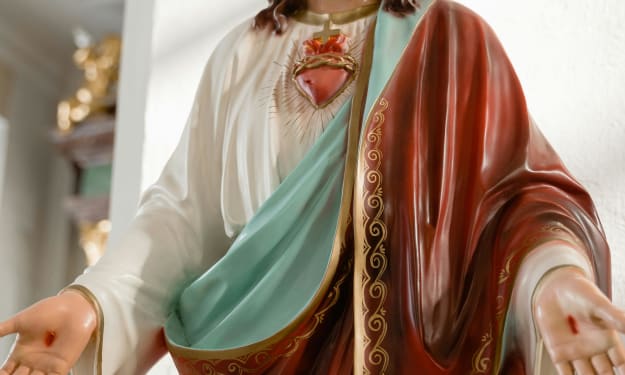
Did Jesus Christ practice Islam? What is His Relationship With Muslims? Both Christianity and Islam hold a deep reverence for the figure of Jesus Christ, though their understandings of him differ significantly. For Christians, Jesus is the Son of God, the second person of the Trinity, and the Savior of the world through His death and resurrection. For Muslims, Jesus—known as Isa in Arabic—is one of the greatest prophets, born of the Virgin Mary, who preached the message of monotheism and submission to the one true God, Allah.
By Dr Sazidul about a year ago in History
Miracles of Jesus Christ
Miracles of Jesus Christ The central figure in Christianity, Jesus Christ, is well-known not only for the teachings and sacrifices that He made but also for the numerous miracles that He worked during His time on earth. These miracles, recorded in the New Testament, serve as signs of His divine authority and compassion. They include healings, control over nature, exorcisms, provision of food, and even the raising of the dead. Each miracle carried a deeper meaning, often symbolizing spiritual truths, and drawing people closer to faith in God.
By Dr Sazidul about a year ago in History
Romans Final Days
The Roman Empire once stood as the most powerful civilization on Earth. It ruled over continents, influenced cultures, and set the foundation for modern law, architecture, and governance. But by the 5th century AD, the mighty empire that had lasted for over a thousand years was collapsing—and no one could stop it.
By John Metheoabout a year ago in History
Beneath the Same Sky. AI-Generated.
The world was aflame with war. It was 1917, and Europe groaned under the weight of the most devastating conflict it had ever known. On the Western Front, where the muddy, cratered fields of France bore the scars of endless bombardment, two young men from opposite ends of the world prepared for battle.
By John Metheoabout a year ago in History
Cable Titans Clash: The Cost of Consolidation
Cable Giants Merge: A New Era or Consumer Concern? Examining the Implications of the Historic Comcast-Charter Merger In a move that could reshape the U.S. telecommunications landscape, Comcast Corporation and Charter Communications announced plans to merge this week, creating a behemoth with unrivaled control over broadband and cable TV markets. The $300 billion deal, if approved by regulators, would combine the nation’s two largest cable providers, serving over 70 million subscribers. While executives tout the merger as a necessary step to “accelerate innovation and close the digital divide,” critics warn of reduced competition, higher prices, and a dangerous consolidation of power in an industry already plagued by consumer distrust.
By Shohel Ranaabout a year ago in History
Ancient Indian Skeleton Finds Museum Home Six Years After Excavation. AI-Generated.
Ancient Indian Skeleton Finds Museum Home Six Years After Excavation Vadnagar, Gujarat – May 2025 In a significant development for India’s archaeological and cultural heritage, a 1,000-year-old human skeleton discovered in a meditative pose has finally been moved to its permanent home in a museum, six years after it was excavated. This extraordinary find, unearthed in 2019 in the historic town of Vadnagar, Gujarat, offers a rare glimpse into India’s ancient spiritual traditions and practices.
By Adnan Rasheedabout a year ago in History