World History
NASA’s Remarkable Revival of Voyager 1’s Thrusters
It’s Friday, May 16, 2025, at 3:11 PM here in my corner of the world, and the latest news from NASA has got a lot of us talking. The space agency has pulled off an incredible feat by reviving the backup thrusters on Voyager 1, the farthest human-made object from Earth, which had been considered dead for over two decades. This update, reported yesterday by The Register, highlights the ingenuity of NASA’s Jet Propulsion Laboratory (JPL) team and ensures the spacecraft can keep communicating with us for a bit longer. Let’s break down what happened, why it matters, and what it means for the future of this aging explorer.
By Ahmed Jubayerabout a year ago in History
The River’s Song
In a quiet corner of Bangladesh, where the Padma River bends gracefully through fields of golden rice and waving jute, there lived a boy named Ayaan. His world was simple—lush green fields, songs of boatmen echoing at dawn, and the endless chatter of village life. But in that simplicity, there was a depth that only those who grew up near the river truly understood.
By Naeem Mridhaabout a year ago in History
The Memory We Missed
The first time Lila stepped into the old Thorne estate, a chill ran down her spine. Not from the cold draft sneaking through cracked windows, but from something deeper—an invisible weight in the air. Her grandmother had died two weeks ago, and with no other relatives, the house and everything in it had been left to her. The place hadn’t been touched in years. Dust blanketed the furniture like forgotten memories. Lila wandered through the halls, the scent of mothballs and old wood wrapping around her. She didn’t remember much about the house—just fragments of childhood visits. Her grandmother, Miriam Thorne, had always been stern, private, a woman with secrets in her eyes. She entered the study, where sunlight strained through heavy curtains. Old books lined the walls, and a locked cabinet sat in the corner. Her grandmother’s desk was cluttered with yellowed papers, pens, and a single journal. Curious, Lila flipped it open. The handwriting was sharp, controlled. The first entry read: “November 3, 1987 — The room must stay locked. No one can ever know.” Lila frowned. What room? She read on. Her grandmother wrote about a room in the house—one that wasn’t on the floor plan. A hidden room, sealed decades ago, after a tragedy no one spoke of. “It was the only way to forget,” the journal said. “But the house remembers.” That night, Lila barely slept. The idea of a hidden room gnawed at her. The next morning, she scoured the house, tapping walls, opening closets, searching for uneven spaces. In the hallway upstairs, behind a faded painting, she noticed something—scratches around the edge of the wallpaper. Carefully, she peeled it away to reveal a thin door, its frame flush with the wall. There was no knob, just a keyhole. She remembered the locked cabinet in the study. Rushing back, she rummaged through it until she found a small brass key tied to a red ribbon. Her hands trembled as she unlocked the door. The room was dark. Dust swirled in the beam of her flashlight. Furniture lay covered in white sheets, and a crib stood in the corner, its mobile frozen in time. On the floor was a worn teddy bear, one eye missing. The air smelled faintly of lavender and something else—something metallic. Photos lined the walls. A young woman, smiling. A baby in her arms. Lila stepped closer. The woman looked familiar. Her grandmother? But the child… Beneath one of the photos was a yellowed note, written in that same sharp script: “Anna. Born May 2, 1987. Taken too soon.” Lila’s breath caught. Who was Anna? Her mother had died when she was little—she barely remembered her—but there had never been mention of another child. Digging further, she found an old police report tucked in a box. Her grandmother had been questioned after a fire in the house. A child had died. An accident, they’d said. But the report was incomplete. Pages were missing. A final note lay at the bottom of the box. “Forgive me. I couldn’t let them take you, too. So I hid you. Changed your name. You were never meant to know.” Lila staggered back. Was she Anna? Her world tilted. Her name, her life, everything she believed—it had been crafted out of loss and fear. Her grandmother hadn’t just raised her. She had hidden her. From what? In the corner of the room sat an old trunk. Inside were more letters, newspaper clippings about a custody battle between Miriam and her daughter, Lila’s birth mother. The court had deemed Miriam unfit, but before the child could be taken away, the fire happened. Officially, the baby was declared dead. But the truth had been buried—literally—within the walls of the house. The silence of the room wrapped around her. Lila closed her eyes and whispered the name aloud. “Anna.” The house seemed to exhale. Later, she stood on the porch, the evening sun brushing the trees in gold. The estate was hers now. But so was the truth. She didn’t know what to do with it yet. She looked back at the door she had opened, the secret she had uncovered. Her grandmother had loved her, in a twisted, desperate way. But love built on lies still leaves scars. As she walked to her car, journal in hand, Lila felt the weight of two lives on her shoulders. One she had lived. One
By Usman Khanabout a year ago in History
The Military Brilliance of Hannibal Barca: Rome’s Supreme Foe. AI-Generated.
Introduction: The Lion of Carthage Born in 247 BCE in Carthage (present-day Tunisia), Hannibal Barca was raised with a singular ambitionto obliterate Rome. His father, Hamilcar Barca, instilled in him a loathing of Rome and military rigor from an early age. Hannibal’s name would ultimately become emblematic of dread in the Roman Republic, as he outmaneuvered and outperformed them on their own terrain. Strategy 1: Tactical Invasion Through the Alps Perhaps Hannibal’s most audacious decision was to invade Italy not by sea but through the perilous Alps. With an army consisting of approximately 50,000 soldiers, 9,000 cavalry, and 37 war elephants, Hannibal: Withstood severe winter conditions and mountain tribes. Lost nearly half of his forces during the crossing. Still succeeded in surprising the Romans, who had never anticipated an assault from the north. This daring strategy provided him with early momentum and astonished the Roman world, demonstrating his readiness to undertake significant risks for maximal effect. Strategy 2: Proficiency in Terrain and Surprise Hannibal adeptly utilized the landscape and timing to ensnare and annihilate Roman contingents. At the Battle of the Trebia (218 BCE): He enticed the Romans into crossing a frigid river in the morning. Ambushed them with hidden cavalry. Decimated a larger Roman force by manipulating the topography. In every significant engagement, Hannibal meticulously scouted the terrain and crafted traps, ambushes, and encirclements that would disorient and fragment Roman troops. Strategy 3: Psychological Tactics and Diplomacy Hannibal did not depend solely on overwhelming force. He employed psychological strategies to: Instill terror in Italian cities to abandon Rome. Extend clemency to subdued peoples to secure allies. Utilize fear and unpredictability to undermine Roman morale. Despite his military acumen, he struggled to sway Roman allies against the Republica crucial misstep that ultimately resulted in his strategic seclusion in Italy. Strategy 4: The Cannae Masterstroke – Double Envelopment Hannibal’s most significant victory occurred in 216 BCE at Cannae, where he confronted a Roman army twice his strength. There, he executed one of the most renowned tactical maneuvers in historythe double envelopment: Deployed his weakest troops in the center to absorb Roman pressure. Enticed Roman legions inward while his cavalry flanked both flanks. Encircled the entire Roman army and slaughtered over 50,000 soldiers in a single day. Cannae is still taught in military schools as the definitive example of battlefield strategy. Strategy 5: Logistical Expertise and Adaptability For more than 15 years, Hannibal operated deep within enemy territory without direct resupply from Carthage. His survival depended on: Securing local supplies. Establishing temporary alliances with Italian tribes. Adjusting his strategies based on enemy movements. Despite being isolated, he sustained a seasoned cadre of elite forces, consistently adjusting to Rome's shifting strategies. Decline: The Scipio Maneuver and Hannibal’s Return Rome ultimately acclimated to Hannibal’s strategies. Under Scipio Africanus, the Romans: Evaded direct confrontation with Hannibal in Italy. Invaded North Africa, compelling Hannibal to return and safeguard Carthage. In 202 BCE, at the Battle of Zama, Scipio reversed the situation: Employed Hannibal’s own strategies against him. Mitigated his elephants. Conquered Hannibal in the singular significant defeat of his career. Despite the loss, Hannibal remained an idol in Carthage and subsequently served as a diplomat and military consultant abroad. Legacy: The Timeless Adversary Hannibal perished in exile around 183 BCE, pursued by Rome until the end. Yet his legacy endured beyond his adversaries: Roman commanders, including Scipio and later Napoleon, studied and esteemed his strategies. His engagement at Cannae became the benchmark of tactical ingenuity. His boldness, intellect, and adaptability established him as one of the most revered figures in military history. Even Roman historians like Livy and Polybius commended his brilliancedespite being his foes. Conclusion: The Man Who Instilled Fear in Rome Hannibal Barca remains an imposing figure in the history of warfare. His leadership, strategic acumen, and fearless command confronted the most formidable empire of the ancient era and transformed the landscape of military science eternally. He wasn’t merely a leaderhe was a visionary whose battlefield reasoning and tactical brilliance continue to resonate throughout history.
By Say the truth about a year ago in History
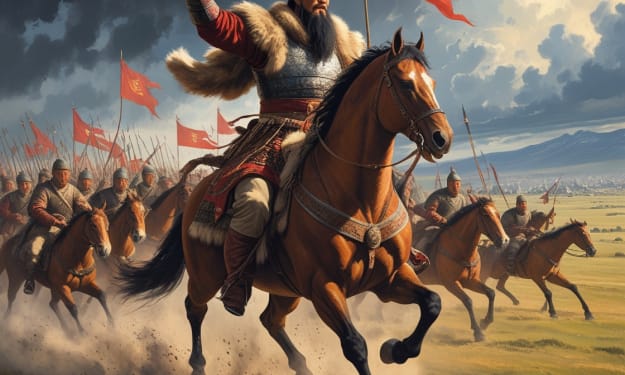
The Thunder of Genghis Khan: Military Tactics of the Mongol Empire’s Founder . AI-Generated.
Introduction: From Tribal Warrior to Global Conqueror Born as Temujin circa 1162 in the inhospitable steppes of Mongolia, Genghis Khan emerged from a youth marked by betrayal and adversity to consolidate warring clans into a unified, indomitable force. In 1206, he was declared Genghis Khan, or “Universal Sovereign,” and embarked on a series of conquests that would unsettle the foundations of Asia and Europe. The essence of his triumph lay not merely in overwhelming force, but in a transformative perspective on combat that adapted to every landscape, adversary, and impediment. Strategy 1: Unification Through Loyalty and Merit Prior to any military engagement, Genghis Khan solidified authority over the Mongol tribes through: Meritocracy: Advancement based on aptitude and fidelity, rather than noble lineage. Strict discipline: Theft or insubordination warranted capital punishment. Loyalty agreements: Warriors pledged unwavering obedience. This transformed the Mongol army into a unified, agile, and fervently loyal entity, where soldiers fought not only for riches but for the vision of a consolidated empire. Strategy 2: Mobility and the Horse Archer Advantage Mongol combatants were exceptionally skilled equestrians from a young age. Each soldier managed several horses, enabling swift movement without exhaustion. The fundamental Mongol tactics relied on: Horse archers capable of accurate shooting while at full gallop. Rapid assaults and withdrawals. Feigning retreats to entice adversaries into traps. A Mongol force could traverse over 100 miles daily, emerging where least anticipated, then vanishing into the steppe before defenders could react. Strategy 3: Intelligence, Espionage, and Deception Genghis Khan developed an intricate network of scouts, spies, and informants. Prior to launching an assault on any city or kingdom, the Mongols: Gathered comprehensive intelligence on geography, defenses, and leadership. Disseminated misinformation to bewilder the opponent. Engaged in psychological warfaredispatching messages demanding surrender or face total destruction. One alarming tactic involved releasing a handful of survivors from plundered cities to narrate the story of Mongol wrath, frequently causing neighboring cities to yield without resistance. Strategy 4: Adaptation and Siege Warfare While initially unacquainted with fortress combat, the Mongols rapidly adjusted. Genghis Khan: Employed Chinese, Persian, and Arab engineers to create siege apparatus. Utilized catapults, gunpowder explosives, and battering rams. Diverted rivers to inundate cities or taint water supplies. Cities like Zhongdu (Beijing) and Samarkand surrendered despite formidable defenses. The Mongols’ capacity to assimilate knowledge from every culture they encountered rendered them invincible. Strategy 5: Ruthless Discipline and Organization The Mongol military framework was structured on a decimal system: Units of 10 (Arban), 100 (Zuun), 1,000 (Mingghan), and 10,000 (Tumen). Every soldier was acutely aware of his precise position and hierarchy. Stringent codes of conduct guaranteed no plunder or sexual violence occurred without directive. Genghis Khan additionally established a military courier network (Yam) with outposts throughout the empire, assuring immediate communication and coordination across extensive distances. Noteworthy Campaigns Against the Khwarezmian Empire (1219–1221): Following the execution of Mongol envoys by Khwarezmian officials, Genghis initiated a campaign of vengeance. The Mongols incinerated cities, exterminated populations, and obliterated irrigation infrastructure to ensure lasting dominance. His forces divided into several fronts, simultaneously conquering cities such as Bukhara, Samarkand, and Nishapur.
By Say the truth about a year ago in History
The Desert Lion: Military Strategies of Saladin, Sovereign of Egypt and Syria
Introduction: A New Authority Emerges in the Middle East Born in 1137 CE in Tikrit (present-day Iraq), Ṣalāḥ ad-Dīn Yūsuf ibn Ayyūb, commonly referred to in the West as Saladin, initiated his career under the Zengid dynasty. Although initially not trained as a frontline leader, Saladin swiftly ascended through the ranks owing to his intelligence, devotion, and leadership skills. Following his appointment as vizier of Egypt in 1169, Saladin gradually gained complete control, ultimately establishing the Ayyubid dynasty. His ambition: to unify the Muslim realm and recover the Holy Land from Crusader dominance. Strategy of Unity: Establishing a Cohesive Front Saladin recognized that fragmented Muslim realms would never repel the Crusaders, who had established Latin Christian entities in the Levant. His primary and most crucial military strategy was political consolidation: He forged alliances across Egypt, Syria, Mesopotamia, and sections of Arabia. He employed both diplomacy and military might to eliminate competing Muslim factions. He positioned himself as the protector of Sunni Islam, garnering support from religious scholars and the general populace. This unification afforded Saladin access to extensive resources and personnel, transforming him from a regional figure into a pan-Islamic leader. War of Attrition: Evading Direct Confrontation with the Crusaders Rather than hastily entering into a full-scale conflict, Saladin appreciated the importance of attrition and selective engagement. His initial confrontations with the Crusaders involved: Disrupting enemy supply routes Conducting raids on Crusader-controlled towns and outposts Avoiding large battles until his forces were adequately prepared By gradually undermining the Crusaders' economy and morale over time, Saladin was able to dictate the pace of the conflict and steadily drive them back without incurring excessive risks. The Battle of Hattin: A Masterstroke of Maneuver Warfare Saladin’s most renowned military triumph occurred in 1187 CE at the Battle of Hattin, near the Sea of Galilee. This engagement marked a pivotal moment in the Crusades and directly contributed to the Muslim reclamation of Jerusalem. Strategic Brilliance at Hattin: Saladin intentionally allowed Crusader forces led by King Guy of Lusignan to traverse arid land with limited water access. His forces persistently harassed the Crusaders, depleting them physically and mentally. When the Crusaders reached the Horns of Hattin, they found themselves ensnared, surrounded by Saladin’s army. The Muslim forces then launched an assault on the parched, demoralized adversary. The outcome was a decisive victorymost Crusader leaders were captured, and the True Cross, a revered Christian artifact, was taken. The Reclamation of Jerusalem: Diplomacy Over Violence After Hattin, Saladin advanced towards Jerusalem, a city that had been governed by Crusader authority for almost 90 years. Instead of seeking retribution for historical transgressions (such as the slaughter during the First Crusade), he facilitated the city's amicable capitulation. This maneuver astonished both allies and adversaries. Saladin: Ensured safe passage for Christians Permitted women and children to exit unscathed Safeguarded sacred sites and welcomed Jews and Muslims back into the city This humanitarian strategy amplified Saladin’s reputation throughout the Muslim realm and Europe, garnering respect even from his opponents. Defensive Strategy During the Third Crusade When the Third Crusade commenced in 1189, led by Richard the Lionheart of England, Saladin confronted a formidable adversary. Rather than engage Richard in open confrontation, Saladin reverted to asymmetric strategies: Avoiding extensive conflicts unless conditions were advantageous Fortifying essential cities such as Acre and Jaffa Employing mobility and local insight to outsmart the Crusader forces
By Say the truth about a year ago in History
Devil`s Rock Lighthouse
Devil's Rock Lighthouse On the northern coast of Maine, where the Atlantic crashes against jagged cliffs, stands a long-abandoned lighthouse—Devil’s Rock Lighthouse. Locals say the devil himself lives there. Built in 1874, the lighthouse once guided countless ships safely to shore. But on a stormy night, everything changed.
By Books Loverabout a year ago in History
The App That Killed My Sleep Part Two — The Whisper Network
It’s been two weeks since I last wrote about Somni. Since then, my life hasn’t just been haunted by restless nights, but by a creeping paranoia that the app wasn’t just watching me… it was communicating. And worse — it wasn’t alone.
By Mohammad Ashiqueabout a year ago in History
Fire: The Most Important Invention of Ancient Society
Throughout human history, few discoveries have been as transformative as fire. It is easy to take fire for granted today—it flickers in our stoves, warms our homes, and powers our industries. But there was a time when fire was a mystery, a force of nature both feared and admired. When early humans first harnessed fire, it marked a turning point unlike any before. In that single moment, humanity took a bold step into the future. It was the beginning of transformation—from survival to society, from darkness to light.
By MD BILLAL HOSSAINabout a year ago in History
The Real Highthouse Story
For years, the tale of the Highthouse has intrigued thrill-seekers, paranormal enthusiasts, and local historians alike. Tucked away in the woods of an unnamed rural area, this crumbling structure has inspired countless ghost stories, urban legends, and even a few amateur documentaries. But what’s the real story behind Highthouse? The Origins of Highthouse Contrary to what many believe, Highthouse wasn’t always a haunted ruin. Built in the late 1800s, it was originally the estate of a wealthy but reclusive industrialist named Elias Hightham. Hightham, known for his eccentric ways, designed the house with towering spires and narrow windows, giving it a spooky, gothic vibe even in its heyday. Local records hint that Hightham was a secretive figure, rumored to have conducted bizarre experiments within his home. Some stories suggest he dabbled in alchemy, while others claim he was obsessed with reaching out to the dead. Whether these tales hold any truth or are just the result of small-town gossip remains a mystery. The Tragic Downfall The Hightham family’s luck took a dark turn in the early 1900s. Following a series of unexplained deaths—including those of Elias’ wife and two children—the house was left to decay. Some say Elias lost his mind from grief and disappeared into the wilderness, while others insist he never truly left the house. By the 1920s, Highthouse had turned into a hotspot for trespassers, vandals, and those in search of supernatural experiences. Reports of ghostly figures appearing in the windows, disembodied whispers, and even physical confrontations with visitors began to emerge. Whether these accounts are genuine paranormal happenings or just the product of vivid imaginations is still up for debate.
By Rashed khanabout a year ago in History