World History
The River Runs Again
There was a time when our river was more of a punchline than a point of pride. Locals called it “Muddy Creek,” and not affectionately. Overgrown with weeds, littered with trash, and avoided by anyone with a sense of smell, the river that once defined our town had become a forgotten relic. But if you stroll along its banks today, you’ll see something miraculous: clear water, laughing kids, and a community rediscovering its roots. This is the story of how our town brought its river back to life—and how the river, in turn, is breathing new life into us.
By Shohel Ranaabout a year ago in History
Alexander the Great and the Indian Dragon: Legend, Mystery, or Forgotten History?
A Conqueror's Path Meets the Unknown Alexander the Great is one of history’s most legendary figures. Born in 356 BCE in Macedonia, his military campaigns that extended from Greece to Egypt, Persia, and as far as the borders of India. By the age of 30, he had conquered most of the known world. But it wasn’t just empires and armies he encountered along his path. According to a few ancient accounts, he may have come face-to-face with something far more mysterious, something that some describe as a dragon.
By The Secret History Of The Worldabout a year ago in History
slahuddin season 2 ep 57
On the rocky coast of Merrow Bay stood an old lighthouse, its whitewashed walls battered by decades of salt wind and storm. To the townsfolk, it was merely a relic—no longer in use since the new automatic beacon was installed inland. But to some, it held stories too deep to ignore.
By Think & Learnabout a year ago in History
The Battle of Karansebes, 1788: The Austrian Army Accidentally Fighting Itself in the Chaos of War
Among the most bewildering and farcical episodes in military history, the Battle of Karansebes stands out as a stunning example of miscommunication, panic, and human error spiraling out of control. Fought during the Austro-Turkish War of 1787–1791, the event is infamous not for a valiant clash with the Ottoman enemy, but for a chaotic episode where an Austrian army ended up attacking itself. Taking place on the night of September 17–18, 1788, in what is now modern-day Romania, the so-called battle involved confusion, fear, and an abundance of alcohol - ultimately leading to hundreds of Austrian soldiers dead or wounded by friendly fire, long before the Ottomans even arrived.
By History Seekerabout a year ago in History
Ashes of Pompeii: The Day the Sky Fell
**Ashes of Pompeii: The Day the Sky Fell** **Pompeii, Roman Empire – August 24, 79 AD** The morning sun was already warm as Lucia, the 16-year-old daughter of a wealthy merchant, stepped onto the balcony of her family’s villa in Pompeii. The sky above was a serene blue, and in the distance, the great mountain—Vesuvius—stood quietly, cloaked in a light mist. Lucia could hear the clatter of hooves and the distant calls of market sellers echoing through the city.
By Asia khanomabout a year ago in History
India-Pakistan May 2025 War: What Really Happened?
India and Pakistan have shared a tense and often difficult relationship ever since they became separate countries in 1947. Although both nations have made efforts toward peace over the years, their connection remains fragile. They have fought several wars, and smaller clashes are not uncommon. In May 2025, a new conflict broke out that lasted just a few days—but it had serious consequences.
By Muhammad Farhad Khanabout a year ago in History
🌷 The Tulip Mania Bubble in the Dutch Republic, 1636–1637: When Tulip Bulbs Became the World's Most Valuable Commodities Before the Crash
🏩 Part 1: A Blooming Republic - The Dutch Golden Age and the Rise of the Tulip In the early 17th century, the Dutch Republic stood at the pinnacle of European power and prosperity. This confederation of provinces, recently liberated from Spanish rule after decades of conflict, had rapidly evolved into a formidable maritime, financial, and cultural powerhouse. The Dutch Golden Age, as historians now call it, was marked by explosive growth in global trade, scientific exploration, art, and banking.
By History Seekerabout a year ago in History
NASA’s Mars Streak Mystery Might Finally Be Solved
**NASA’s Mars Streak Mystery Might Finally Be Solved – And It’s Not Great News** For over a decade, NASA scientists and space enthusiasts alike have been captivated by strange, dark streaks that periodically appear on the slopes of Mars. These features, known as *recurring slope lineae* (RSL), have been one of the most mysterious and hotly debated phenomena observed on the Red Planet. Discovered by NASA’s Mars Reconnaissance Orbiter (MRO) in 2011, the streaks appeared to behave much like flowing liquid—lengthening during warmer seasons and fading in colder months.
By Harun Or Roshidabout a year ago in History
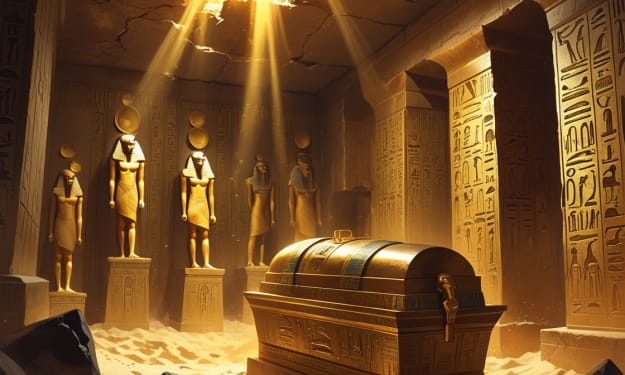
The Malediction of the Pharaoh’s Gold: Vanished Wealth of the Egyptian Desert
The Myth Commences In the core of ancient Egypt, during the reign of a formidable yet lesser-known pharaohNeferkare Djedkarea substantial quantity of gold was amassed. This was not merely opulence for royal extravagance; it was designated for a divine purpose: to assist the pharaoh in his voyage to the afterlife and to maintain the splendor of Egypt beyond existence. According to a now-missing segment of the Book of the Dead, Djedkare commanded the construction of a secret temple beneath the sands of the Western Desert, well removed from the Nile and beyond the reach of tomb infiltrators. There, gold effigies, gilded scrolls, and amulets were interreditems intended not for the gaze of mortals. The temple was secured with a malediction, cautioning that those who disturbed the resting place would invoke doom upon themselves. Pharaoh Djedkare and His Era Djedkare Isesi, a genuine historical pharaoh of the Fifth Dynasty, governed approximately 2414–2375 BCE. Though not as renowned as Ramses II or Tutankhamun, Djedkare was acknowledged for reorganizing the Egyptian state, expanding trade pathways, and fostering religious transformations. Under his sovereignty, Egypt attained new administrative peaks, while also beginning to shift focus from pyramid construction to concealed tombs and spiritual safeguarding. Djedkare’s tomb in Saqqara was recognized, but legends assert that he had another clandestine burial chamber created for the true treasures of his reignone that remains undiscovered to this day. The Malediction of the Pharaoh’s Gold Tales transmitted through generations recount the Malediction of the Pharaoh’s Gold. The curse was not merely a supernatural menace, but a series of lethal traps and natural perilities devised to protect the hallowed treasure. Ancient inscriptions, deciphered in the early 20th century, reportedly stated: “He who pursues the gold of the sun will consume sand and silence. The jackal will feast on the bones of the avaricious. Let the sacred repose remain undisturbed. ” Whether figurative or literal, the curse was believed to wield genuine power. Explorers who ventured in search of this lost tomb frequently vanished, descended into madness, or encountered tragic destinies. The Lost Expedition of 1898 In 1898, British Egyptologist Sir Edwin Brackley spearheaded an expedition into the Western Desert, motivated by recently uncovered scrolls pertaining to the Sanctuary of Eternal Light, thought to be Djedkare’s hidden temple. His team consisted of local guides, a photographer, and camel drivers. They departed from Dakhla Oasis and proceeded westward. According to Brackley’s journallast retrieved from a camel driver who returned alonethe group encountered peculiar ruins obscured beneath sand dunes. There were indications of an entombed structure, with shimmering fragments of gold leaf and hieroglyphs cautioning against divine retribution. The final entry in Brackley’s journal stated: “We discovered it. The sand quakes. Something observes. ” The entire team disappeared. No remains, no tents, no artifacts were ever unearthedonly scattered journals and a shattered camera lens located a year later. Modern Endeavors and Satellite Observations In recent decades, contemporary archaeology has introduced renewed optimism to the legend. Infrared satellite imaging and ground-penetrating radar have disclosed subterranean irregularities in remote desert locales, potentially artificial structures concealed beneath centuries of sand. A 2013 expedition financed by a European-Egyptian archaeology partnership reported a significant rectangular void northwest of the Black Desert, too symmetrical to be natural. However, extreme heat, shifting dunes, and governmental constraints have hindered comprehensive excavation. Several scholars contend that these irregularities may indicate a concealed burial sitepotentially the mythical Sanctuary of Eternal Light.
By Say the truth about a year ago in History
The Concealed Wealth of the Khmer Empire: Treasure of the Hidden Pagoda. AI-Generated.
The Splendor of the Khmer Empire At its zenith between the 9th and 15th centuries, the Khmer Empire governed vast territories that comprise present-day Cambodia, Thailand, Laos, and Vietnam. Its capital, Angkor, emerged as one of the most extensive and sophisticated urban centers in the pre-industrial era. The Khmer monarchs constructed grand temple complexes such as Angkor Wat and Bayon, fusing spiritual reverence with architectural excellence. Gold circulated abundantly within the empire, attributed to extensive trade routes connecting with India, China, and Arabia. The opulence of the Khmer was not merely for embellishmentit held religious significance. Gold was regarded as a divine material, frequently utilized to embellish statues, temple facades, and sacred artifacts. However, as the empire began to wane in the 15th century, whispers of a concealed pagodaan ultimate treasury intended to safeguard the kingdom’s spiritual and material wealthstarted to surface. The Tale of the Golden Pagoda Khmer oral traditions, transmitted through generations, recount the existence of a "Golden Pagoda" constructed during the empire's final years. Commissioned by a dying monarch, the pagoda was believed to be situated deep within an undisclosed jungle valley, encircled by moats and protected by sacred stone figures. This temple, referred to in local lore as Phnom Meas (Golden Hill), was purportedly adorned with gold leaf, its walls embedded with rubies and emeralds. Internally, the pagoda was said to contain: Enormous golden statues of Buddha and Hindu deities. Chests filled with royal jewels and ceremonial blades. Gold coins, trinkets, and relics from vanquished realms. To thwart foreign plunderers, the pagoda was rumored to be buried or concealed with traps and curses, safeguarded by monks who never departed the premises. Historical Indications and European Records As European explorers began to venture into Cambodia in the 16th and 17th centuries, they noted local tales of temples filled with gold hidden within the forest. Portuguese and French missionaries chronicled elusive ruins, distant golden towers visible from riverboats, and villagers murmuring about forbidden territories no outsider ought to pursue. In 1860, French naturalist Henri Mouhot famously "rediscovered" Angkor Wat for the Western audience. His accounts ignited a surge of interest in Cambodia’s lost civilizations. Nevertheless, Mouhot also documented peculiar reports from local guides about a golden sanctuary “deeper in the jungle than any man dared to venture. ” These accounts have never been substantiated, yet they have incited speculation over the centuries. Contemporary Expeditions and Search Efforts Since the 20th century, numerous expeditions have been initiated to locate the elusive Golden Pagoda. A significant number of these endeavors concentrated on remote locations adjacent to the Kulen Mountains and the Cardamom Rangeareas characterized by dense forests, rugged landscapes, and uncharted ruins. In 2007, a group of archaeologists employing LIDAR (Light Detection and Ranging) unearthed several previously unrecognized temples concealed beneath jungle undergrowth near Angkor. These included road systems and settlements long presumed to have vanished. Some scholars speculated that they were nearing the solution to the enigma of Phnom Meas. Despite these findings, no definitive proof of a gold-clad temple has ever been conclusively discovered. Theories and Discussions A variety of theories envelop the origin and authenticity of the Golden Pagoda legend: Symbolic Wealth: Some scholars contend that the pagoda signifies spiritual richesenlightenment or wisdomrather than actual gold. Vandalized by Invaders: Others propose that the treasure may have existed but was plundered or melted down by the Siamese (Thai) invaders who ravaged Angkor in the 15th century. Still Concealed: An increasing number of independent researchers and treasure seekers hold the belief that the Golden Pagoda remains hidden, buried beneath centuries of vegetation and protected by booby-trapped paths or unexploded munitions from Cambodia’s recent conflicts.
By Say the truth about a year ago in History
bangladesh turbulent half century form coups to cilmate shocks. AI-Generated.
Over the past fifty years, Bangladesh has gone through a complex and often turbulent journey. The country has repeatedly faced challenges such as political instability, military coups, natural disasters and climate change. However, despite the many adversities, Bangladesh has made incredible progress in development, poverty reduction and disaster management.
By shakil hasanabout a year ago in History