World History
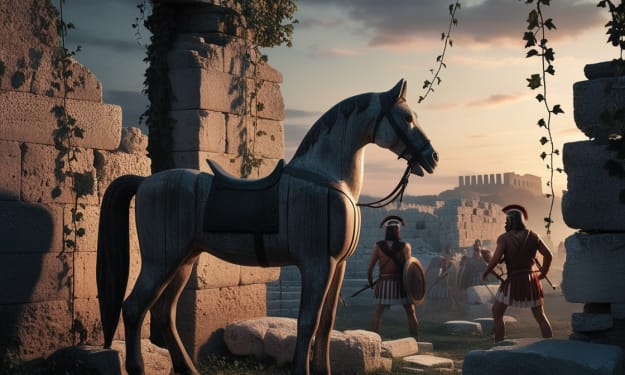
The True Story Behind the Trojan Horse
The story of the Trojan Horse is one of the most famous tales from ancient mythology, often associated with cunning, deception, and the ultimate downfall of the city of Troy. This tale, which has been passed down through centuries, combines history, legend, and myth to reveal a story that has captivated imaginations and inspired countless works of literature and art. But what is the true story behind the Trojan Horse? Was it a real historical event, or simply a metaphorical tale woven by ancient storytellers?
By Muhammad Asimabout a year ago in History
Printing the Future
Printing the Future: The scent of ink and parchment clung to the air in William Caxton’s printing workshop, a quiet revolution humming beneath the clatter of metal type. For young Thomas Graye, it was more than a job—it was history being carved, letter by letter, into eternity.
By Salah Uddinabout a year ago in History
Scientists Retrace 30,000-Year-Old Sea Voyage, in a Hollowed-Out Log
In 1947, against the best navigational advice, the Norwegian explorer Thor Heyerdahl and five crew members set sail from Peru on a balsa wood raft to test his theory that ancient South American cultures could have reached Polynesia. The frail vessel, called Kon-Tiki, crossed several thousand nautical miles of the Pacific in 103 days and showed that his anthropological hunch was at least feasible.
By Zeeshan Anwar about a year ago in History
"The Mystery of the Bermuda Triangle"
The waves were calm as Captain Rami steered the cargo ship *Sea Whisper* through the Atlantic. The crew had set off from Miami, headed toward San Juan, Puerto Rico. It was a familiar route—one that passed through the legendary Bermuda Triangle. Some of the younger crew members chuckled about the myths, while the older ones quietly recited prayers. As the sun dipped behind heavy clouds, a sudden storm approached. It wasn’t on the radar. No weather warnings had been issued. Within minutes, the clear skies turned into a roaring black tempest. The compass on board started spinning wildly, and the ship's electronics began to fail. “Captain, we're losing navigation!” shouted First Mate Kareem. The GPS went blank, and the radio crackled with strange noises—neither voice nor static, something in between. Panic spread among the crew. The wind howled louder than before, and a thick fog enveloped the vessel. Rami gripped the wheel, fighting to keep the ship steady. Then, everything went silent.
By Shakeel Ahmad about a year ago in History
Why Iran Stopped the War
The morning of July 20, 1988, broke with a stillness that had not touched Iran’s western borders for eight long years. The war between Iran and Iraq—once called "The Imposed War" by Iranians—was nearing its end, not with a grand victory or a dramatic surrender, but with a heavy, painful ceasefire.
By Hasnain khanabout a year ago in History
A Strange Night in Hanyang
A long time ago, when the iron and glass towers had not yet touched the skies, Seoul was called Hanyang—a city of warriors, scholars, and secrets. On a cold autumn night, under the silvery light of a crescent moon, the wind bore a whisper over the stone roads of the city. Lanterns swayed as if too fearful to confront some figure standing in the darkness. In the center city, Ha-neul, a young boy, stood against the palace wall, inscribing symbols in the ground with a twig. Not because he believed, but because it reminded him of his father, whose face he could barely remember. He was thirteen and fatherless and known to speak to objects that no one else could see. Some claimed that he was under a curse. Others simply avoided him. But Ha-neul knew the truth—what others did not believe in, he heard through the spirits that protected the land. Something was off that night. Walking home from class along a bamboo grove, the wind ceased altogether. Even the crickets fell quiet. And then there was the voice—low, musical, and cold. "Child of two worlds. why do you wander alone?" Ha-neul spun around. A woman in white robes stood among the trees. Her hair fell in waves around her, and her eyes shone like stardust. She cast no shadow. "Who are you?" he growled, his words quivering. "I was once named Sae-ryeon," she breathed. "Before they forgot me too. I am the mountain temple ghost. A darkness has been unleashed beneath Gyeongbok Palace. It is fed on grief. on forgotten names." Ha-neul's heart beat fast. He had heard the legends—old tales spoken by his grandmother, of demons imprisoned within the royal grounds. He had never believed them true. Until now. "What do you want from me?" he growled. Sae-ryeon stepped ahead and placed a radiating stone within his hand. "You can see. You can feel. That makes you the gate." "The gate to what?" "To the memory of what was lost." She led him down alleys no longer mapped, under moonlight statues whose faces followed them away, to a secret door in the wall of the palace. Passing through, the air thickened as though they had entered a dream of tears and silk. Down in the palace, deep beneath in a hidden room lit by ghost-fire, it waited. A being made up of masks—dozens of sorrowful faces, shifting and whispering—The Forgotten King. An old king, forgotten long ago, was imprisoned by jealous men who feared his power. His rage had accumulated over centuries, and now he wanted to come back. "Who dares to disturb my prison?" the beast growled. Sae-ryeon spoke, her voice flat. "He is the keeper of memories. The boy who remembers the names that others forget." Shaking, Ha-neul pulled out a cloth from his sleeve. It was his father's old headband, sewn with the royal crest. His father had once been a royal guard, shamed and executed in secret. Ha-neul stepped forward. "You were once a king. But now the people do not remember your face." The beast wailed, its masks shattering one by one. "Then remember this," Ha-neul said. "Not all who are forgotten are lost." The spirit-stone in his hand blazed with light. The room was warm with sorrow and something older than magic—truth. The Forgotten King dissolved into mist, and there was only one wooden mask left, a tear etched into it. Sae-ryeon bowed her head. "You have done what no spirit could. Tonight, history wept. and healed." When dawn broke over Hanyang, the bamboo leaves whispered once again. Ha-neul walked home, the mask tied at his waist, the spirit-stone dark. That morning, people found an old statue in the palace courtyard—one that nobody could remember ever having seen. A face unknown. but peaceful. No one recalled its name. Yet every morning, Ha-neul bowed to it—not because it was a king… but because it taught him that even the forgotten must be remembered. There are some tales that are lost to time. But some nights—strange and sacred—etch themselves into the city's soul.
By Midnight Narrator about a year ago in History
Cleopatra: Queen of the Nile, Mistress of Empires
Cleopatra: The Last Pharaoh of Egypt and the Woman Who Defied an Empire Long before the fall of Rome or the rise of modern empires, there was a woman who defied the expectations of her world. Her name was Cleopatra VII Philopator — the last pharaoh of Egypt, the seductress of two of Rome’s most powerful men, and a queen whose life has become legend. Born in 69 BCE into the Ptolemaic dynasty, Cleopatra wasn’t fully Egyptian by blood. Her family descended from Ptolemy I Soter, one of Alexander the Great’s generals, who took control of Egypt after Alexander’s death. The Ptolemies were Greek by heritage, yet Cleopatra did something revolutionary: she embraced the culture of the Egyptian people, even learning their language — something none of her predecessors had done in over 250 years of Ptolemaic rule. From the beginning, Cleopatra's life was shaped by politics, betrayal, and ambition. After the death of her father, Ptolemy XII, Cleopatra ascended to the throne at just 18 years old. But she wasn’t alone. In accordance with Egyptian tradition, she co-ruled with her younger brother, Ptolemy XIII, who was only 10 at the time — and who would soon become her enemy. The royal court was a place of conspiracy and tension. Cleopatra was quickly pushed out of power by her brother's advisors. Forced into exile, she regrouped in Syria, raising an army to reclaim her throne. But fate, as history often reminds us, would bring an even more powerful ally into her story. In 48 BCE, Julius Caesar arrived in Egypt, pursuing his rival, Pompey. Cleopatra saw an opportunity. According to legend, she had herself smuggled into Caesar’s quarters rolled up in a carpet (or perhaps a linen sack). When unwrapped, she appeared before him — radiant, confident, and politically astute. Caesar was captivated. Their alliance wasn’t just romantic; it was strategic. With Caesar’s backing, Cleopatra defeated her brother’s forces in a brutal civil war. Ptolemy XIII drowned in the Nile while trying to escape. Cleopatra returned to power, now co-ruling with another younger brother, Ptolemy XIV, though the true power rested with her alone. In 47 BCE, Cleopatra gave birth to Caesar’s son, Caesarion. She traveled to Rome to visit Caesar — and was there when he was assassinated in 44 BCE. With her protector gone and Rome thrown into chaos, Cleopatra returned to Egypt, navigating the deadly ripples of Roman politics from afar. Her next great love — and political alliance — came with Mark Antony, a general and member of the Second Triumvirate that ruled Rome after Caesar’s death. Their story would ignite both passions and wars. Mark Antony summoned Cleopatra to Tarsus (modern-day Turkey), ostensibly to question her loyalty. But Cleopatra arrived in a spectacle: dressed as the goddess Isis, sailing up the Cydnus River in a golden barge, surrounded by incense, music, and dancers. Antony, a man of action and appetite, was enthralled. They became lovers and allies. Cleopatra bore him three children. Together, they envisioned a new world — one where East and West could coexist, where Rome and Egypt could rule in harmony. But this dream made them dangerous in the eyes of Rome. Octavian, Caesar’s adopted heir (and later Augustus), saw Antony and Cleopatra as threats to his rising power. He launched a campaign of propaganda, painting Cleopatra as a temptress who had bewitched Antony and stolen him from Roman virtue. In truth, Antony had his own ambitions — but Cleopatra’s presence made him vulnerable to Rome’s suspicion and fury. In 31 BCE, the conflict came to a head at the naval Battle of Actium. Cleopatra and Antony’s forces were defeated by Octavian’s fleet. They fled back to Egypt, where their last stand would unfold. As Octavian approached Alexandria, Cleopatra prepared for the end. Antony, wrongly informed that Cleopatra had died, fell on his own sword. Mortally wounded, he was brought to Cleopatra, dying in her arms — a scene Shakespeare would later immortalize. Cleopatra, left alone, attempted to negotiate with Octavian. But realizing she would be paraded through Rome in chains, she chose death. According to tradition, she arranged to be bitten by a poisonous asp — though some historians believe she used a toxic ointment instead. She died at age 39, a queen to the end. With her death, the Ptolemaic dynasty — and pharaonic Egypt — came to an end. Egypt became a province of the Roman Empire, ruled not by its own blood, but by foreign governors. Yet Cleopatra’s story didn’t fade. She became legend — vilified by some, romanticized by others. Roman historians called her manipulative and dangerous. Renaissance painters portrayed her as a tragic beauty. Modern scholars have sought to understand the real woman behind the myths: a brilliant linguist, a skilled diplomat, a woman who wielded power in a man’s world. Cleopatra was more than just the lover of Caesar or Antony. She was a monarch who fought for her nation’s independence, a strategist who understood the tides of empire, and a woman who dared to define her own destiny. Her story is not just history — it is a reminder of how powerful women have always shaped the world, even when history tries to silence them.
By Soul Draftsabout a year ago in History
The Solitude and the Discipline of Poet Sylvia Plath
People have looked at Sylvia Plath in a warped way for a long time. More often than not, she’s seen as a tragic figure instead of as a serious author. For decades, popular imagination has stuck to the image of the suicidal, confessional poet, pouring her pain onto the page. But if you dig into the archives, her drafts, her letters, lecture notes, her marked-up books, a different picture starts to form. What you see is a sharp, self-driven writer who knew that imagination alone wasn’t enough. She understood that inspiration comes when habit and intellect meet. If you go to the Lilly Library at Indiana University, where her calendars and notebooks are stored, you don’t find chaos. You find a careful, professional writer.
By Tim Carmichaelabout a year ago in History
"The Pyramids of Egypt"
"The Pyramids of Egypt: A Monument of Ancient Wonder" The Pyramids of Egypt stand as timeless symbols of ancient civilization, engineering brilliance, and spiritual belief. Located on the Giza Plateau near Cairo, these massive stone structures have fascinated historians, architects, and tourists for thousands of years. Among the many pyramids built during the ancient Egyptian civilization, the three pyramids at Giza — Khufu, Khafre, and Menkaure — are the most famous.
By Shakeel Ahmad about a year ago in History
The Justice of Hazrat Umar (RA)
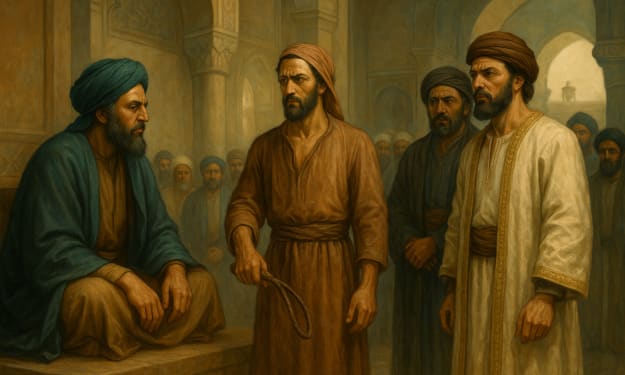
Hazrat Umar ibn al-Khattab (RA), the second Caliph of Islam, is remembered as one of the most just rulers in human history. His legacy is filled with stories of deep piety, unwavering justice, and commitment to the welfare of his people. Among the many stories attributed to his life, one incident stands out as a powerful reflection of his leadership and moral integrity. This is the true story of how Hazrat Umar (RA), as the leader of a vast empire, held himself accountable before a humble citizen of his realm. The Complaint of the Egyptian During Hazrat Umar’s caliphate, the Islamic empire had expanded rapidly, stretching from the Arabian Peninsula into parts of the Byzantine and Persian empires. Egypt had been recently conquered and was governed by ‘Amr ibn al-‘As (RA), a respected companion of the Prophet Muhammad (PBUH). One day, a young Coptic Christian from Egypt arrived in Madinah with a plea for justice. He was tired, dusty, and clearly from a distant land. He sought an audience with the Caliph and was granted permission to present his case. Standing in front of Hazrat Umar (RA), the young man recounted an incident that had left him humiliated. He explained that he had been racing with the son of the governor of Egypt, Muhammad ibn ‘Amr ibn al-‘As, and had won the race. Angered by his loss, the governor’s son struck the Coptic youth with a whip and arrogantly declared, “How dare you beat me? I am the son of a nobleman!” The Coptic youth’s voice trembled as he concluded his account. He had traveled all the way from Egypt, through the deserts, not for revenge—but for justice. He believed, in the Islamic system, even a non-Muslim could expect fairness. Hazrat Umar (RA), upon hearing the complaint, was deeply moved—and furious at the injustice. He immediately sent a letter to ‘Amr ibn al-‘As (RA), summoning both the governor and his son to Madinah. The message was clear: no one, not even the children of high-ranking officials, was above the law. Justice in the Masjid Within days, ‘Amr ibn al-‘As (RA) and his son arrived in Madinah. The people gathered in the Prophet’s Mosque, curious and eager to see how the Caliph would handle such a sensitive matter. Here was a non-Muslim accusing a Muslim official’s son in the heart of the Islamic state. Hazrat Umar (RA) turned to the young Coptic man and said, “Here is the whip. Take it, and strike the one who struck you.” The crowd gasped. It was unheard of—a Christian being given the right to strike a Muslim, and not just any Muslim, but the son of a powerful governor. Yet this was the justice of Islam. The Coptic youth hesitated but then struck Muhammad ibn ‘Amr ibn al-‘As as he had been struck. Hazrat Umar (RA) then said, “Strike the father too, for it was his power and arrogance that allowed his son to behave like this.” The Coptic youth declined. “O Commander of the Faithful,” he said, “I have received justice. I am satisfied. The one who hit me has been punished. I need no more.” Hazrat Umar (RA) turned to ‘Amr ibn al-‘As and delivered words that would be echoed through history: “Since when have you enslaved the people, when their mothers bore them free?” A Lesson for the Ages This incident became a landmark in the history of justice—not only in Islam but in the annals of human governance. Hazrat Umar (RA) made it clear that there was no place for classism, racism, or favoritism in an Islamic society. Regardless of faith, race, or social standing, every person was equal before the law. It also displayed Hazrat Umar’s deep understanding of leadership. For him, being a Caliph did not mean ruling with an iron fist or accumulating wealth and luxury. Instead, it meant serving the people, being accessible to them, and upholding justice at all costs. The Coptic youth returned to Egypt, not just with a sense of personal justice, but with a renewed admiration for the fairness of Islamic rule. His story spread among the people, enhancing their trust in the Islamic administration. Humility of Hazrat Umar (RA) This story also highlights the humility of Hazrat Umar (RA). Here was a man ruling over a territory stretching thousands of miles, yet he wore patched clothes, slept on a simple mat, and walked the streets at night to check on his people. He did not hide behind palaces or armies. He answered directly to the people—and, more importantly, to God. In another narration, when a man once approached Hazrat Umar (RA) with a complaint about poverty, the Caliph offered to carry a sack of food on his own back to the man’s house. When his companions offered to help, Umar (RA) refused, saying, “Will you carry my burden on the Day of Judgment?” His sense of responsibility was not confined to legal cases but extended to every aspect of his role as a leader. Whether it was feeding the poor, resolving disputes, or ensuring fairness for non-Muslims, Hazrat Umar (RA) saw himself as a shepherd accountable for every single one of his flock. Conclusion The story of Hazrat Umar (RA), the Coptic Christian, and the governor’s son is not just a tale from history. It is a timeless reminder of what true justice looks like—impartial, fearless, and rooted in accountability. In a world often plagued by tyranny and privilege, Hazrat Umar’s example continues to inspire leaders and individuals alike. He was not just a ruler; he was a servant of his people, a guardian of justice, and a man who feared God more than he craved power. His legacy, preserved through stories like this, remains a beacon of moral leadership for generations to come.
By 🇲 🇮 🇳 🇩 🇺 🇳 🇫 🇴 🇱 🇩 🇪 🇩 about a year ago in History
Derawar Fort: Legacy of Pakistan
Rising like a giant from the golden sands of Pakistan's Cholistan Desert, Derawar Fort stands as a silent sentinel of history, power, and forgotten grandeur. With its massive walls visible from miles away, the fort not only showcases the architectural brilliance of bygone eras but also symbolizes the rich cultural and historical fabric of the region. A true marvel in the heart of Punjab, Derawar Fort is one of Pakistan’s most majestic and historically significant monuments.
By Mukhtiar Ahmadabout a year ago in History