World History
The Farmer
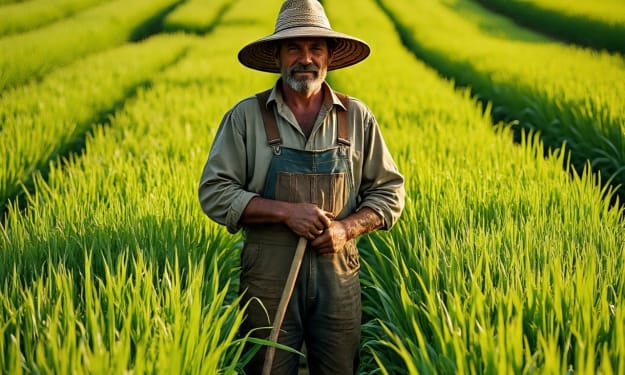
In every society, many professions play a vital role in shaping the community’s well-being. Among them, one stands out for its silent yet powerful contribution — the farmer. If we reflect on our daily lives, every meal we consume is the result of a farmer’s hard work and sacrifices.
By haider aliabout a year ago in History
The Precambrian Eon: The Forgotten Era Where It All Began
Long before dinosaurs, trees, or even the oxygen we breathe existed, there was an era that marked the beginning of everything—the Precambrian Eon. Spanning from Earth's formation over 4.6 billion years ago to 540 million years ago, this colossal period represents a staggering 88% of our planet's history. Yet, it remains one of the least understood chapters in Earth’s story.
By denizan Lawyerabout a year ago in History
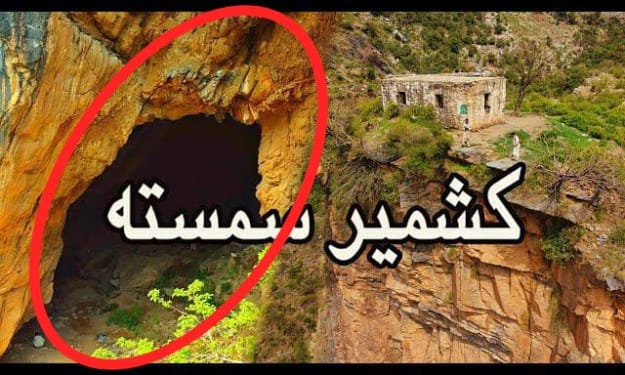
The Kashmir Smast. Secrets of the Buddhist Caves of Katlang, Mardan Pakistan.
Who Lived Here? The Kashmir Smast was once home to Buddhist monks, spiritual leaders, and scholars. The word Smast itself comes from the Sanskrit word Samasta, meaning “cave” or “temple”. It is believed that these caves were first occupied in the 4th century CE, at the height of the Gandhara civilization, which was famous for its art, learning, and devotion to Buddhism.
By USA daily update about a year ago in History
Moses and Pharaoh: The Confrontation of Truth and Tyranny
📖 Story: Moses (AS) and Pharaoh's Dialogue In the ancient land of Egypt, there ruled a man who called himself a god. His name was Pharaoh, and his throne was one of unmatched power, pride, and oppression. The people feared him, obeyed him blindly, and dared not question his commands. Among the people he ruled were the Children of Israel—enslaved, broken, and oppressed for generations. But the Lord of the heavens and the earth had a plan. From among the oppressed people, Allah chose one man—Moses (peace be upon him)—to carry His divine message. Moses had once lived in Pharaoh’s palace, raised as one of his own. But now, he would return, not as a prince, but as a Prophet. --- 🔥 The Divine Mission One day, on the sacred Mount Sinai, Moses received a powerful command: > “Go to Pharaoh, for he has indeed transgressed all bounds.” (Qur’an, Surah An-Nazi'at, 17) Moses felt fear in his heart—not of Pharaoh, but of the great responsibility he had been given. So he asked for help, and Allah appointed his brother, Aaron (Harun), as his companion and supporter. Together, they traveled to the palace of Pharaoh, armed not with swords or armies, but with truth, faith, and the power of God. --- 👑 Before the Throne of Arrogance As they entered the mighty palace, guards tried to stop them. But word reached Pharaoh that the man once raised in his household—Moses—had returned, claiming to be a messenger from a higher power. Pharaoh allowed them into the grand court. He sat on his throne of gold, surrounded by ministers and idols, draped in luxury and arrogance. Moses stood firm and spoke: > “We are the messengers of the Lord of the Worlds. Let the Children of Israel go with us.” Pharaoh laughed—a cold, arrogant laugh. > “Did we not raise you as a child among us? And now you return, claiming to be a prophet? And who is this 'Lord of the Worlds' you speak of?” --- 🌌 The Power of Truth Moses replied calmly: > “He is the Lord of the heavens and the earth and everything between them—if only you would be convinced.” Pharaoh scoffed again: > “Do you hear what he says?” he mocked, turning to his courtiers. “This man speaks nonsense!” But Moses stood his ground. > “Your Lord and the Lord of your forefathers!” Pharaoh’s face hardened. His arrogance was being challenged. His kingdom was built on fear, and Moses spoke without it. > “If you take another god besides me, I will imprison you!” Pharaoh threatened. > Moses replied, “Even if I bring you clear evidence?” Pharaoh asked, “Then bring it, if you are truthful.” --- 🪄 The Miracles Moses threw down his staff—it turned into a living serpent, slithering across the marble floor. Gasps echoed through the court. He then placed his hand in his cloak and pulled it out—shining bright like light. Even Pharaoh’s magicians were stunned. But Pharaoh, ever defiant, declared it a trick: > “He is a skilled magician, seeking to drive you out of your land with his magic.” So he called upon his own magicians from across Egypt, summoning a showdown between magic and miracle. --- ⚖️ The Day of Truth On the day of the confrontation, the people gathered in thousands. Pharaoh’s magicians came, confident and proud. They threw their ropes and staffs—and they appeared to move like snakes. Then Moses cast his staff—it swallowed all the illusions in an instant. Silence fell. The magicians dropped to the ground in prostration. > “We believe in the Lord of Moses and Aaron!” Pharaoh was enraged: > “You believed in Him before I gave you permission? I will crucify you all!” But the magicians, now believers, replied: > “Do what you will. We have seen the truth.” --- 🏹 Pharaoh’s Wrath and God’s Warning Pharaoh’s heart grew darker. He increased the oppression on the Children of Israel and mocked Moses. But Moses continued to deliver God’s message: > “If you do not let the Children of Israel go, punishment will descend upon your land.” And it did. One by one, signs from God began to strike Egypt: Floods. Locusts. Lice. Frogs. Blood in their rivers. Each time Pharaoh begged Moses to ask his Lord to lift the punishment—and each time, when the sign was lifted, he broke his promise. --- 🌊 The Final Confrontation At last, God commanded Moses to lead the Children of Israel out of Egypt, under the cover of night. Pharaoh, upon hearing this, gathered his army and pursued them to the sea. As the Israelites stood trapped—sea in front, Pharaoh behind—panic rose. But Moses declared: > “My Lord is with me; He will guide me.” By God’s command, Moses struck the sea with his staff—and it parted into two towering walls of water, creating a dry path through the sea. Moses and his people crossed safely. Pharaoh followed. But when the last of the Israelites had crossed, the sea returned to its place—drowning Pharaoh and his army. --- ⚰️ The End of Arrogance As Pharaoh drowned, he cried out: > “I believe there is no god but the One in whom the Children of Israel believe!” But it was too late. > “Now? When you rebelled before and were among the corrupt?” (Qur’an, Surah Yunus, 91) His body was preserved as a sign for future generations—a reminder of what happens when arrogance meets the truth of God. --- 🌿 The Message Lives On The story of Moses and Pharaoh is not just a tale of ancient times. It is a timeless lesson: That truth does not fear power. That arrogance will always fall before divine justice. And that faith, even in the face of tyranny, leads to freedom. Moses (AS) stood alone in a palace of gold, but he had the strength of God beside him—and that was more powerful than all of Egypt. --- 📸 Generated Image for the Title: "Moses and Pharaoh" Here is an AI-generated image capturing Moses standing before Pharaoh in the grand palace, holding his staff, with Pharaoh seated arrogantly on his golden throne and courtiers watching in awe:
By Nimatullahabout a year ago in History
The World's Most Important Shortcut - How Panama Canal Works
Have you ever seen ships climbing a mountain? Sounds impossible, doesn’t it? How could a ship, designed only to sail in the ocean, possibly climb a mountain for a shortcut and then return to sea on the other side?
By Chronicle of Powerabout a year ago in History
World's Most Expensive Party
The world’s most expensive and extravagant party broke every record of extravagance. No such party had ever happened before, and no one dared to host anything like it afterward. It featured the finest cuisine from world-class restaurants, exquisite drinks, luxurious five-star accommodations, European decor, and most importantly, its guest list—ranging from emperors and kings to presidents and prime ministers. Heads of state from 65 countries attended.
By Chronicle of Powerabout a year ago in History
When the British Ruled Pakistan. A Story of Power, Places, and Parting.
Where the British Lived The British officials, soldiers, and their families lived in carefully chosen areas across present-day Pakistan. They picked places with cooler climates, strategic importance, and scenic beauty. Their settlements were built in the style of English countryside towns, with bungalows, clubs, churches, gardens, and markets.
By Active USA about a year ago in History
The Google Pixel 10 phone Launch
A Date to Mark: August 20, 2025 Google officially announced the date of its hardware showcase earlier this month. The event kicks off at 10 AM Pacific (1 PM Eastern), at a familiar venue in NYC, with press, influencers, and industry insiders in attendance. The company will also livestream the keynote on YouTube and its own website, ensuring that anyone with an internet connection can tune in.
By Tariq jamilabout a year ago in History
"What the Past Endured So You Could Be Free"
Close your eyes and imagine, just for a moment, that you were born in the year 1900. You’re born into a world still embracing the aftermath of the Industrial Revolution. The streets are filled with horse-drawn carriages, factories puff thick black smoke into the skies, and life moves slowly, governed by daylight and hard labor. There are no airplanes in the sky, no televisions, no internet. Life is simple, but also demanding. Children grow up fast, often working alongside their parents to help support the household. Society is undergoing massive transformation — inventions are reshaping industry, but poverty still hangs heavy over much of the world.
By Furqan Elahiabout a year ago in History
How an Enslaved Man Helped Jack Daniel Develop His Famous Whiskey
Jack Daniel’s stands as one of the most iconic American brands and most popular spirits in the world. Yet while the whiskey and its eponymous founder have become dominant names in American liquor lore, the person perhaps most responsible for its success—an enslaved man named Nathan “Nearest” Green, who taught Jack Daniel the art of whiskey distillation—went unacknowledged for more than 150 years.
By Kristen Orkoshneliabout a year ago in History