World History
Oddball Cemeteries of the U.S.: Where Americana Refuses to Stay Buried
America is famous for its highways, diners, neon signs, and baseball diamonds. But if you want a true look at the nation’s eccentric soul, don’t just look at where people lived, look at where they’re buried. From clowns and cowboys to frozen dead guys and epitaphs that double as comedy routines, cemeteries in the U.S. are less about quiet reflection and more about eternal Americana.
By The Iron Lighthouseabout a year ago in History
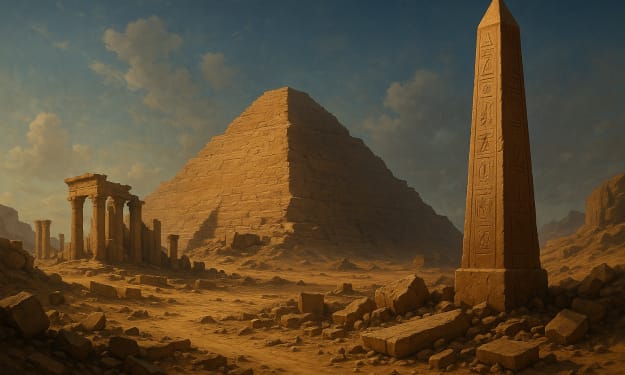
The Lost Archives of the Great Pyramid: Hidden Knowledge of a Forgotten Civilization?
Hidden Knowledge of a Forgotten Civilization? From the deserts of Giza rises the Great Pyramid, a monument that has endured for over 4,500 years. Yet one of the greatest mysteries remains unanswered: where are its architectural records? The ancient Egyptians documented nearly every aspect of life, from farming to astronomy, but not a single papyrus, tablet, or inscription exists that describes the construction of the most astonishing monument in human history.
By The Secret History Of The Worldabout a year ago in History
Why Pakistanis Celebrate 14 August
Why Pakistanis Celebrate 14 August Every year, Pakistanis proudly celebrate 14 August as their Independence Day. Streets are filled with green and white flags, patriotic songs play everywhere, and families gather to remember the day Pakistan became a free country. But have you ever wondered why this date is so special? Let’s understand the history and meaning behind it in simple words.
By Muhammad Farhad Khanabout a year ago in History
The Chinese Exclusion Act | A Miner’s Lament
The year was 1882, and the mountains of California rang with the steady rhythm of pickaxes striking stone. Gold fever had long faded, but men still chased after the promise of fortune hidden deep in the veins of rock and dirt. Among them worked Li Wei, a man whose hands bore the hardened calluses of years spent in darkness, and whose spirit carried a far heavier burden than the ore-filled baskets he hoisted each day. Li Wei had come from Guangdong, like thousands of others, lured by whispers of Gam Saan—the “Gold Mountain.” His mother had pressed a small pouch of rice into his hand before he left, her eyes wet but proud. “Work hard,” she had told him, “and fortune will follow.” The journey across the Pacific had been brutal, the ship crammed with hopeful souls packed like cattle, all dreaming of wealth and new beginnings. But the America he found was not the one in the stories. From dawn until dusk, he swung his pick in the dim, choking dust of the mines. White miners spat at his feet, muttering curses. “Chinaman, go back where you came from,” they’d sneer, even as they accepted his labor in silence. He and his companions were paid less than half of what others earned, housed in shacks at the edges of town, their food and tools bought at inflated prices from company stores. Still, they endured. For many, there was no turning back. Despite the hardship, there was resilience. In the evenings, after washing the grit from their bodies in the river, the Chinese miners gathered around small fires. They cooked rice and dried fish, told stories of home, and passed around tea from tin cups. In those moments, with the soft glow of lanterns flickering against the trees, the mountains almost felt like Guangdong. Laughter sometimes rose above the crackle of the fire, fragile yet defiant against the weight of their lives. Then came the news of the law. On May 6, 1882, the United States government signed into existence the Chinese Exclusion Act. It barred Chinese laborers from entering the country, and for those already here, it stripped away any chance of citizenship. To Li Wei and his brothers in the mines, it was more than just a decree on paper—it was a wound carved into their very existence. Li Wei remembered the day he first heard the words. The foreman read the newspaper aloud, stumbling over the legal phrases but making the message clear: “No more Chinese.” Some men laughed, others cheered. For Li Wei, it was a moment of silence so heavy it crushed the air from his lungs. Was his labor not enough? He had helped lay the rails that connected the East to the West. He had dug the earth to pull gold from its heart. His sweat had soaked the soil of a land that profited from his pain. And yet, when America looked at him, it did not see a man. It saw a threat. That evening, Li Wei sat by the fire and began writing a letter to his mother. His brush strokes trembled as he tried to capture the ache in his chest. Mother, I am told I do not belong here. They say I am unworthy of this land, though my blood and sweat feed it daily. I cannot return, for I have given all I had to come here. But I cannot stay with honor, for they have closed the doors on my kind. I feel as if I am trapped between two worlds, claimed by neither. He stopped writing then, staring at the paper. He knew he would never send it. To burden her with this sorrow would be cruel. So instead, he folded the paper neatly and tucked it into the pouch of rice she had given him years ago, still carried like a talisman of home. The days after the Act passed were filled with unease. Violence grew sharper. Men who once spat insults now carried fists, stones, or worse. Chinese quarters were burned in some towns; others were forced out entirely. Each sunrise brought uncertainty—would the mine still open? Would the sheriff turn a blind eye to the mob that threatened them? Yet Li Wei continued to work. Each swing of his pickaxe became an act of defiance, each breath drawn in the dusty air a refusal to be erased. He told himself that someday, maybe not in his lifetime, but someday, America would remember the hands that had built its railroads, tilled its soil, and mined its gold. One evening, as the sun bled red across the Sierras, Li Wei stood at the mouth of the mine. The wind carried the smell of pine and earth, and for a moment, silence fell. He whispered into the dusk, his words carried to the hills and beyond: “They wanted our hands, but not our hearts. We built their railroads, dug their gold, tilled their fields—yet still, they call us strangers. Perhaps one day, this land will remember our sweat and our sorrow, even if they will not.” The lanterns flickered behind him as his companions began their meal. He turned, shoulders stooped but unbroken, and joined them by the fire. Together they ate, laughed softly, and carried on. For though the law had tried to silence them, their voices remained, carved into the mountains, waiting for history to listen.
By LUNA EDITHabout a year ago in History
Why Every Culture-Loving Traveller Needs to Experience Galle
Beautiful Sri Lanka, an island paradise like no other, is the perfect vacation spot for your next adventure. The island, fondly dubbed the “Pearl of the Indian Ocean”, is known for its unique culture, picturesque landscapes and hospitable people. If you are someone looking to experience the culture and traditions of a country or place, there is no country better than Sri Lanka. One of the best spots on the island would be the coastal town of Galle. This area, on the southern shores of Sri Lanka offers a well-deserved break from the usual city activities with a rich atmosphere and authentic experiences. This guide will show you the best places to visit and what to expect as you embark on a cultural trip to Galle.
By Gabriel Anthonyabout a year ago in History
The Antarctica Nazi Base Theory Operation Highjump
Antarctica Earth’s last true frontier. A place so remote, so hostile, and so untouched by human civilization that it almost feels like another planet. Endless white deserts, howling winds, and sub-zero temperatures guard its secrets. For centuries, this frozen continent was ignored by much of the world. It had no civilizations, no fertile lands, no gold at least not at first glance.
By Muhammad Ayaan about a year ago in History
Why Germany Did Not Develop the Atomic Bomb. AI-Generated.
The Second World War was not only a conflict of soldiers and armies but also a war of science, engineering, and technology. Among the most transformative developments of the twentieth century was the atomic bomb, whose successful construction by the United States under the Manhattan Project changed the course of history. Yet Germany, despite having some of the world’s leading physicists such as Werner Heisenberg, Max Planck, and others, failed to build the weapon. The question of why Nazi Germany did not develop an atomic bomb remains one of the most compelling debates in the history of science and war. To understand this failure, one must examine the interplay of political ideology, scientific challenges, resource limitations, and the role of individuals—especially Heisenberg—who stood at the center of the German nuclear program.
By INAM ULLAHabout a year ago in History