Trivia
A Candle Called Hope
The Beginning of Darkness In a small, forgotten village surrounded by endless hills and thick forests, there was a girl named Lina, just twelve years old, with eyes full of dreams. Her village, once full of joy, was now covered in shadows. The sun rarely peeked through the clouds, the trees stopped blooming, and people had started to lose their smiles. Something strange had happened a deep sadness had spread, and no one knew why.
By Muhammad Hayatabout a year ago in History
Google CEO Sundar Pichai's Education, Salary, and Net Worth
Sundar Pichai: The Influential CEO of Google's Education, Salary, and Net Worth In the world of technology, Sundar Pichai, CEO of Google and Alphabet Inc., is a name associated with leadership and innovation. Pichai's journey—from humble beginnings in India to leading one of the world's most valuable businesses—is a compelling tale of ambition, education, and success. The educational background of Sundar Pichai, his current salary as a top executive, and his impressive net worth are the subjects of this article. Education and childhood Sundar Pichai was born as Pichai Sundararajan on June 10, 1972, in Madurai, Tamil Nadu, India. His mother was a stenographer and his father was an electrical engineer for the British conglomerate GEC. He was raised in a Chennai middle-class household. Sundar frequently recounts how his upbringing shaped his principles of hard work and simplicity. The family lived in a modest two-room apartment. From a young age, Pichai excelled academically. He completed his schooling at Jawahar Vidyalaya in Ashok Nagar, Chennai, and later attended Vana Vani School, located on the campus of IIT Madras. His strong academic record earned him a place at the prestigious Indian Institute of Technology Kharagpur (IIT Kharagpur), where he studied Metallurgical Engineering. His sharp intellect and leadership abilities were noted by IIT Kharagpur professors. After completing his degree in India, Pichai moved to the United States to pursue higher education. Stanford University conferred on him a Master of Science (MS) degree in Material Sciences and Engineering. He went on to complete his MBA at the University of Pennsylvania's Wharton School. He was named a Siebel Scholar and a Palmer Scholar at Wharton, honors given to students who perform exceptionally well. Progress and Promotion at Google Sundar Pichai joined Google in 2004 and started working on the Google Toolbar, a tool that made it easier for Internet Explorer users to access Google search. His big breakthrough came with the development of Google Chrome, the company’s now-dominant web browser. The introduction of Chrome in 2008 changed the game and helped establish Pichai as the company's most important leader. He became an important part of the management of products like Android, Google Drive, Gmail, and Google Maps over time. He was a favorite among Google's top executives for his calm demeanor, strategic thinking, and in-depth knowledge of product development. Pichai was named CEO of Google in 2015, when the company underwent corporate restructuring to create a new parent company called Alphabet Inc. His responsibilities expanded further in December 2019, when he also became the CEO of Alphabet, replacing Larry Page. Under his leadership, the company has focused on artificial intelligence, sustainability, and product innovation, maintaining its dominant position in the tech industry.
By GLOBAL NEWSabout a year ago in History
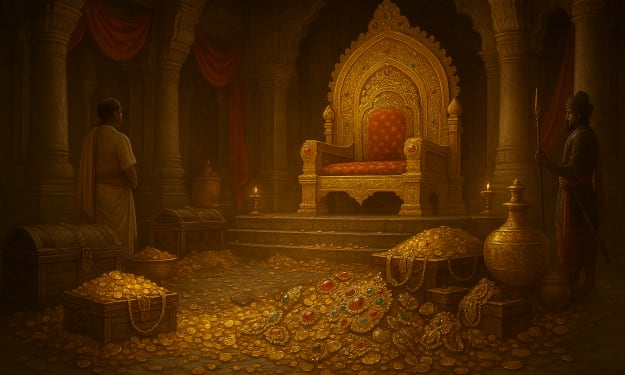
Throne of Gold: The Hidden Wealth of the Pandiyan Kings. AI-Generated.
Throne of Gold: The HiThrone of Gold: The Hidden Wealth of the Pandiyan Kings Introduction: The Heritage of the Pandiyas Among the ancient Tamil monarchies, the Pandiyan dynasty distinguished itself due to its significant cultural and economic impact. Centered in Madurai, the Pandiyan rulers governed a thriving trade empire from as early as the 6th century BCE to the 14th century CE. Their dominion spanned the fertile lands of southern Tamil Nadu, critical ports along the Indian Ocean, and essential trade routes connecting the East and West. Their palaces served not only as political hubs but also as repositories of unimaginable wealth, containing royal thrones crafted from gold, rare gemstones, religious artifacts, war spoils, and offerings from vassals and foreign merchants. The Pandiyan economy was robust, with their coinage circulating in Southeast Asia, the Roman Empire, and China. Sources of the Pandiyan Prosperity Maritime Commerce The Pandiyas operated vibrant ports such as Korkai, Kayal, and Thoothukudi, which linked South India with Southeast Asia, Rome, Arabia, and China. They exported: - Pearls (notably from the Gulf of Mannar) - Spices such as pepper and turmeric - Textiles and dyed fabrics - Sandalwood, ivory, and precious stones Foreign traders, particularly the Romans, transacted in gold coins, which enriched the Pandiyan treasury. Agricultural Abundance The fertile river valleys, especially those surrounding the Vaigai, yielded copious amounts of rice, sugarcane, and cotton. Revenue generated from agriculture swelled the royal treasury. Tributes and Military Campaigns Victories in southern India and alliances with other Tamil dynasties resulted in tribute. Certain campaigns brought treasure troves from rival leaders and temple repositories. Religious Patronage and Temple Wealth The Pandiyas constructed and enhanced temples, such as the Meenakshi Amman Temple in Madurai, which emerged as hubs for both spirituality and wealth accumulation. These temples possessed extensive riches in the form of: - Gold idols - Jewels donated by devotees and monarchs - Artifacts and inscriptions crafted from precious metals The Royal Throne and Palace Wealth Accounts from ancient Tamil literature and observations from foreign travelers (like Marco Polo) depict opulent royal courts: The Pandiyan throne was noted to be made of solid gold, embellished with inlays of diamonds, rubies, and sapphires. Its value in contemporary markets could surpass $50 million USD based solely on material worth. The royal palace in Madurai was replete with: - Ornate furniture made of gold and ivory - Luxurious silk draperies - Weaponry encrusted with gemstones - Royal seals and coins stored in secured vaults A conservative assessment of the palace’s movable wealthexcluding landwould approximate $500 million to $1 billion USD in today’s values, contingent upon current rates for gold, gemstones, and historical artifacts. The Temple Treasuries Temples under Pandiyan authority were centers of economic and cultural significance. The Meenakshi Temple alone was reputed to house: - Gold-plated chariots - Hundreds of gold and silver idols - Thousands of objects inlaid with gemstones - Donations in the form of gold coins and jewelry If the wealth accumulated within the temple were evaluated today, it might easily total $2–3 billion USD or more. Net Worth of the Pandiyan Family and Empire Let us summarize a contemporary estimate based on accessible historical records: | Asset | Estimated Value (Modern USD) | |--------------------------------|-------------------------------| | Royal Throne and Crown Jewels | $50 million | Palatial Artifacts and Safeguards $500 million – $1 billion Temple Relics (Principal Temples) $2–3 billion Gold from Nautical Commerce $500 million Land Tax (Converted Estimate) $1 billion Total Estimated Asset Value $4–5. 5 billion USD This assessment excludes artifacts that are currently lost, plundered, or unrecordednor does it factor in inflation-adjusted valuations of rare relics and inscriptions. Diminution and Distribution of Wealth The Pandiyan empire encountered regular incursions from the Delhi Sultanate in the 14th century, resulting in the plundering of Madurai. A considerable portion of their riches was confiscated, refined, or transported to Delhi. Subsequently, colonial entities (Portuguese, Dutch, British) and internal conflicts further dismantled their legacy. Some valuables disappeared, while others were concealed in temple safes or interred. Nonetheless, the mark of their affluence and magnificence remains evident today in extant temples, retrieved artifacts, and ancient Tamil inscriptions. Conclusion: A Sovereign Fortune Lost and Commemorated The Pandiyan crown, though no longer present, continues to epitomize the zenith of Tamil affluence, maritime dominance, and cultural elegance. The dynasty's true net worthboth material and symbolicmirrors centuries of wealth, astute governance, and expertise in global trade. Their narrative is not solely centered on gold and jewels, but serves as a reminder of a civilization that once illuminated the Indian Ocean realm with its brilliance, philanthropy, and extensive impact.
By Say the truth about a year ago in History
The Lost Golden City of Luxor: Egypt’s Greatest Ancient Treasure
City of Gold: The Myth and Revelation of the Largest Golden City in History Throughout the annals of history, the concept of a "Golden City" has enthralled the imaginations of adventurers, sovereigns, and historians. From the legendary El Dorado in South America to the resplendent cities of ancient India, myriad narratives existbut only a select few have been substantiated by reality. Among these, the recent unveiling of an extensive ancient metropolis near Luxor, Egypttermed the "Lost Golden City" by archaeologistshas been regarded as the most crucial discovery since the tomb of Tutankhamun. This article explores the history, folklore, and archaeological evidence surrounding the largest golden city ever revealed. Introduction: The Appeal of Hidden Wealth For centuries, explorers and monarchs have sought mythical cities purportedly adorned with gold and brimming with riches. Accounts of El Dorado, Paititi, and Shambhala filled the annals of European explorers’ records. While numerous such cities remained myths, the concept of a golden citya prosperous urban center of considerable affluencewas not entirely fictional. In 2021, Egyptian archaeologists made a remarkable proclamation: they had unearthed a 3,000-year-old city beneath the sands of Luxor. Named the “Rise of Aten,” this lost metropolis, also referred to as the Golden City of Luxor, is deemed the largest ancient settlement ever discovered in Egypt. Its significance parallels that of Machu Picchu or Pompeii concerning preservation and historical relevance. The Golden City of Luxor: Discovery and Importance The city was revealed during an excavation initiated by the team of esteemed archaeologist Dr. Zahi Hawass. Initially, the objective was to locate the mortuary temple of Tutankhamun, but what surfaced was something entirely unexpecteda colossal, well-preserved urban center dating back to the reign of Amenhotep III (c. 1391–1353 BCE). What renders this site so significant? It originates from over 3,400 years ago during Egypt’s golden era. Structures are predominantly intact, with walls erect and rooms containing tools, pottery, and jewelry. The city exhibits evidence of prolonged utilization during the reigns of Amenhotep III, Akhenaten, Tutankhamun, and Ay. The city is believed to have functioned as an administrative and industrial nucleus, complete with bakeries, workshops, storage facilities, and residential zones. Inscriptions and seals bearing the name of Amenhotep III corroborate its age and function. A Metropolis of Actual Gold? Was the city constructed of gold? Not literallybut symbolically and economically, it epitomized a golden city in every aspect. Egypt’s Golden Age: Amenhotep III governed during a time of unparalleled prosperity. Commerce with Nubia, Mesopotamia, and the Mediterranean introduced a deluge of gold, ivory, and luxury commodities into Egypt. Temples and Artifacts: Items uncovered at the site include gold jewelry, scarabs, amulets, and toolsindicative of the city’s opulence. Goldsmiths’ Workshops: Evidence of metalworking facilities and molds implies that artisans resided and operated here, fabricating decorations for royalty and temples. Religious and Political Influence: This city likely supported the temple complexes at Karnak and Luxor, rendering it vital to Egypt's religious and political elite. Although the city's walls were not constructed of solid gold, its significance in the processing and distribution of wealth during Egypt's zenith garnered it the moniker "The Golden City. " Life in the Golden City Archaeologists unearthed neighborhoods, thoroughfares, and residences arranged in grid layoutsa distinctive characteristic in ancient Egyptian cities. Among the discoveries: Clay seals of wine vessels and meat parcels Furnaces and kilns for glass and metal fabrication Bracelets, rings, and pottery exemplifying artistic refinement
By Say the truth 2 years ago in History
AI in Cybersecurity: A game changer or a double-edged sword?
Artificial intelligence has utterly transformed cybersecurity in diverse manners, both remarkable and multifold. Its skills—including scouring immense datasets, searching for anomalies and systematising retaliation—have propelled protective tactics to unprecedented heights.
By Abjol Hussain Laskar2 years ago in History
Mike Waltz seen in photos using Signal app at White House after group chat scandal
Mike Waltz Spotted Using Signal App at White House After Group Chat Leak Sparks Controversy Congressman Mike Waltz was recently photographed using the encrypted messaging app Signal during a visit to the White House, sparking new conversations about digital privacy and communication security among lawmakers. The sighting comes in the wake of a recent group chat scandal involving leaked messages from a private conversation among Republican members of Congress. The controversy has heightened awareness of the risks of unsecured communication, pushing several lawmakers to reevaluate how they share sensitive information.
By GLOBAL NEWS2 years ago in History
Letters From a Locked Drawer
The Drawer No One Touched In the quiet town of Meadowridge, 16-year-old Clara Wren lived with her father in an old, creaky house full of memories. Her mother had passed away when Clara was just a baby, and the only thing left of her was an antique wooden desk in the attic. It had belonged to her mother, and on that desk sat a single drawer locked tight for as long as Clara could remember.
By Muhammad Hayat2 years ago in History