Trivia
Antônio Gonçalves Teixeira e Sousa
Antônio Gonçalves Teixeira e Sousa (1812–1861) is often regarded as one of Brazil’s most underrated yet essential literary figures. Born into a life of poverty in Cabo Frio, Rio de Janeiro, to a Portuguese father and an Afro-Brazilian mother, his existence was characterized by struggle, resilience, and a steadfast commitment to literature. Although financial difficulties compelled him to take up carpentry before he could fully engage in writing, Teixeira e Sousa became a significant voice in Brazil’s Romantic movement. His most notable work, O Filho do Pescador (1843), is considered the first Romantic novel in Brazilian literature—a landmark achievement that, despite his current lack of recognition, secures his position in the annals of literary history.
By A Históriaabout a year ago in History
History Would’ve Burned: How Fire Shaped Civilizations
Fire is one of humanity’s oldest and most transformative discoveries. Its mastery marked the dawn of civilization, altering the course of history in ways both constructive and destructive. From providing warmth and protection to enabling technological advancements, fire has been a double-edged sword—capable of nurturing societies or reducing them to ashes. This article explores how fire has shaped human history, from prehistoric times to the modern era, and how civilizations have risen, fallen, and adapted in its flames. The Dawn of Fire: Humanity’s First Great Tool The controlled use of fire dates back at least 1 million years, with evidence suggesting that early hominids like Homo erectus harnessed it for warmth, cooking, and protection. Fire allowed early humans to: Cook food, making it more digestible and unlocking greater nutritional value, which may have contributed to brain development. Ward off predators, enabling safer settlements. Extend waking hours by providing light after sunset, fostering social interaction and tool-making. Without fire, human evolution and migration—especially into colder climates—would have been drastically different. Fire and the Birth of Civilization As humans transitioned from nomadic hunter-gatherers to settled agricultural societies, fire became indispensable. 1. Agriculture & Land Management Slash-and-burn farming cleared forests for crops, though it also led to soil depletion over time. Controlled burns were used by Indigenous peoples to manage ecosystems, promoting biodiversity. 2. Metallurgy & Technology The discovery of smelting (extracting metal from ore using fire) revolutionized tool-making, leading to the Bronze and Iron Ages. Fire enabled ceramics and glassmaking, essential for storage, construction, and art. 3. Warfare & Destruction Fire was weaponized early, from flaming arrows to Greek fire (a Byzantine incendiary weapon). Cities like Rome (64 AD) and London (1666) suffered catastrophic fires that reshaped urban planning. Fire as a Cultural and Religious Symbol Beyond its practical uses, fire held deep spiritual significance: Zoroastrianism revered fire as a symbol of divine wisdom. Greek mythology told of Prometheus, who stole fire from the gods to give to humanity. Hindu rituals involve sacred fires (yajna) for purification and offerings. The Industrial Revolution: Fire Powers the Modern World The 18th and 19th centuries saw fire’s role expand exponentially with the advent of: Steam engines (burning coal) powering factories and transportation. Internal combustion engines, leading to automobiles and airplanes. Electricity generation, initially through coal and later gas and oil. However, industrialization also brought pollution, deforestation, and climate change—unintended consequences of humanity’s reliance on fire. Fire in the Modern Age: Control and Catastrophe Today, fire remains both a vital tool and a devastating force: 1. Controlled Use Energy production (natural gas, nuclear reactions). Space exploration (rocket propulsion). Medicine and industry (sterilization, manufacturing). 2. Uncontrolled Disasters Wildfires (exacerbated by climate change) destroy millions of acres annually. Urban fires (e.g., Grenfell Tower, 2017) reveal vulnerabilities in modern infrastructure. Warfare (napalm, incendiary bombs) continues to use fire as a weapon. Conclusion: Will Fire Consume or Sustain Us? Fire has been a defining force in human history—both creator and destroyer. As we advance, the challenge is to harness its power responsibly, mitigating its dangers while leveraging its benefits. From ancient campfires to fusion energy, fire remains at the heart of civilization’s progress. If history is written in flames, then humanity’s future will be shaped by how well we master this primal force—before it masters us.
By Silas Blackwoodabout a year ago in History
Julia Thomas: The Woman Who Died Chasing the Lost Dutchman’s Gold
🌵 She Sat by His Bedside. Then She Went Looking for Gold. In the vast, rugged history of the American West, few tales are as enduring — or as haunting — as that of the Lost Dutchman’s Gold Mine. Most versions of the story center on Jacob Waltz, the elusive German immigrant who allegedly hid a treasure trove of gold deep in Arizona’s Superstition Mountains.
By Rukka Novaabout a year ago in History
The Peralta Stones: Are These Ancient Maps the Key to the Lost Dutchman’s Gold — or the Greatest Treasure Hoax in American History?
A Treasure Map Carved in Stone… Or Just a Clever Mystery? Imagine stumbling across a set of heavy, hand-carved sandstone tablets buried in the Arizona desert — covered in cryptic symbols, Latin inscriptions, and what looks like a map.
By Rukka Novaabout a year ago in History
99-million-year-old dinosaur tail found preserved inside amber fossil
**99-Million-Year-Old Dinosaur Tail Found Preserved Inside Amber Fossil** In one of the most extraordinary paleontological discoveries of the 21st century, scientists have uncovered a 99-million-year-old dinosaur tail preserved in amber. This rare and stunning find, unearthed in Myanmar, has provided researchers with a unique glimpse into the ancient world, revealing incredible details about feather evolution, dinosaur biology, and the ecosystems of the Cretaceous period.
By GLOBAL NEWSabout a year ago in History
Joe Biden. AI-Generated.
Joe Biden was born on November 20, 1942, in Scranton, Pennsylvania, a small city in the United States. He grew up in a working-class family. His father, Joseph Biden Sr., worked very hard to take care of the family. At times, the family had little money. But they stayed strong and close together.
By Khalil Rehmanabout a year ago in History
Gerrymandering the Presidency: Why Trump could lose the popular vote in 2020 by 6 percent and still win a second term.
Donald Trump was the clear Electoral College winner in the 2016 election, despite losing the popular vote by a wide margin to Hillary Clinton. Anthony J. McGann, Charles Anthony Smith, Michael Latner and Alex Keena write that, unless the Supreme Court stops congressional gerrymandering, President Trump can guarantee re-election in 2020 – even if he loses by 6 percent. When the US Supreme Court takes up the issue of partisan gerrymandering this year, they will decide not only the fate of popular control in the House of Representatives and many state legislatures, but quite possibly the Presidency as well. If four Republican controlled state governments (Pennsylvania, Michigan, Wisconsin and Florida) change the way they allocate Electoral College votes, President Trump could be re-elected in 2020, even if he loses the popular vote by 6 percentage points. All the states need do is to allocate Electoral College votes by congressional district (like Nebraska and Maine), instead of giving all of the state’s electors to the statewide winner. Of course, this strategy only works to the benefit of the Republicans because the congressional districts in these states are heavily gerrymandered. As we argue in our book Gerrymandering in America, the congressional districts in many states are drawn to advantage the Republican Party. For example, in Pennsylvania in 2012 the Republicans took 13 out of 18 House districts even though the Democrats received more votes. If this partisan gerrymandering were outlawed, then allocating Electoral College votes by congressional district in the four states would actually disadvantage the Republican candidate for President. However, if the Supreme Court continues to allow partisan gerrymandering – as it has since its decision Vieth v. Jubelirer in 2004 – then the plan is highly effective and there is nothing that can stop the four states adopting it. Allocating Electors by congressional district is clearly legal – Nebraska and Maine already do it this way. Furthermore, the Republicans control the state legislature and the governor’s mansion in all four states. How allocating Electors by congressional districts could benefit the Republican candidate Surprisingly, the strategy that is most effective for the Republicans is to change how Presidential Electors are allocated in certain states that voted for Trump in 2016. Of course, the Republicans would get an advantage by allocating Electors more proportionally in states that Clinton won. The problem is that this would require the support of Democrats. For example, Republican legislators in Virginia and Minnesota have already proposed such measures, and Stephen Wolf describes this as an attempt to “gerrymander the electoral college”. The problem is that both these states have Democratic governors, who would surely veto such proposals. Similarly Harry Enten at fivethirtyeight.com shows that if all states allocated Electors by Congressional districts, the Republicans could win the Presidency despite a 5 percent popular vote deficit. Again the problem is that this would require Democratic controlled states to agree to such a system. However, in Pennsylvania, Wisconsin, Michigan and Florida, Republicans control both the state legislature and the
By Silas Blackwoodabout a year ago in History
2024 Election Fallout: Supreme Court Rules on Trump’s Immunity Case
Introduction In a historic decision that could reshape the future of U.S. presidential accountability, the Supreme Court ruled on former President Donald Trump’s immunity case in 2024. The case, Trump v. United States, centered on whether a former president enjoys absolute immunity from criminal prosecution for actions taken while in office. The ruling not only impacts Trump’s multiple legal battles but also sets a precedent for the limits of executive power. This article examines the Court’s decision, its legal and political implications, and the potential consequences for the 2024 election and beyond. Background: The Legal Battle Over Presidential Immunity
By Silas Blackwoodabout a year ago in History
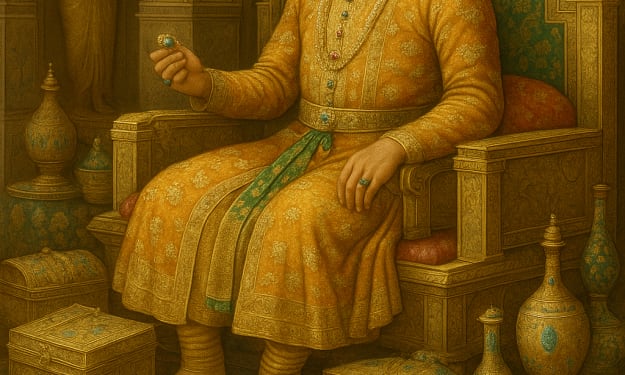
The Disappeared Gems of Emperor Jahangir: An Elusive Mughal Wealth Beyond Belief. AI-Generated.
The Golden Era of the Mughal Empire The Mughal Empire during the early 17th century was at the zenith of its splendor. Encompassing a vast expanse of the Indian subcontinent, it exhibited a thriving economy, a strong administrative framework, and luxurious courtly life. Jahangir, whose name translates to "Conqueror of the World," assumed the throne in 1605 after Akbar’s passing and governed for over twenty years. Unlike his predecessor, Jahangir was not a formidable military commander, yet he was a shrewd ruler and a fervent supporter of the arts. His court was populated by Persian painters, architects, and jewelers. During his reign, Mughal artistry attained unprecedented levels, with his palaces adorned with gemstones, pearls, and intricate gold craftsmanship. The Imperial Jewel Collection Jahangir’s wealth represented more than merely a token of royal affluenceit was a meticulously assembled collection of some of the most remarkable objects ever gathered in the subcontinent. These encompassed: The Timur Ruby, a substantial, crimson gem etched with the names of Mughal emperors. Thrones embellished with pearls and golden chests encrusted with emeralds and sapphires. Valuable jewelry, consisting of jeweled turban ornaments, anklets, rings, and ceremonial daggers. European artifacts, presented by foreign emissaries, such as mechanical clocks and Venetian glass. The emperor had a particular fondness for jade and rock crystal, commissioning inscribed wine vessels and dishes from craftsmen throughout Persia and Central Asia. Jahangir’s Affection for Opulence Jahangir was noted for his excessparticularly in wine and opium. He frequently hosted extravagant gatherings where the nobility exhibited their fortunes and competed in extravagance. Historical accounts describe evenings where carpets woven with gold thread were extended, and rosewater was poured from diamond-adorned ewers. His illustrious autobiography, the Tuzk-e-Jahangiri, expounds on his admiration for beauty and artistry. However, it also suggests an increasing disengagement from governance as his sons and nobles contended for power, notably Prince Khurram, who would eventually become Shah Jahan. The Enigma of the Vanished Wealth Following Jahangir's death in 1627, a fierce conflict for succession ensued. Shah Jahan triumphed, yet not without consequence. During the struggle for power, numerous jewels of Jahangir were plundered by rival factions. Some royal possessions were concealed by loyal supporters, while others were sold or lost during hurried retreats. In subsequent years, the treasure became increasingly scattered. As Shah Jahan constructed the Taj Mahal and Peacock Throne, he integrated some of his father’s jewels into his own collectionbut significant portions were never rediscovered. The circumstance deteriorated with the subsequent decline of the Mughal Empire. By the time of Aurangzeb's reign in the late 17th century, civil conflicts and the escalating menace from regional monarchies undermined the empire. European entities, particularly the British East India Company, capitalized on this frailty. Colonial Exploitation and Diminution The ultimate strike to Jahangir’s lost riches may have occurred during the British colonial era. After the British seized Delhi in 1857 subsequent to the Indian Rebellion, the Red Fort was plundered. Numerous royal relics, including manuscripts, jewels, and ceremonial objects, were either taken or exported abroad. Presently, various Mughal gemstones thought to originate from Jahangir’s epoch can be located in museums and private collections throughout Europe. The Timur Ruby, for example, is currently part of the British Crown Jewels collection, inaccurately classified as a ruby despite being a spinel. Could the Wealth Still Be Concealed? Scholars and treasure seekers have long pondered that a portion of Jahangir’s wealth was concealed during the succession conflicts and has yet to be retrieved. Folklore in northern India recounts tales of subterranean vaults near Agra and Lahore that remain sealed, filled with Mughal gold and emeralds. Unauthorized excavations have even taken place in the vicinity of Fatehpur Sikri and the ancient Mughal pathways. While no verified treasure has been discovered, remnantssuch as jeweled sword hilts or enameled ornamentsoccasionally appear in antique markets or during urban excavations. The Enduring Legacy of Jahangir’s Wealth Regardless of whether Jahangir’s entire treasure will ever be recovered, its influence on art and history is indisputable. His enthusiasm for collecting reshaped the Mughal aesthetic, merging Persian sophistication with Indian opulence. The art, architecture, and craftsmanship patronized during his rule remain among the most distinguished in South Asian history. In many respects, the lost wealth signifies not merely gold or jewelsit embodies a missing chapter of imperial aspiration, cultural integration, and regal magnificence.
By Say the truth about a year ago in History
70 Rare Historical Photos That Shaped Global History – From Gandhi to Guevara, Einstein to Elvis
1. Madhubala – The Eternal Beauty Madhubala, often hailed as the most beautiful actress Indian cinema has ever seen, remains an enduring symbol of grace, charm, and cinematic brilliance. Her performances in classics like Mughal-e-Azam continue to mesmerize audiences decades after her untimely demise.
By Sujeet M Sonarabout a year ago in History
Brooklyn Bridge History: 15 Reasons It Became a New York City Icon
The Brooklyn Bridge is one of the most famous bridges in the world. It connects Manhattan and Brooklyn, two important parts of New York City. Every day, thousands of people walk, bike, or drive across it. But why is the Brooklyn Bridge so famous? Let’s look at 15 simple reasons why this bridge became a true New York City icon.
By Sangita Nandiabout a year ago in History