Research
The Journey of the Kohinoor
The Adventure of the Kohinoor: From 700 Carats to 100 Carats The Kohinoor diamond, additionally accepted as the "Mountain of Light," has captivated the acuteness of the apple for centuries. Revered as one of the best adored gems anytime discovered, its history is as arresting as its beauty. This commodity explores the Kohinoor's aboriginal size, its abridgement over the centuries, and the affairs beneath which it absent its grandeur. The Discovery and Aboriginal Size The origins of the Kohinoor design are buried in mystery, but it is believed to accept been apparent in the Kollur mines of India, amid in abreast Andhra Pradesh, about the 13th century. Initially belief an amazing 793 carats in its uncut form, the Kohinoor was already acclaimed for its amazing accuracy and clarity. Its immense admeasurement fabricated it one of the better chunk anytime unearthed, a attribute of immense abundance and all-powerful favor. Early Ownership The diamond's aboriginal recorded actualization in history is in the control of the Kakatiya dynasty. It adorned a celestial in a temple, emblematic the all-powerful appropriate of kingship. Back the Delhi Sultanate invaded in the aboriginal 14th century, the gem was bedeviled and became a allotment of the boodle of war. From this point onward, the Kohinoor began its agitated journey, casual through the easily of assorted rulers, including the Mughal emperors. Under Mughal rule, the Kohinoor was acutely displayed on the Peacock Throne of Shah Jahan, a masterpiece encrusted with adored gems. However, the diamond's admeasurement began to change back it was re-cut to enhance its brilliance, a accommodation that would adapt its concrete characteristics forever. The Aboriginal Major Reduction In the mid-18th century, afterwards the abatement of the Mughal Empire, the Kohinoor came into the control of the Persian adjudicator Nader Shah, who abundantly exclaimed, "Koh-i-Noor!" (Mountain of Light) aloft seeing it. Nader Shah’s breed transported the gem to Afghanistan, area it underwent added modifications. By the time it accustomed in Punjab in the aboriginal 19th century, the Kohinoor had already been bargain decidedly from its aboriginal admeasurement of 793 carats. Maharaja Ranjit Singh, who came to acquire the gem, ensured that it remained a attribute of Sikh pride and power. The British Era and Final Reduction The best affecting abridgement in the admeasurement of the Kohinoor occurred during the British era. Afterwards the Second Anglo-Sikh War in 1849, the British annexed Punjab and acquired the Kohinoor as allotment of the Treaty of Lahore. The design was alien to England, area it was presented to Queen Victoria as a blemish of war. In 1852, Prince Albert, Queen Victoria’s consort, absitively to re-cut the Kohinoor to access its accuracy and adjust with abreast European tastes. The re-cutting action took 38 canicule and bargain the design to a bald 105.6 carats. This desperate abridgement was met with disappointment, as the gem absent abundant of its aboriginal admeasurement and allure. The Accepted Admeasurement and Setting Today, the Kohinoor weighs 105.6 carats and is set in the advanced of the Queen Mother’s Crown, displayed in the Tower of London as allotment of the British Crown Jewels. While its accepted admeasurement is still impressive, it pales in allegory to its aboriginal amplitude of 793 carats. How Did the Kohinoor Lose Its Size? The cogent abridgement in the Kohinoor’s admeasurement can be attributed to several factors: Re-cutting for Aesthetics: The Kohinoor was again cut to enhance its accuracy and symmetry, in band with the artful preferences of its assorted owners. Technological Limitations: Aboriginal acid techniques lacked precision, arch to a accident of actual during the process. Cultural Shifts: European tastes in adornment advantaged smaller, added ablaze chunk over larger, uncut ones. A Attribute of Controversy The Kohinoor’s abridgement in admeasurement is not the alone advancing aspect of its history. Its buying charcoal a accountable of acrimonious debate. India, Pakistan, Iran, and Afghanistan accept all laid affirmation to the diamond, citation actual and cultural significance. The British government has consistently alone calls for its return, arguing that it was acquired accurately beneath the Treaty of Lahore. Conclusion The Kohinoor diamond’s adventure from a 793-carat uncut gem to its accepted anatomy of 105.6 carats is a account of conquest, craftsmanship, and cultural shifts. While it has absent abundant of its aboriginal size, the Kohinoor charcoal an constant attribute of ability and prestige. Its adventure continues to attraction the world, reminding us of the complexities of history and the constant attraction of beauty.
By Say the truth 2 years ago in History
Mahakumbh Mela
The Mahakumbh: A Spiritual Odyssey The Mahakumbh Mela, often regarded as the world’s largest spiritual gathering, is a festival that embodies the essence of India’s rich cultural and religious tapestry. Held once every twelve years, it is a celestial confluence of faith, mythology, and community. Millions of devotees, ascetics, pilgrims, and tourists from across the globe flock to the designated holy sites to immerse themselves in the sanctity of this grand event.
By NEERAJ KUMAR SINGH2 years ago in History
Snowstorm Weather Forecast for the UK
The United Kingdom is preparing for a significant snowstorm, and weather experts are warning people to get ready. Winter weather can bring beauty, but it can also cause challenges for travel, homes, and daily life. Here's everything you need to know about the upcoming snowstorm in simple terms.
By Farhan Sayed2 years ago in History
Blue Monday
Every year, on the third Monday of January, people around the world hear about something called "Blue Monday." It is often referred to as the "saddest day of the year." But what is Blue Monday, and why do people believe it is so depressing? Let’s explore the meaning, origins, and truth behind this idea.
By Farhan Sayed2 years ago in History
Mahakumbh mela
The Mahakumbh Mela is one of the largest spiritual gatherings in the world celebrated with great fervor and devotion by Hindus Rooted in ancient tradition and mythology the event signifies the confluence of faith culture and spirituality Held every twelve years at four holy riverbank locations in India Haridwar Prayagraj Ujjain and Nashik the Mahakumbh is an occasion where millions of devotees come together to take a sacred dip in the holy rivers believing it will purify their souls and wash away their sins Historical and Mythological Significance The origin of the Mahakumbh Mela is deeply embedded in Hindu mythology particularly the tale of the Samudra Manthan Churning of the Ocean According to legend gods Devas and demons Asuras churned the cosmic ocean to extract the nectar of immortality or Amrit As the pot containing Amrit emerged a fierce battle ensued To safeguard the nectar Lord Vishnu in the guise of Mohini took the pot and ensured its distribution among the gods During this pursuit drops of Amrit fell at four places Haridwar Prayagraj Ujjain and Nashik sanctifying these locations The Mahakumbh is celebrated to commemorate this divine event Rituals and Practices The central ritual of the Mahakumbh Mela is the Shahi Snan Royal Bath where devotees bathe in the holy river It is believed that the waters become charged with divine energy during this period offering spiritual benefits Several auspicious dates are chosen for these baths often coinciding with planetary alignments which are considered to amplify the spiritual potency of the ritual
By Anishant Singh2 years ago in History
A cutthroat love story
Some time ago, in a domain where hearts were the most valuable fortunes, there carried on with a young lady named Lyra. Her reality was one of unending magnificence, yet in addition of perpetual distress. The land, called Lumen, was managed by a strong and baffling power known as the Wanton — spirits who had lost their affection, their feelings, and their mankind. They meandered the world, unfilled and empty, trying to take the hearts of others to make up for their own shortcoming.
By Ahmad hasan Tamim2 years ago in History
The Hidden Tomb of Genghis Khan: A Legacy of Secrecy and Bloodshed. AI-Generated.
While such occurrences are shocking, they pale in comparison to a historical event involving Genghis Khan. In 1227, the infamous Mongol ruler ensured the secrecy of his burial by ordering the massacre of everyone who attended his funeral. This was not mentioned in any invitation, of course. To further protect the secret, even the soldiers who carried out the killings were slain by another group of soldiers, ensuring no witnesses remained to betray the location of his tomb. This ruthless bloodshed aimed to keep the precise whereabouts of Genghis Khan’s final resting place hidden from the world. Given that he was responsible for the deaths of around 40 million people during his brutal conquests, this additional loss of life seemed almost insignificant by his standards, reflecting the extreme lengths to which he would go to preserve his legacy.
By Ahmed mohsin2 years ago in History
The Majestic World of Horses
There’s something undeniably magical about horses. Whether you’ve watched them gallop across an open field, admired their elegance at a racetrack, or simply enjoyed the gentle nuzzle of one seeking a treat, horses have a way of capturing our imagination and our hearts. But what is it about these majestic creatures that has fascinated humans for thousands of years?
By Rachel Morgan2 years ago in History
Ancient Egypt Unveiled. AI-Generated.
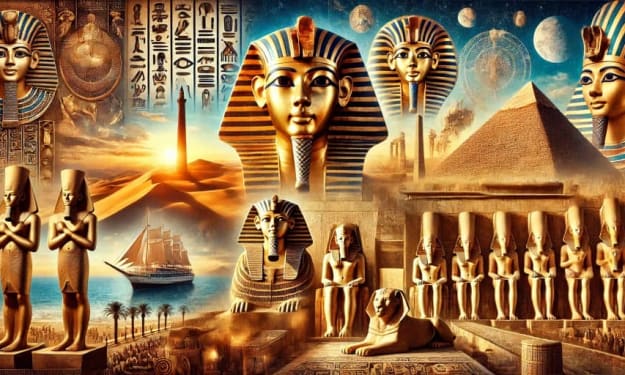
Over a span of more than 3,000 years, ancient Egypt emerged as a luminary of power and innovation, its grandeur enduring until Alexander the Great's conquest in the 4th century BC. This fascinating civilization bequeathed us with awe-inspiring monuments and enigmatic mysteries that continue to capture our imagination and curiosity.
By SimplyWrite2 years ago in History
Can You Read This Cursive Handwriting? The National Archives Wants Your Help
The National Archives houses countless historical documents, many written in cursive and dating back more than two centuries. These records, however, can be challenging to read, particularly for individuals who were never taught cursive in school.
By Rachel LaBella2 years ago in History
The Majestic Wealth of King Solomon
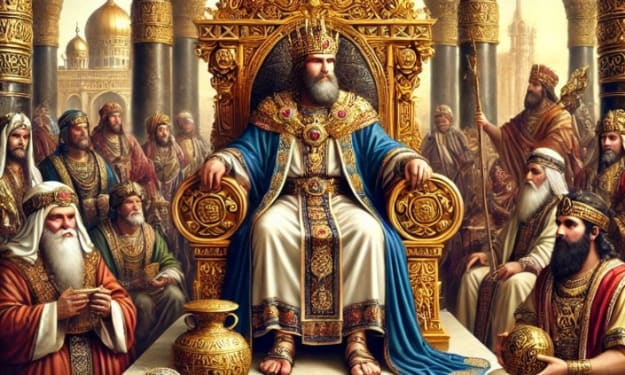
"The Allegorical Abundance of Baron Solomon" Introduction: The name Baron Solomon evokes visions of unparalleled wealth, wisdom, and power. As the son of Baron David and the adjudicator of the United Commonwealth of Israel, Solomon’s reign, which lasted from about 970 to 931 BCE, has been immortalized in biblical texts, actual accounts, and cultural lore. Known as the wealthiest baron in history, Solomon’s abundance was said to be so all-inclusive that it became a antecedent of attraction for centuries. But what fabricated Baron Solomon’s abundance so extraordinary? This commodity explores the sources of his prosperity, the amplitude of his kingdom, and the constant abstruseness surrounding his allegorical riches. 1. The Sources of Solomon’s Wealth King Solomon’s immense abundance was acquired from assorted sources, anniversary accidental to his allegorical status. a. Barter and Commerce: Solomon’s cardinal position in the age-old apple accustomed him to boss key barter routes amid Africa, Asia, and Europe. His agile of ships, congenital with the advice of Hiram, the Baron of Tyre, enabled Israel to authorize amphibian barter with abroad acreage like Ophir and Sheba. These voyages brought aback gold, silver, ivory, spices, and adored stones, adorning his commonwealth immensely.
By Say the truth 2 years ago in History