Places
"King Baldwin: The Untold Legend of the Medieval Warrior Who Changed History!"
King Baldwin: A Comprehensive Look at the Crusader King's Life and Legacy King Baldwin, often remembered as a pivotal figure in the history of the Crusades, played a crucial role in shaping the Holy Land. His life and actions not only influenced his time but continue to be studied for their enduring impact on history. Baldwin I of Jerusalem: From Brother to King Early Life and Family Ties: His Relationship with Godfrey of Bouillon Baldwin I, born in the late 11th century, grew up in a noble family. He was the brother of Godfrey of Bouillon, a leader of the First Crusade. Their bond was important in Baldwin's early years and later shaped his decisions as a ruler. Military Prowess: Key Battles and Strategic Decisions in the First Crusade Baldwin displayed military skill during the First Crusade, participating in major battles. His tactical abilities helped secure victories against Muslim forces. These victories established his reputation and laid the groundwork for his ascent to the throne. Consolidation of Power: Establishing the Kingdom of Jerusalem In 1099, after the capture of Jerusalem, Baldwin became the first king of Jerusalem. He worked hard to unite diverse factions and solidify his power. His reign marked the beginning of a new era in the region. Baldwin II of Jerusalem: A Ruler Faced with Constant Threats Challenges to the Throne: Internal Conflicts and External Enemies Baldwin II faced numerous challenges during his reign. Internal strife among nobles and external threats from Muslim armies constantly tested his leadership. Despite these challenges, he managed to hold his kingdom together. Political Maneuvering: Maintaining Power in a Turbulent Region Baldwin II excelled in political maneuvering. He often formed alliances with local leaders to strengthen his position. His ability to navigate a complex political landscape was crucial for his reign. Securing Alliances: Diplomatic Strategies and Marriages Baldwin II utilized marriages to secure alliances. These strategic unions helped forge crucial partnerships. He understood the power of diplomacy in a tumultuous region. Baldwin III of Jerusalem: The Boy King's Rise to Power Early Reign and Mentors: Overcoming the Challenges of Youthful Leadership Baldwin III ascended to the throne as a teenager, presenting unique challenges. He relied on experienced mentors to guide him through the complexities of kingship. This support was vital for his early reign. Military Victories: Significant Battles and Expansion of the Kingdom Under Baldwin III, the kingdom saw significant military successes. His leadership in various battles expanded Jerusalem's territory and solidified its power in the region. Building Infrastructure: Strengthening Jerusalem's Defenses and Economy Baldwin III focused on improving Jerusalem's infrastructure. He invested in fortifications and the economy, aiming to strengthen the kingdom's resilience against external threats. Baldwin IV of Jerusalem: The Leper King and His Enduring Legacy Health Challenges and Political Implications: Ruling Despite Illness Baldwin IV, known as the Leper King, faced immense obstacles due to his health. His illness, however, did not impede his commitment to leadership. He ruled with determination, earning respect from his subjects. Military Strategies and Leadership: Victories Against Saladin's Forces Baldwin IV's military strategies were noteworthy. He achieved significant victories against Saladin’s forces, showcasing his capabilities as a leader despite his challenging condition. Succession Crisis: The Fight for Power After His Death Baldwin IV’s death led to a succession crisis. The kingdom faced instability as various factions vied for control. This turmoil had lasting impacts on the future of Jerusalem. Baldwin V of Jerusalem: A Brief Reign, A Lasting Impact Short Rule and Guardianship: The Challenges of a Child King Baldwin V became king at a young age, facing immense challenges. His reign was short-lived, and he relied heavily on guardians to manage state affairs. Nevertheless, his short rule had significant implications. Significance in the Larger Context of the Crusader States Baldwin V's reign occurred during a critical time for the Crusader States. His leadership, though brief, impacted the political landscape and set the stage for future conflicts. Legacy: The Impact of His Reign on the Future of Jerusalem Despite his young age and short time on the throne, Baldwin V's legacy endured. His reign contributed to the complex history of Jerusalem during the Crusades. Conclusion: The Enduring Legacy of the Baldwin Dynasty in the Crusader States Key Takeaways: Summarizing Baldwin's collective contributions and challenges The Baldwin dynasty, with its range of rulers, played a vital role in the Crusader States. Each king faced unique challenges but collectively influenced the region's history. Their actions shaped the kingdom's future. Historical Significance: Analyzing the long-term effects of the Baldwin era The era of the Baldwins marked significant developments in military strategy, diplomacy, and governance in the Holy Land. Their legacies are still studied in historical contexts today. Further Research: Suggesting additional avenues for exploration For those interested in this fascinating period, exploring individual battles, alliances, and the cultural impacts of Baldwin's reign will provide deeper insights into the complex history of the Crusader States.
By Story silver book 2 years ago in History
Why Does the New Year Start on January 1?
New Year's Day is one of the most celebrated events in the world, marking a new calendar cycle with the coming of January 1st each year. But out of 365 days, which one was chosen to be the beginning of the calendar? It lies in an interesting mix of ancient history, religious significance, political reforms, and international standardization. Let's get on the journey of how January 1 became synonymous with the start of a new year and examine some cultural and historical factors that contributed to the choice. The Roman Roots of the Calendar For those to learn why the New Year has to start on January 1 we have to go back into ancient Rome. The very first calendar that the city of Rome brought in 753 years before Christ by Romulus is a basic 10-month lunar calendar, which has started in March, known after Mars the Roman God of War; this just makes sense to an agrarian and a military people because March brings the plantings and, of course, military campaigns. However, the early calendar was not a good record. This covered only 304 days. The "winter" period at the end was then left to estimate. This variation brought serious differences in reconciling the calendar with the solar year. The second king of Rome, King Numa Pompilius, about 713 BCE introduced the additional two extra months: one after the god Janus, god of beginnings January, and February after purification. That approach made the Roman calendar much closer to the solar year of 365 days because the Roman calendar became a 12-month calendar. Although January was the added calendar month, March was the start of the year for such a long period. It was because spring was one of the renewal seasons of Rome, which marked cycles for agriculture as well as the military. Janus: The God of Beginnings There were certainly logical reasons the date of January was chosen for the beginning of the calendar year. January was derived from the name of a two-faced Roman god Janus, who represented crossing thresholds and doorways of new beginnings. Janus guarded the threshold of the seasons, among other things the threshold between one year and another. The personage of Janus, one face gazing into the past and the other into the future, perfectly typified the duality of reflection and anticipation that characterizes the New Year. Romans commonly made sacrifices to Janus in January, asking for his blessing in the coming year. This symbolic connection to the origins meant January became a natural fit when reforms finally established it at the beginning of the year. Julian Calendar: A System Contained Julius Caesar renewed another modification made on the Roman calendar when it was still in his government. By 46 BCE, confusion related to the synchronization with the solar year was now in disorder; therefore, seasons in terms of planting time and holding festivals as well as any state function could no longer be decided correctly. Caesar introduced the Julian calendar, which is actually a solar-based system set to correct those mismatches. It comprises 365 days divided into 12 months, with an added extra year leap every four years for making sure that an extra quarter of a day in Earth's orbit had been compensated for. Under this reform, January 1 was decided to be the beginning of the year. It was partly practical in that it coincided with the solar year and was thus uniform but symbolically carried weight because a start to the year at the beginning of January honored Janus and reinforced his connection to new beginnings and turning points. Not, however did everyone take the January 1 change on day one. Local custom throughout the Roman Empire would mean it wasn't uncommon for New Year celebrations to continue being observed in March or whatever other month was locally fashionable. This continued even when Europe's later centuries saw a process of Christianization; this is because churchmen needed to coordinate the calendar around the major festivals of Christianity. The Gregorian Calendar: Harmonizing the Globe Another reform was brought in 1582 by Pope Gregory XIII when he initiated the Gregorian calendar. This arose because the Julian calendar carried a leap-year system, which overcompensated through the years and resulted in a drift of nearly about 10 days over centuries. The leap-year rules were readjusted, and calendar readmitted to proper alignment with the solar year; it corrected its error. It even made January 1 a New Year's Day for most of the Christian world. The use of the Gregorian calendar was adapted gradually. All the major Catholic nations were adopted promptly, including Spain, Italy, and France. Meanwhile, the protestant countries took their fair share of time to acquire this form of calendar. Long ago, the Gregorian calendar is now the recognized world-wide calendar. All nations welcomed New Year starting on January 1. Although it is today's most widely accepted New Year, not all of it celebrates during this date of January 1. This makes most societies have maintained the traditional calendars and festivities proving how different time measuring as well as marking of beginnings ways are. Chinese New Year: It occurs between late January and mid-February depending on the lunar calendar. It is a time of great festivity, family reunions, and symbolic rituals for ushering in prosperity. Jewish New Year (Rosh Hashanah): It falls during early autumn, a period of reflection, prayer, and renewal in the Jewish calendar. Islamic New Year (Hijri): The first day of Muharram marks the start of the Islamic new year, which is based on a lunar calendar. Hindu New Year: In India, every region celebrates the new year according to their regional lunar or solar calendars using Ugadi, Gudi Padwa, or Diwali. This indicates the richness of human culture and the different ways in which people relate to the passage of time. Significance of January 1 Today, January 1, is a grand symbol of renewal and hope. People throughout the world celebrate this event with fireworks, celebrations, and personal resolutions. It's the time when everyone is called to reflect upon one's achievements and challenges over the last year, and how to be hopeful about the opportunities that will soon knock the door. In many ways, the day transcends historical roots to become a marker of progress for the masses. Whether it is over midnight toasts or in the quietest moments of introspection, January 1 personifies the human desire to reinvent and renew itself. The choice of January 1 as the New Year is deeply embedded in history, shaped by the legacy of ancient Rome, the reforms of Julius Caesar, and the world embracing the Gregorian calendar. While its origins are specifically cultural and religious, it has become a universal day to celebrate and unite all humanity across the globe. From the symbolic power of Janus to practical alignments with the solar year, the journey of January 1 as New Year's Day reflects man's eternal desire to measure time and create communal tradition. Every year that we gather to celebrate this anniversary brings us closer to the calendar's new page, but also to the centuries-old tradition that makes us connect with the past and propels us forward into time.
By J Pavan Kumar2 years ago in History
Discover the island of Crete: a jewel in southern Greece
Crete, Greece’s largest island, fascinates with its breathtaking scenery, legendary history and warm culture. With its golden beaches, towering mountains and picturesque villages, Crete offers the perfect balance of relaxation, exploration and cultural immersion. This Mediterranean island, located at the crossroads of three continents, appeals to adventure seekers and history buffs alike. Its ancient sites, wilderness trails and authentic gastronomy reflect a rich and vibrant heritage. Discover this jewel of southern Greece, where every corner of the island tells an unforgettable story.
By Growy and Tasty2 years ago in History
Unsung Plagues: 10 Historical Pandemics You Should Know About
History is littered with the wreckage of forgotten catastrophes, and among the most devastating are the unsung plagues that have ravaged humanity. While the Black Death and Spanish Flu remain etched in our collective memory, countless other epidemics have left equally profound, albeit less-remembered, marks on civilizations. This exploration delves into ten such historical pandemics, revealing their terrifying impact on societies and offering a sobering reminder of humanity's ongoing vulnerability to infectious disease. From ancient Rome to modern times, these forgotten outbreaks offer valuable lessons about resilience, public health, and the enduring power of disease.
By Agammegwa udo philip2 years ago in History
The Dawn of Civilization
The history of cities is the history of human progress. Cities have transformed the way we live, offering better living conditions, increased food storage, and enhanced knowledge transfer across generations. This transformation set the stage for the society we know today, complete with its unique challenges and triumphs. But have you ever wondered: What was the first city in history?
By A História2 years ago in History
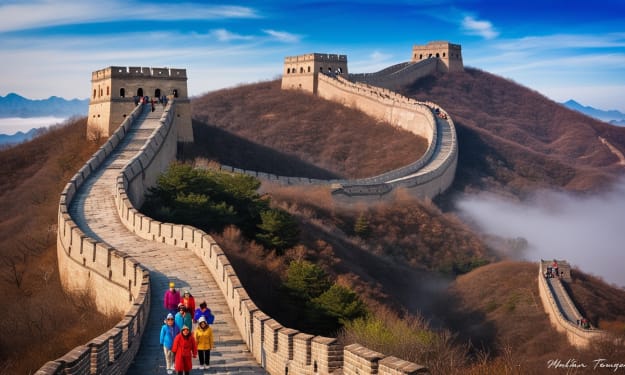
The Story of the Great Wall of China: A Symbol of Strength and Determination
The Story of the Great Wall of China: A Symbol of Strength and Determination Introduction The Great Wall of China stands as one of humanity’s most extraordinary architectural feats. Stretching over 13,000 miles, it symbolizes strength, resilience, and cultural unity. Built over centuries, this monumental structure aimed to protect China from invasions, regulate trade, and solidify the empire’s boundaries. In this article, we will explore the history, purpose, and legacy of the Great Wall, highlighting how it became a timeless emblem of perseverance.
By 💓 Pulse of Stories 💓2 years ago in History
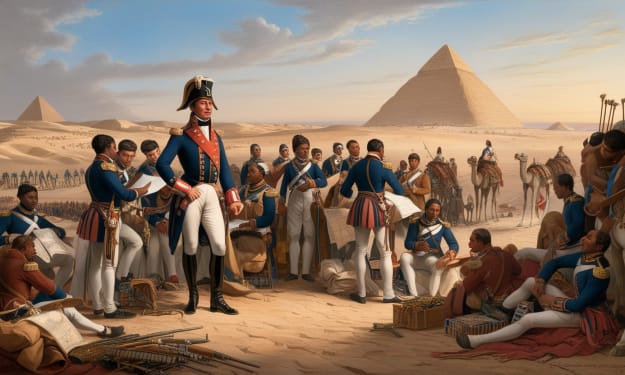
The French Campaign in Egypt: Ambitions and Challenges
The French Campaign in Egypt: Ambitions and Challenges Introduction The French Campaign in Egypt (1798–1801) remains a fascinating episode in history, blending military ambition, cultural exchange, and political turmoil. Initiated by Napoleon Bonaparte, the campaign aimed to undermine British interests, expand French influence in the East, and establish a new route to India. However, the journey was fraught with challenges, from local resistance to logistical setbacks. This article delves into the French expedition to Egypt, exploring its objectives, obstacles, and enduring legacy.
By 💓 Pulse of Stories 💓2 years ago in History
The Story of the Discovery of America:
The Story of the Discovery of America: The Journey That Changed the World Introduction The discovery of America in 1492 was a pivotal event in human history. The world map changed, and new dimensions of trade, culture, and politics emerged. But how did it all begin? What are the intricate details behind this historic journey? In this article, we will take you on an exploratory journey to uncover the challenges faced by Christopher Columbus and analyze the outcomes of discovering the New World.
By 💓 Pulse of Stories 💓2 years ago in History