Narratives
The Homo Naledi fossils in South Africa. Content Warning.
Homo Naledi fossils in South Africa: In the cradle of humanity, deep within the Rising Star Cave system in South Africa, a remarkable discovery rewrote the history of human evolution. It was here that the enigmatic Homo naledi fossils were unearthed, shedding light on our ancient past and challenging conventional notions of our ancestors. The story begins in 2013 when two local cavers, Steven Tucker and Rick Hunter, stumbled upon an entrance to a previously unexplored chamber within the Rising Star Cave. Little did they know that this seemingly ordinary cave would lead to an extraordinary scientific revelation. They reached out to Lee Berger, a paleoanthropologist and National Geographic Explorer-in-Residence, who organized an expedition to investigate further. What the team encountered in the chamber was nothing short of astonishing. The floor was littered with ancient bones, clearly belonging to a previously unknown species of hominin. The chamber was challenging to access, with a narrow, jagged pathway leading to it, and the fossilized remains were remarkably well-preserved despite their age, estimated to be around 250,000 to 300,000 years old. The name "Homo naledi" derives from the Sesotho word "naledi," which means "star." It's a fitting name for a species discovered in the Rising Star Cave. The initial discovery consisted of a partial skeleton, but as further expeditions were organized, more remains were found. In total, the team recovered the remains of at least 15 individuals, including adults, adolescents, and infants. What makes Homo naledi particularly intriguing is its blend of primitive and modern traits. The hominins had a small brain, similar in size to some of our earliest ancestors, like Homo habilis. However, their hands and wrists exhibited adaptations for tool use and complex manipulation, reminiscent of later hominins. Their feet, on the other hand, were remarkably human-like, suggesting they were capable of walking efficiently on two legs. The presence of Homo naledi in the same time frame as more modern Homo sapiens raises questions about our understanding of human evolution. How did this species fit into the complex tapestry of early humans, and what role did it play in our ancestral tree? The discovery challenges the linear progression model of human evolution, suggesting that multiple hominin species may have coexisted and interacted in Africa. One of the most astonishing aspects of the Homo naledi discovery was the deliberate disposal of their dead. The fossils were found in a remote chamber, far from the cave's entrance, raising the intriguing possibility that these hominins practiced burial rituals. This behavior hints at a level of cultural sophistication previously not attributed to hominins with such small brains. The Rising Star Cave system has since become known as the "Dinaledi Chamber," or "Chamber of Stars," in honor of this groundbreaking discovery. The exploration of this chamber required a team of skilled scientists and cavers who could squeeze through the narrow openings to reach the fossils. The challenging conditions made the discovery all the more remarkable. The Homo naledi fossils have sparked intense scientific interest and debate. Researchers have worked tirelessly to analyze and date the remains, using a variety of dating methods. The results have confirmed their age and provided insights into their place in the evolutionary timeline. While the exact relationship between Homo naledi and other hominin species remains a subject of ongoing research and discussion, one thing is clear: this discovery has expanded our understanding of human evolution. It has shown that the story of our species is far more complex and intertwined than previously imagined. The discovery of Homo naledi serves as a reminder of the importance of exploration and scientific curiosity. In a remote cave chamber, deep beneath the South African landscape, a window into our past was opened, revealing a previously unknown chapter in the epic saga of human evolution. The courage and dedication of those who ventured into the darkness, both in the past and in modern times, have allowed us to glimpse the mysterious and extraordinary world of our ancient ancestors. As we continue to explore and uncover the secrets of our past, the story of Homo naledi stands as a testament to the enduring human spirit of discovery and the unquenchable thirst for knowledge that drives us to seek out the mysteries of our origins, no matter how deep they may be buried. Homo naledi reminds us that our history is a puzzle with many missing pieces, waiting to be unearthed and assembled to reveal the fascinating mosaic of our shared ancestry.
By Raymark Marcos3 years ago in History
The Ancient City of Machu Picchu, Peru
the Ancient City of Machu Picchu, Peru: Hidden amidst the breathtaking peaks of the Andes Mountains in Peru lies the mystical and awe-inspiring Ancient City of Machu Picchu. This UNESCO World Heritage Site is not just an archaeological wonder but also a testament to the architectural genius of the Inca civilization, shrouded in mystery and intrigue. Perched at an altitude of over 2,400 meters above sea level, Machu Picchu is often referred to as the "Lost City of the Incas." It was built during the 15th century under the reign of the Inca Emperor Pachacuti. The city was constructed using massive stone blocks, carefully fitted together without the use of mortar, a testament to the engineering prowess of the Inca people. Machu Picchu's purpose remains a subject of debate among historians and archaeologists. Some believe it was a royal estate or a retreat for Inca nobility, while others suggest it might have had religious significance. Regardless of its original purpose, its remote location and remarkable construction have made it a symbol of Inca achievement and a pilgrimage site for travelers seeking to connect with the past. To reach Machu Picchu, one must embark on a journey through the Sacred Valley of the Incas, a lush and picturesque region that was once the heartland of the Inca Empire. The journey itself is an adventure, winding through dramatic landscapes and ancient ruins before arriving at the base of the mountain where the city is situated. The final leg of the journey involves ascending the steep slopes of Machu Picchu Mountain or Huayna Picchu for a more panoramic view. As you climb the stone steps, a sense of anticipation builds, and the reward is nothing short of awe-inspiring. The first sight of Machu Picchu from above is an unforgettable moment, as the city emerges from the mist like a mirage, surrounded by lush green terraces and cradled by towering peaks. Walking through the intricate network of stone buildings, plazas, and terraces, one can't help but marvel at the ingenuity of the Inca architects. The precision with which the stones were cut and placed, the advanced drainage systems, and the alignment of buildings with astronomical phenomena are all indicative of a highly sophisticated society. One of the most iconic structures at Machu Picchu is the Intihuatana stone, often referred to as the "Hitching Post of the Sun." It is believed to have served as an astronomical and ritualistic device, connecting the Inca civilization with the celestial world. Standing beside it, you can't help but feel a connection to the past and a sense of wonder about the knowledge and beliefs of the people who once inhabited this city. As you explore the city, the Temple of the Sun with its curved stone walls and the Room of the Three Windows with its breathtaking view of the surrounding landscape stand out as testaments to Inca craftsmanship. The agricultural terraces that cascade down the slopes of the mountain showcase their mastery of farming techniques in a challenging environment. Machu Picchu also offers a glimpse into the spiritual world of the Inca people. The presence of temples, shrines, and ritualistic stones hints at the importance of religion in their lives. The whole city seems to be designed in harmony with the natural environment, with the mountain peaks and the Urubamba River forming a sacred backdrop. Perhaps one of the most enchanting aspects of Machu Picchu is the resident llamas that roam freely among the ruins. These gentle creatures add a touch of charm to the already magical setting, and watching them graze in this ancient city creates a unique and endearing experience. While Machu Picchu has been a site of wonder for centuries, it was largely unknown to the outside world until its rediscovery by American historian and explorer Hiram Bingham in 1911. Since then, it has become one of the most visited and revered archaeological sites on the planet, drawing travelers and scholars alike to unravel its secrets and bask in its beauty. In recent years, efforts have been made to preserve and protect Machu Picchu from the impacts of tourism and environmental factors. Visitor numbers are controlled, and strict regulations are in place to ensure the site's sustainability for future generations. In conclusion, the Ancient City of Machu Picchu is a place of wonder, a testament to human achievement, and a window into the rich history of the Inca civilization. Its breathtaking beauty, intricate architecture, and mystical aura continue to captivate all who have the privilege to set foot in this remote and enchanting corner of the world. As you stand amidst the ruins and gaze upon the majestic peaks of the Andes, you can't help but feel a profound connection to the past and a deep appreciation for the enduring legacy of the Inca people. Machu Picchu truly is a treasure of human history and a marvel of the ancient world.
By Raymark Marcos3 years ago in History
Was Mary Magdalene a Prostitute? Age-old Mystery!
The question of whether Mary Magdalene was a prostitute has long intrigued scholars and ignited debates among theologians and historians. In this article, we will delve into the historical and biblical context surrounding Mary Magdalene, examining various perspectives to shed light on this age-old mystery.
By Exotic History3 years ago in History
Kaiser strike
Introduction The Kaiser Strike of 1934 was a pivotal moment in the history of labor movements in the United States. It marked a time when workers, particularly in the shipbuilding industry, rose up against oppressive working conditions, low wages, and the lack of job security. This strike not only shook the foundations of the shipbuilding industry but also played a significant role in shaping the labor rights and union movements of the 20th century. In this essay, we will delve into the events, causes, and outcomes of the Kaiser Strike and its lasting impact on the labor landscape.
By Zaka Ullah3 years ago in History
From Ancient Rituals to Modern Expression
Marilyn Monroe once said, "Put on some red lipstick and live a little." She knew that lipstick could make people feel confident and powerful. Have you ever wondered how this small tube of color became such a symbol of confidence? Let's go back in time and explore the history of lipstick.
By Ines Lozina3 years ago in History
Titanic Love Story
"We've lived together for many years" – Ida Strauss spoke these words to her husband. She was one of the wealthiest women on the Titanic, but she chose not to board a lifeboat with her husband, Isadore. Just before this, she gave her maid a valuable gift that likely saved her life.
By Ines Lozina3 years ago in History
Gravitational Waves!!!
Gravitational Waves: Ripples in the Fabric of Spacetime In the grand theater of the cosmos, where celestial bodies dance to the tune of gravity, there exists a phenomenon so profound that it reverberates through the very fabric of spacetime itself. This phenomenon is known as gravitational waves—ripples in the cosmic ocean—whose discovery in the 21st century transformed our understanding of the universe and offered a new way to explore the cosmos. The story of gravitational waves begins with a brilliant insight by none other than Albert Einstein. In 1915, Einstein, armed with his theory of general relativity, predicted the existence of gravitational waves. He proposed that massive objects, like planets and stars, could warp spacetime around them as they moved through the cosmos, causing ripples—gravitational waves—that would propagate outward at the speed of light. For decades, gravitational waves remained a theoretical concept, tantalizing but unproven. The search for these cosmic ripples was fraught with challenges because their effects were minuscule, requiring extraordinarily sensitive instruments to detect. It wasn't until the turn of the 21st century that the hunt for gravitational waves gained momentum. In 2015, the Laser Interferometer Gravitational-Wave Observatory (LIGO) made history by detecting gravitational waves for the first time. The waves had been generated by the collision of two massive black holes more than a billion years ago, and their detection was a testament to human ingenuity and perseverance. The discovery of gravitational waves opened a new era of astronomy—the era of "multi-messenger" astronomy. For the first time, scientists could observe the universe not only through electromagnetic waves (such as light and radio waves) but also through gravitational waves. This breakthrough allowed astronomers to explore cosmic phenomena that had been invisible to traditional telescopes. Gravitational waves have since revealed a wealth of cosmic phenomena, from the collision and merger of black holes and neutron stars to the oscillations of cosmic strings, hypothetical cosmic structures. Each detection has provided a unique glimpse into the most extreme and energetic events in the universe. One of the most groundbreaking moments in the study of gravitational waves came with the detection of the first neutron star merger in 2017. This event, observed by both LIGO and the Virgo interferometer, not only produced gravitational waves but also a burst of electromagnetic radiation, including gamma-ray bursts. It marked the first time a cosmic event had been observed through multiple messengers, confirming the profound synergy between gravitational wave and traditional astronomy. Gravitational waves have also allowed scientists to test Einstein's theory of general relativity with unprecedented precision. Every detection provides a new opportunity to explore the nature of gravity itself, to examine the properties of black holes and neutron stars, and to delve into the heart of cosmic mysteries. As we continue to detect and study gravitational waves, we stand on the precipice of transformative discoveries. The cosmos has become an orchestra, and gravitational waves are the cosmic symphony—a symphony that tells the story of the universe's most dramatic and energetic events. The story of gravitational waves is a testament to human curiosity and the indomitable spirit of exploration. It reminds us that the universe is not silent but filled with the vibrations of spacetime itself. Gravitational waves beckon us to venture further into the cosmos, to listen to the cosmic symphony, and to uncover the secrets of the universe hidden in the ripples of spacetime.
By Raymark Marcos3 years ago in History
Cosmic Shadow!!!
Dark Matter and Dark Energy: Unveiling the Cosmic Shadows In the vast cosmic tapestry that envelops our universe, there exists a profound enigma—an enigma of shadowy proportions that has captivated the minds of scientists and astronomers for decades. This enigma goes by two names: dark matter and dark energy. Together, they comprise the vast majority of the cosmos, yet their true nature remains shrouded in mystery, challenging the very foundations of our understanding of the universe. The story of dark matter and dark energy begins with a quest to comprehend the gravitational forces at play in the cosmos. As early as the 1930s, astronomers observed the movement of galaxies within galaxy clusters, and something perplexing emerged. The visible matter, the stars, gas, and dust we could detect with telescopes, couldn't account for the gravitational forces needed to hold these galaxies together within their clusters. It was as if something invisible was at work—an unseen cosmic hand guiding the fate of galaxies. The term "dark matter" was coined in the 1970s to describe this mysterious, invisible substance that was affecting the dynamics of galaxies and galaxy clusters. Dark matter doesn't interact with light or electromagnetic forces, rendering it virtually undetectable by traditional observational methods. Yet, it exerts a gravitational pull, holding galaxies together and sculpting the cosmic web of the universe. The discovery of dark energy, however, added another layer to the cosmic puzzle. In the late 1990s, astronomers studying distant supernovae made an astonishing revelation—the universe's expansion wasn't slowing down as previously thought; it was accelerating. This unexpected cosmic acceleration was attributed to "dark energy," a mysterious force that opposes gravity and appears to be driving the universe apart at an ever-increasing rate. The implications of dark matter and dark energy are profound. Dark matter acts as the cosmic scaffolding, underpinning the formation of galaxies and galaxy clusters. Without it, the universe as we know it would look drastically different. Dark energy, on the other hand, defies gravity, challenging our understanding of the fundamental forces that govern the cosmos. The quest to unravel the nature of dark matter and dark energy has spawned a host of ambitious experiments and missions. Particle physicists search for elusive dark matter particles deep underground, hoping to catch a glimpse of these ghostly entities. Meanwhile, astronomers employ a multitude of observational tools, from cosmic microwave background measurements to large-scale galaxy surveys, to probe the cosmic expansion driven by dark energy. Yet, despite decades of research and groundbreaking discoveries, the true nature of dark matter and dark energy remains elusive. The search for dark matter particles continues, and alternative theories of gravity have been proposed to explain the cosmic acceleration attributed to dark energy. The enigma persists, inviting scientists to explore the frontiers of physics and cosmology. The mysteries of dark matter and dark energy are not merely scientific puzzles; they are cosmic questions that touch the essence of our universe's existence. Understanding these enigmas could redefine our understanding of the universe's fate, from its birth in the Big Bang to its eventual destiny. The story of dark matter and dark energy is a testament to the boundless curiosity of humanity and our relentless quest to understand the cosmos. As we peer deeper into the shadows of the universe, we are confronted with profound questions that challenge our most fundamental beliefs about the nature of space, time, and the very fabric of reality. The enigma of dark matter and dark energy reminds us that the universe is far more mysterious and complex than we can fathom. It beckons us to venture further into the unknown, to explore the cosmic shadows, and to seek answers to the most profound questions that lie at the heart of our existence.
By Raymark Marcos3 years ago in History
Exoplanets and Habitable Zones
Exoplanets and Habitable Zones: The Quest for Other Earths In the infinite tapestry of the cosmos, the question of whether we are alone in the universe has fascinated humanity for generations. The discovery of exoplanets, planets orbiting stars beyond our solar system, has ignited a scientific revolution and kindled the hope of finding other habitable worlds—a quest that has unlocked the doors to a universe of possibilities. The journey to unearth exoplanets began with a simple realization: our Milky Way galaxy alone contains billions of stars, and each of these stars could potentially host planets. It was a realization that beckoned astronomers to peer beyond the boundaries of our solar system and into the vast cosmic expanse. In the early 1990s, the first exoplanets were detected, but they were unlike any planet in our solar system. These initial discoveries were massive, gaseous giants that orbited their stars at close proximity. While intriguing, these gas giants were inhospitable and far from Earth-like. The turning point in the quest for exoplanets came with the development of more sophisticated technology, including space-based observatories like NASA's Kepler Space Telescope. Launched in 2009, Kepler was a planet-hunting powerhouse, capable of detecting the faintest of stellar dimmings caused by a planet passing in front of its host star—a phenomenon known as a "transit." Kepler's unblinking eye scanned a portion of the Milky Way, patiently watching thousands of stars. Over the years, it unveiled a treasure trove of exoplanets, each one a unique world in its own right. From the scorching infernos of close-in "hot Jupiters" to distant, frozen giants, Kepler's discoveries ran the gamut of planetary diversity. But it was the revelation of "Goldilocks planets" that captured the world's imagination. These planets resided in the habitable zone—the region around a star where conditions might be just right for liquid water to exist, a critical ingredient for life as we know it. Among them was Kepler-186f, a planet with a similar size to Earth and a place in the habitable zone, earning it the nickname "Earth's cousin." The discovery of these Earth-like exoplanets was a watershed moment in our search for extraterrestrial life. It suggested that, just as our planet orbits the Sun in the habitable zone, other worlds in the universe might share similar conditions. The tantalizing prospect of finding another Earth, complete with oceans, continents, and possibly life, fueled the collective imagination of scientists and dreamers alike. Kepler's mission eventually concluded, but its legacy continued through the Transiting Exoplanet Survey Satellite (TESS), launched in 2018. TESS embarked on a similar mission, surveying the sky for exoplanets, and it has already added numerous new candidates to the ever-growing list of known exoplanets. As technology advances and our understanding of the cosmos deepens, the search for exoplanets continues to evolve. The James Webb Space Telescope, set to launch in the near future, promises to revolutionize our ability to characterize exoplanet atmospheres, providing insights into their potential habitability. Yet, the quest for exoplanets extends beyond space telescopes and scientific instruments. It encompasses the collective human curiosity to unravel the mysteries of the universe and the profound question of whether life exists beyond our home planet. It challenges us to confront our place in the cosmos and the possibility of sharing the universe with other intelligent beings. The search for exoplanets also highlights the importance of preserving our own Earth. As we uncover these distant worlds, we are reminded of the rarity and fragility of our own planet. The pursuit of habitable exoplanets serves as a poignant reminder that Earth is a unique oasis in the vast cosmic desert—a fragile, interconnected ecosystem that we must cherish and protect. In the grand cosmic tableau, the discovery of exoplanets stands as a testament to human ingenuity, perseverance, and our insatiable desire to explore the unknown. Each new exoplanet uncovered is a glimpse into the diversity and wonder of the universe, a step toward answering the profound question of whether we are truly alone in the cosmos. The journey to find other Earths continues, fueled by our unwavering curiosity and the tantalizing promise that, one day, we may peer through the cosmic veil and glimpse a world that is not so different from our own—a world that could forever alter our understanding of life, the universe, and our place within it.
By Raymark Marcos3 years ago in History
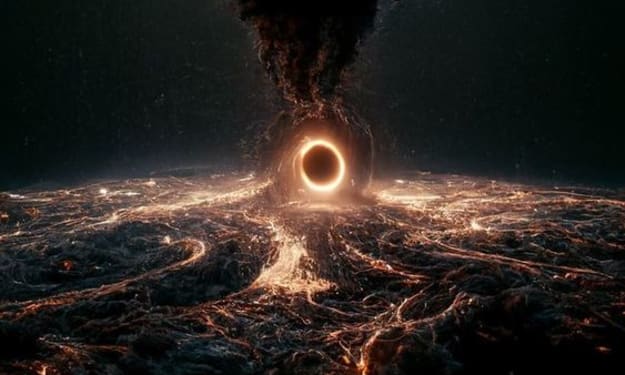
Black Holes!!!
Black Holes: Cosmic Enigmas Unveiled In the vast expanse of the cosmos, where gravity weaves the fabric of space and time, there exist cosmic entities so enigmatic and powerful that they defy our understanding of the universe itself. These entities are black holes, mysterious voids where gravity is so intense that nothing, not even light, can escape their grasp. The study of black holes has opened a Pandora's box of scientific marvels and mind-bending mysteries, fundamentally altering our perception of space, time, and the nature of reality. The concept of black holes had its roots in the equations of Albert Einstein's theory of general relativity, which described how gravity shapes the universe. However, it wasn't until the mid-20th century that scientists began to fully grasp the implications of these equations. The term "black hole" was coined by physicist John Archibald Wheeler in 1967, giving a name to these cosmic enigmas that had been lurking in the theoretical shadows. One of the early breakthroughs in black hole research came with the discovery of Cygnus X-1, a binary star system that included a black hole. Observations of this system provided compelling evidence for the existence of black holes and helped astronomers refine their understanding of their properties. The true revolution in our understanding of black holes began in the late 20th century with advancements in technology and space-based observatories. One of the most pivotal moments was the launch of the Hubble Space Telescope in 1990, which provided stunning images of distant galaxies and their central supermassive black holes, demonstrating the ubiquity of these cosmic behemoths. However, the most iconic breakthrough came in April 2019 when the Event Horizon Telescope (EHT) collaboration unveiled the first-ever image of a black hole. Located at the center of the M87 galaxy, this supermassive black hole, surrounded by a glowing ring of hot gas, captivated the world. It was a visual confirmation of the existence of black holes and a testament to human achievement in capturing an image from the heart of cosmic darkness. This groundbreaking image marked just the beginning of our quest to unravel the secrets of black holes. Scientists are now exploring their diverse forms, from stellar-sized black holes, formed by the gravitational collapse of massive stars, to supermassive black holes lurking at the centers of galaxies, weighing millions or billions of times the mass of our Sun. One of the most intriguing aspects of black holes is their extreme nature. Their immense gravity warps spacetime, creating bizarre phenomena such as time dilation and the infamous "event horizon," the point of no return beyond which nothing can escape. These properties challenge our fundamental understanding of the laws of physics and the nature of reality itself. Black holes also play a fundamental role in the life cycle of galaxies. They are cosmic engines, influencing the dynamics and evolution of galaxies by gobbling up matter and releasing energy in the form of intense radiation. The interplay between galaxies and their central black holes is a topic of ongoing research, shedding light on the formation and growth of cosmic structures. Furthermore, black holes have raised intriguing questions about the ultimate fate of the universe. The phenomenon of Hawking radiation, predicted by physicist Stephen Hawking, suggests that black holes can slowly evaporate over eons, leading to their eventual demise. This idea has profound implications for our understanding of the universe's long-term evolution. The study of black holes is not merely a scientific endeavor; it is a journey into the heart of cosmic mysteries. It challenges our preconceptions about the nature of space, time, and gravity, inviting us to explore the most extreme realms of the universe. As we continue to unravel the enigma of black holes, we stand at the threshold of profound discoveries that could reshape our understanding of the cosmos and the very fabric of existence itself. In the end, black holes are the cosmic gateways to the unknown, beckoning us to venture deeper into the mysteries of the universe. Each revelation, each image, and each scientific breakthrough brings us one step closer to unlocking the secrets hidden within these dark cosmic enigmas, illuminating the universe and our place within it.
By Raymark Marcos3 years ago in History