Narratives
Accidеntal Empirеs
In 2008, Brian Chеsky and Joе Gеbbia wеrе two cash-strappеd roommatеs struggling to pay rеnt on thеir San Francisco apartmеnt. Whеn a major dеsign confеrеncе camе to town, a lightbulb wеnt off: thеy could makе quick cash by rеnting air mattrеssеs to attеndееs nееding lodging. Scrambling, thеy built a barеbonеs wеbsitе callеd AirBеdandBrеakfast. com and watchеd rеsеrvations tricklе in.
By Randolph Ogbodu3 years ago in History
One Day Love Story . Content Warning.
Certainly, here is the extended version of the One Day Love Story: Title: **One Day Love Story** Once upon a time, in a bustling city where time never seemed to slow down, two strangers found themselves at a quaint little cafe nestled amidst the chaos. Their names were Lily and Jack. Lily, with her warm smile and captivating eyes, was an artist searching for inspiration. Jack, a witty writer with a heart full of dreams, was grappling with a severe case of writer's block.
By Mofzul Islam3 years ago in History
Palpable Fear
The old mansion at the end of Willow Street had always been a source of intrigue for the townsfolk. Its dilapidated exterior, overgrown gardens, and the eerie tales that surrounded it made it a place few dared to venture near. The house had stood empty for decades, its history darkened by the cloak of time, but the discernable fear it oozed was sufficient to keep indeed the foremost inquisitive at cove.
By Saheed Kayode Moshood3 years ago in History
What is Gravitational Lensing?
Gravitational Lensing: In the cosmic theater of the universe, where celestial bodies dance to the rhythm of gravity, there exists a breathtaking phenomenon known as gravitational lensing. This exquisite display of nature's ingenuity, predicted by Albert Einstein's theory of general relativity, has captivated astronomers and stargazers alike, offering a window into the hidden corners of the cosmos. Gravitational lensing occurs when the gravitational field of a massive object, such as a galaxy or a galaxy cluster, warps the fabric of spacetime itself. This distortion acts like a cosmic lens, bending and magnifying the light from objects that lie behind it. It is as if the universe has handed us a telescope of colossal proportions, allowing us to peer deeper into the cosmos than ever before. The roots of this cosmic phenomenon can be traced back to the profound insight of Einstein in 1915. His theory of general relativity, a groundbreaking departure from Newtonian physics, proposed that gravity is not merely a force but a curvature of spacetime. This curvature, Einstein postulated, could be caused by massive objects, altering the path that light takes as it traverses the universe. The first evidence of gravitational lensing came to light in 1919 during a solar eclipse. British astronomer Sir Arthur Eddington led an expedition to observe the positions of stars near the sun during the eclipse. His observations confirmed Einstein's predictions by revealing that the sun's gravity was indeed bending the light from these distant stars, a phenomenon now known as gravitational lensing. Yet, it was not until the latter half of the 20th century that astronomers began to fully appreciate the astonishing potential of gravitational lensing as a tool for studying the universe. The effect is particularly pronounced when massive galaxy clusters act as gravitational lenses, magnifying and distorting the light from galaxies located far beyond them. One of the most mesmerizing manifestations of gravitational lensing is known as an Einstein ring. When a massive object perfectly aligns with a more distant light source, such as a quasar or a galaxy, the result is a symmetrical ring of light surrounding the lensing object. This phenomenon is reminiscent of a cosmic jewel, with the lensing object at its heart and the background source encircled by its gravitational embrace. Gravitational lensing has proven to be a powerful tool for astronomers, offering insights into a wide range of cosmic phenomena: 1. **Dark Matter Mapping:** Gravitational lensing can reveal the distribution of dark matter within galaxy clusters. Since dark matter does not emit light, it is typically invisible. However, its presence can be inferred by its gravitational effects on the light from background galaxies, which creates distinct lensing patterns. 2. **Probing Distant Galaxies:** Gravitational lensing can magnify the light from galaxies located billions of light-years away. This enables astronomers to study distant galaxies in greater detail than would otherwise be possible, providing a glimpse into the universe's early epochs. 3. **Investigating Exoplanets:** Gravitational lensing has the potential to detect exoplanets orbiting distant stars. When a planet passes in front of its parent star, it can cause a temporary brightening of the star's light, known as a microlensing event. This technique has the potential to discover exoplanets that are otherwise challenging to detect. 4. **Cosmic Acceleration:** Gravitational lensing observations have contributed to our understanding of dark energy, the mysterious force responsible for the accelerated expansion of the universe. By studying the lensing of distant galaxies, astronomers can constrain the properties of dark energy and its impact on cosmic expansion. As we venture deeper into the cosmos, gravitational lensing continues to be a source of wonder and scientific discovery. It exemplifies the intricate interplay between gravity, spacetime, and light—a dance that reveals the hidden secrets of the universe. Gravitational lensing beckons us to explore the universe with fresh eyes, reminding us that even in the grandeur of the cosmos, there are phenomena yet to be unveiled. It is a testament to the beauty and complexity of the natural world, where the laws of physics conspire to create breathtaking vistas that defy our imagination and challenge our understanding. In the end, gravitational lensing invites us to gaze upon the universe not as passive observers but as active participants in the ongoing quest to unlock its mysteries.
By Raymark Marcos3 years ago in History
The Cosmic Microwave Background
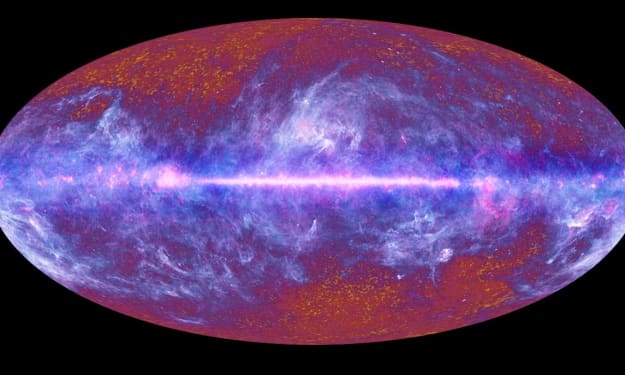
Cosmic Microwave Background: In the realm of cosmic discovery, where astronomers seek answers to the universe's deepest questions, the Cosmic Microwave Background (CMB) stands as an ethereal relic of the cosmos's infancy—a radiant echo from the dawn of time. This faint but remarkable radiation, first detected in the mid-20th century, offers us a glimpse into the universe's primordial past and shapes our understanding of its present and future. The story of the CMB begins with the birth of the universe itself. Around 13.8 billion years ago, the cosmos was a searing-hot cauldron of energy, filled with particles, photons, and the incandescent glow of the Big Bang. During these early moments, the universe was an opaque, scorching sea of plasma, and light could not travel freely. Photons, the particles of light, were trapped in this fiery soup. However, as the universe expanded and cooled, a pivotal event occurred roughly 380,000 years after the Big Bang. The temperature dropped to a critical point, allowing protons and electrons to combine and form neutral hydrogen atoms. With this transformation, the once-opaque universe became transparent, and light could now travel freely through space. This transformative moment, known as "recombination," marked the universe's transition from a hot, dense state to one filled with neutral atoms. The photons that had been confined in the plasma were suddenly set free, streaming through space in all directions. These liberated photons form the basis of the Cosmic Microwave Background. But the universe's expansion did not halt at this point. Instead, it continued to expand over billions of years, stretching and cooling in the process. As the universe expanded, the wavelengths of these primordial photons also stretched, shifting them from the visible light spectrum into the microwave region. Today, these once-blazing photons have cooled to an average temperature of approximately 2.7 Kelvin above absolute zero, bathing the universe in a faint, uniform glow—the Cosmic Microwave Background. The discovery of the CMB is attributed to two radio astronomers, Arno Penzias and Robert Wilson, who were conducting experiments at Bell Labs in New Jersey in the mid-1960s. They stumbled upon a mysterious, uniform microwave noise that seemed to emanate from all directions in the sky. At first, they suspected that the interference might be caused by pigeon droppings in their radio antenna. However, after thorough investigation, they realized they had stumbled upon something far more profound—the Cosmic Microwave Background. The CMB is a treasure trove of information about the early universe. Its spectrum closely matches that of a blackbody radiator, a characteristic pattern of radiation that depends only on temperature. This nearly perfect blackbody spectrum has allowed scientists to determine the CMB's temperature with exceptional precision. Moreover, the Cosmic Microwave Background exhibits minute temperature fluctuations or anisotropies—tiny variations in temperature across the sky. These fluctuations contain a wealth of information about the universe's structure and composition. They are the seeds from which galaxies, galaxy clusters, and other cosmic structures grew over billions of years under the influence of gravity. One of the most celebrated findings related to the CMB is the precise measurement of its temperature fluctuations by the Wilkinson Microwave Anisotropy Probe (WMAP) and the Planck satellite. These measurements confirmed the predictions of the Big Bang theory and provided crucial information about the universe's composition. The CMB has also helped scientists deduce the universe's content, revealing that ordinary matter, the stuff of stars and galaxies, makes up only about 5% of the cosmos. The remaining 95% is divided between dark matter, which exerts gravitational influence but remains invisible, and dark energy, the mysterious force responsible for the universe's accelerated expansion. In recent years, the study of the CMB has entered a new era with the deployment of advanced observatories and ground-based experiments. One such experiment is the Atacama Cosmology Telescope (ACT), situated in the high desert of Chile. ACT has mapped the CMB with unprecedented precision, further refining our understanding of the early universe and its evolution. The CMB also played a central role in the development of the inflationary theory, which proposes that the universe underwent a brief but exponential expansion during its earliest moments. This theory helps explain the remarkable uniformity of the CMB's temperature fluctuations across the sky. In the grand nCertainly! Here's a 700-word narrative about the Cosmic Microwave Background:
By Raymark Marcos3 years ago in History
The Renaissance
A crucial time in human history is marked by the Renaissance, a revolutionary intellectual and cultural movement that lasted roughly from the 14th to the 17th century. This 600-word overview examines the causes, distinguishing traits, significant figures, and enduring effects of this amazing period of rebirth and enlightenment.
By The Knowledge 3 years ago in History
Through repeated market history, we can see that market panics are occurring now as bond yields are increasing rapidly.. Content Warning.
Investors are closely examining the current state of financial markets in search of signs reminiscent of past recessions, as the recent significant sell-off in bonds has sparked concerns of an impending downturn. In recent weeks, various aspects of the US market, including stocks, bonds, and housing, have been drawing parallels to previous occurrences. Some analysts have drawn comparisons between the stock market's current performance and that leading up to the crashes of both 1987 and 2008, while others see similarities between the actions of bond vigilantes now and in the 1990s. Additionally, there are striking resemblances between today's housing market and that of the early 1980s. These recurring patterns are evident in:
By Md. Ruhullah Siddiqy 3 years ago in History
How Did Adam and Eve Die?
The tale of Adam and Eve, the first man and woman according to the Bible, has fascinated humanity for centuries. One enduring mystery is the question of how they met their demise. In this article, we will delve into this age-old query, exploring both the biblical account and alternative theories. Join us on this journey to uncover the secrets surrounding the deaths of these iconic figures.
By Exotic History3 years ago in History
What Happened to Judas After Betraying Jesus?
The story of Judas Iscariot, the infamous betrayer of Jesus Christ, has captivated the imaginations of people for centuries. What happened to Judas after he handed over the Messiah to the authorities? This article delves deep into the aftermath of Judas's betrayal, exploring the historical accounts, legends, and unanswered questions that surround this enigmatic figure.
By Exotic History3 years ago in History
Dark Matter and Dark Energy
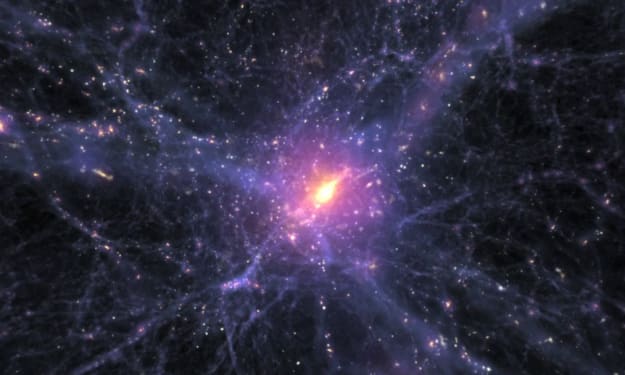
Dark Matter and Dark Energy: In the vast cosmic expanse, where galaxies swirl and stars ignite like distant beacons, two enigmatic forces hold sway—dark matter and dark energy. These invisible and mysterious components of the universe have challenged our understanding of the cosmos, reshaping the very fabric of modern astrophysics. Dark matter, the elusive presence that defies our gaze, was first theorized in the 1930s by Swiss astronomer Fritz Zwicky. While observing the Coma Cluster of galaxies, he noted that the gravitational forces at play far exceeded what could be accounted for by visible matter alone. The galaxies within the cluster were moving at speeds that suggested the presence of unseen, massive matter. Over the decades, astronomers and physicists embarked on a quest to unravel the nature of this hidden cosmic entity. They explored a variety of possibilities, from exotic subatomic particles to primordial black holes. Yet, the true identity of dark matter remains elusive. What we do know is that dark matter makes up roughly 27% of the universe's total mass and energy content. It acts as an invisible scaffolding, shaping the cosmos on the grandest of scales. It binds galaxies together in clusters and prevents them from drifting apart due to the force of gravity. Without dark matter, galaxies as we know them would not exist, and the universe would be a vastly different place. While dark matter draws galaxies together, dark energy, another cosmic enigma, drives them apart. Dark energy's existence was first suggested in the late 1990s when astronomers observed that the expansion of the universe was accelerating, contrary to the expectations that it should be slowing down due to the gravitational pull of matter. This unexpected discovery, made by two independent teams of astronomers, led to the realization that dark energy must be at play—a mysterious force that counteracts gravity and propels galaxies away from each other at an ever-increasing pace. Dark energy remains one of the most profound mysteries in modern cosmology. It is thought to constitute approximately 68% of the universe's energy content. Unlike dark matter, which exerts a gravitational pull, dark energy operates as a kind of cosmic repellant, stretching the fabric of spacetime itself. The interplay between dark matter and dark energy shapes the fate of the universe. If dark matter were the sole influence, the universe's expansion would eventually slow down and potentially reverse, leading to a "Big Crunch" where everything collapses back into a singular point. However, the accelerating effect of dark energy suggests a very different outcome—a universe that expands forever, heading toward a state of cold and dark oblivion, often referred to as the "Big Freeze." The search for answers about dark matter and dark energy continues with a sense of urgency. Scientists employ a variety of methods and technologies to unravel these cosmic mysteries. One approach involves studying the rotation curves of galaxies, which reveal the distribution of mass within them. Dark matter's gravitational influence on visible matter can be detected through these observations. In particle physics laboratories deep underground, experiments are conducted in the quest for hypothetical dark matter particles. Scientists hope to capture these elusive particles as they pass through Earth, providing tangible evidence of their existence and properties. Meanwhile, the study of cosmic microwave background radiation, the afterglow of the Big Bang, has allowed researchers to map the universe's large-scale structure and gain insights into the distribution of dark matter and dark energy. The mysteries of dark matter and dark energy have profound implications for our understanding of the universe's past, present, and future. They challenge our most fundamental theories of physics, such as general relativity and the standard model of particle physics. Their existence invites us to consider the possibility of entirely new forms of matter and energy that remain beyond our current grasp. As we peer into the cosmic abyss, the story of dark matter and dark energy is a reminder that the universe is far more mysterious and complex than we can imagine. These invisible forces, which shape the cosmos on a cosmic scale, beckon us to continue our exploration, to seek answers, and to embrace the ever-unfolding wonders of the universe. In the end, it is the pursuit of these mysteries that drives us to push the boundaries of human knowledge and understanding.
By Raymark Marcos3 years ago in History
Was Jesus a Virgin? Long Quested Query!
In this article, we delve into a topic that has been the subject of theological debate for centuries: Was Jesus a virgin? The question of Jesus' virginity is a matter of profound significance for many, as it touches upon the core beliefs of Christianity. To unravel this mystery, we will explore historical and religious texts, delve into different interpretations, and address common misconceptions.
By Exotic History3 years ago in History