Modern
The Great American Cheese Stockpile
Somewhere beneath Missouri in 1981, the United States government had a problem. It wasn’t nuclear weapons. It wasn’t Soviet espionage. It wasn’t an experimental aircraft or some classified Cold War project buried safely underground. It was cheese... Lots and lots of cheese!
By The Iron Lighthouseabout a month ago in History
When Science Became a Problem: The Swedish Dentist Who Paid a Heavy Price for Questioning Refugee Ages
In 2017, Bernt Herlitz was working as a dental hygienist on the Swedish island of Gotland. His job was relatively straightforward: as part of the public healthcare system, he provided preventive dental care to young refugees arriving in Sweden without identification documents.
By Lenka Čihařováabout a month ago in History
The Label Meant to Shame Germany Became Its Greatest Advertisement: How “Made in Germany” Was Born
In the second half of the 19th century, Britain was at the height of the Industrial Revolution. The country proudly considered itself the “workshop of the world”, producing machinery, textiles, steel and tools that were exported across the globe.
By Lenka Čihařováabout a month ago in History
The Forgotten 1930s Dream of Rocket Mail
There was a time when checking the mail did not require protective eyewear. The mail carrier came down the road, the postman walked up the steps, and letters arrived in bags, by train between cities, or by airplane across great distances. Everybody generally agreed that correspondence should reach its destination without first passing through a cloud of smoke and fire.
By The Iron Lighthouseabout a month ago in History
The Sticker That Furious Europe Didn't Want to Pay For
Today, we don’t even think about it. You pull up to a gas station near a border, or you open an app on your smartphone, and you buy a highway vignette. It’s a completely standard, boring part of traveling across Europe. But back in 1985, Switzerland did something so radical, so completely unheard of, that it literally drove the rest of the European continent into a state of absolute geopolitical frenzy. They introduced the world's very first highway vignette. And oh boy, you wouldn't believe the massive diplomatic drama, road blockades, and furious political screaming that followed.
By Lenka Čihařováabout a month ago in History
Year 1785: Fun Facts, Trivia, and History
This quick read presents a mix of fun facts, trivia, and history events from the year 1785. Discover the year’s top news stories, most influential people, historic firsts, U.S. economic data, entertainment trivia, and much more.
By Gregory DeVictorabout a month ago in History
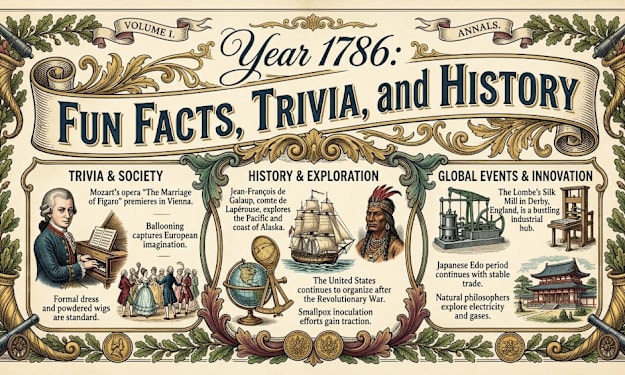
Year 1786: Fun Facts, Trivia, and History
This quick read presents a mix of fun facts, trivia, and history events from the year 1786. Discover the year’s top news stories, most influential people, historic firsts, U.S. economic data, entertainment trivia, and much more.
By Gregory DeVictorabout a month ago in History
Year 1787: Fun Facts, Trivia, and History
In 1787, the United States Constitution, the Northwest Ordinance, and William Hershel’s outer space discoveries were all center stage. Oatmeal porridge and cornmeal mush were American food staples, and William and Elizabeth were two of the most popular baby names. In addition, salt pork cost about eight cents a pound, flour was around $5.00 a barrel, and corn retailed for about 33 cents a bushel. Inflation rate: -2.11% Consumer price index (CPI): 9.300 $100.00 in 1787 is equivalent in purchasing power to about $3,590.52 today. The U.S. dollar had “an average inflation rate of 1.51% per year” between 1787 and 2026, “producing a cumulative price increase of 3,490.52%.” In other words, a U.S. dollar today buys about 2.785% of what it could purchase back in 1787. It’s worth noting that the U.S. dollar has lost about 97% of its value since 1787. The average daily wage for a common laborer in the United States hovered around $1.00. Farmers accounted for over 90% of the U.S. labor force. In 1787, there were three U.S. states. In order of admission to the Union, they were Delaware (1787), Pennsylvania (1787), and New Jersey (1787). American companies established in 1787 included the Massachusetts-based Beverly Cotton Manufactory, America’s first cotton mill. On January 11, British-German astronomer William Hershel discovered Titania and Oberon, the first moons of Uranus ever found. On February 28, the Commonwealth of Pennsylvania granted a charter to the Pittsburgh Academy, which later became the University of Pittsburgh. On April 16, American playwright Royall Tyler's The Contrast debuted at the John Street Theatre in New York City. It was “the first comedy written by an American citizen to be professionally produced.” On April 17, William Creech published the first edition of Robert Burns' poems, entitled Poems Chiefly in the Scottish Dialect . On May 6, abolitionist Prince Hall established the first African American Masonic lodge, which was located in Boston. On May 8, the Philadelphia Society for Alleviating the Miseries of Public Prisons—led by physician and social reformer Dr. Benjamin Rush and supported by statesman Benjamin Franklin—was established as “the first prison reform society in the United States.” On May 25, 55 state delegates, including George Washington, James Madison, and Benjamin Franklin, “convened in Philadelphia to compose a new U.S. constitution.” Rhode Island chose not to attend the convention. On June 27, just before midnight, British essayist Edward Gibbon completed The History of the Decline and Fall of the Roman Empire “in the small summerhouse in his garden in Lausanne, Switzerland.” On July 13, Congress enacted the Northwest Ordinance, which created a policy for settlement of the Northwest Territory and the subsequent “addition of new states to the nation.” On August 22, American inventor John Fitch “successfully tested a 45-foot steamboat on the Delaware River in Philadelphia, more than 20 years before Robert Fulton's commercial breakthrough.” On September 17, at the conclusion of the Constitutional Convention in Philadelphia, 39 delegates from 12 states signed the U.S. Constitution. Signers included William Samuel Johnson (Connecticut), Richard Bassett (Delaware), Daniel Carroll (Maryland), Nathaniel Gorham (Massachusetts), Nicholas Gilman (New Hampshire), William Paterson (New Jersey), Alexander Hamilton (New York), Hugh Williamson (North Carolina), Benjamin Franklin (Pennsylvania), Thomas Mifflin (Pennsylvania), George Washington (Virginia), and James Madison (Virginia). Benjamin Franklin of Pennsylvania was the oldest signer at age 81, while Jonathan Dayton of New Jersey was the youngest signer at age 26. On December 7, Delaware became the first state to ratify the U.S. Constitution. On December 12, Pennsylvania became the second state to ratify the U.S. Constitution. On December 18, New Jersey became the third state to ratify the U.S. Constitution. In 1787, Philadelphia was America’s largest city and featured Quaker merchants, German farmers, and enslaved African Americans. Pittsburgh, Pennsylvania, located over 300 miles west of Philadelphia, consisted mainly of log cabins and wooden structures situated along the Allegheny, Monongahela, and Ohio rivers. It was “a boat-building hub for pioneers traveling further west into the Ohio Country.” Famous people born in 1787 were Louis Daguerre (French inventor) and Thomas Hopkins Gallaudet (American teacher). Famous people who died in 1787 included Arthur Middleton (American planter and a signer of the Declaration of Independence) and Leopold Mozart (German composer). Also in 1787, the words “befuddled,” “betwixt and between,” “blue cheese,” “Ceylon cinnamon,” “chambray,” “clear the decks,” “clodhopping,” “exceptional,” “eye-catcher,” “fertilization,” “ground level,” “legislative council,” “living room,” “love-in-a-mist,” “marketer,” “midnight sun,” “psychological,” “rhapsodize,” “theatrics,” and “verbalism” all appeared in print for the first time. Beef: About $2.00 to $3.00 per 100 pounds Chicken: Around 12 cents each Coffee: About 25 cents to 33 cents per pound Corn: Around 50 cents per bushel Flour: About $5.00 per barrel Oats: Around 33 cents per bushel Salt Pork: About eight cents per pound Turkey: Around 50 cents each Wheat: About $1.00 to $1.25 per bushel
By Gregory DeVictorabout a month ago in History
Year 1788: Fun Facts, Trivia, and History
This quick read presents a mix of fun facts, trivia, and history events from the year 1788. Discover the year’s top news stories, most influential people, historic firsts, U.S. economic data, entertainment trivia, and much more.
By Gregory DeVictorabout a month ago in History
Dolly Parton Has Passed Away: The Woman Who Turned a One-Room Cabin into an Empire and Her Life into the Ultimate Show
Dolly wasn’t just a singer; she possessed an immense, unique gift. It was the ability to seamlessly connect the world of country music, everyday people, Hollywood glamour, and charity. Absolutely everything she touched and every venture she started was calculated down to the smallest detail. Her life was her brand. Selling over 100 million records and penning more than 3,000 songs, she lived an authentic American dream that started as far away from the Hollywood elite as one could possibly imagine.
By Lenka Čihařováabout a month ago in History
Year 1789: Fun Facts, Trivia, and History
This quick read presents a mix of fun facts, trivia, and history events from the year 1789. Discover the year’s top news stories, most influential people, historic firsts, U.S. economic data, entertainment trivia, and much more.
By Gregory DeVictorabout a month ago in History