Modern
The Evolution of Digital Marketing - Past, Present, and the Future
Over the past two decades, digital marketing has undergone a revolutionary transformation. What began as simple banner ads and rudimentary email marketing has evolved into a sophisticated, data-driven industry that leverages cutting-edge technology and innovative strategies. My article will delve into the changes I have personally seen in digital marketing over the last twenty years and will explore what I think the future holds for us all.
By MATTHEW LEE2 years ago in History
The Man Who Was Struck by Lightning Seven Times. AI-Generated.
Roy Cleveland Sullivan, a United States park ranger in Shenandoah National Park, holds the record for surviving the most lightning strikes. Born on February 7, 1912, in Greene County, Virginia, Sullivan became known as the "Human Lightning Rod" due to his incredible and terrifying encounters with one of nature’s most powerful forces. Over a span of 35 years, Sullivan was struck by lightning an astonishing seven times, each incident leaving him with injuries but miraculously alive.
By Julio Javier2 years ago in History
Leonardo da Vinci: A Life Beyond Time
Leonardo da Vinci: The Renaissance Visionary Who Defied Time. In the annals of history, few individuals have left an indelible mark on human civilization like Leonardo da Vinci. This Italian polymath was a master of various arts and sciences, and his innovative spirit, creative genius, and boundless curiosity continue to inspire and awe people to this day. Born on April 15, 1452, in Vinci, Italy, Leonardo was the illegitimate son of a notary and a peasant woman. Despite the societal norms of his time, his father recognized and supported his artistic talent from an early age. This encouragement laid the foundation for Leonardo's remarkable journey, which would span over six decades and leave an enduring legacy. The Artistic Genius Leonardo's artistic prowess is perhaps his most celebrated attribute. His iconic works, such as the Mona Lisa and The Last Supper, are widely regarded as some of the greatest paintings in human history. The Mona Lisa's enigmatic smile and intricate details have captivated art lovers for centuries, while The Last Supper's poignant depiction of Jesus' final meal with his disciples continues to evoke emotions and spark theological debates. However, Leonardo's artistic contributions extend far beyond these two masterpieces. His pioneering work in sfumato, a painting technique that creates a soft, hazy effect by layering thin glazes of paint, revolutionized the art world. His use of chiaroscuro, a strong contrast between light and dark, added depth and dimensionality to his subjects. The Innovative Inventor Leonardo's artistic talents were matched only by his inventive genius. He was fascinated by the potential of human flight and spent years studying the anatomy of birds and designing flying machines. Although his winged contraptions never achieved sustained flight, his innovative designs and ideas paved the way for modern aeronautics. His inventive spirit didn't stop there. Leonardo designed various machines, such as armored vehicles, submarines, and catapults, which were well ahead of their time. His work in engineering and anatomy led to the development of sophisticated surgical instruments and a deeper understanding of human physiology. The Visionary Scientist Leonardo's scientific curiosity knew no bounds. He was a prolific note-taker and sketch artist, filling thousands of pages with observations, theories, and designs. His work in anatomy led to several groundbreaking discoveries, including the identification of the spiral nature of the human gut and the concept of blood circulation. His fascination with light and color led to experiments with optics and the behavior of light. He even predicted the existence of the microscope and the telescope, centuries before their invention. The Legacy of Leonardo Leonardo da Vinci's impact on human history is immeasurable. He embodied the Renaissance spirit, which sought to revive classical knowledge and push the boundaries of human potential. His work in art, science, and engineering has inspired countless generations of innovators, from Michelangelo to Steve Jobs. Today, Leonardo's legacy extends far beyond the art world. His inventive spirit and scientific curiosity have influenced fields as diverse as medicine, physics, and computer science. His work continues to inspire new generations of thinkers, creators, and innovators. In conclusion, Leonardo da Vinci was a true visionary, whose work and ideas continue to defy time and inspire humanity. His boundless curiosity, creative genius, and innovative spirit have left an indelible mark on our collective history. As we continue to navigate the complexities of our modern world, Leonardo's legacy reminds us of the power of human imagination, creativity, and innovation to shape our future.
By Jophiel williamson2 years ago in History
Exploring Reykjavík
Reykjavík, the capital and largest city of Iceland, is a captivating blend of rich history, vibrant culture, and stunning natural beauty. As the northernmost capital of a sovereign state, Reykjavík offers a unique combination of modern urban life and the raw, untamed landscapes that Iceland is famous for. This article delves into the history of Reykjavík, highlights must-visit places, and provides insights into the best times to explore this enchanting city.
By Santosh Sahu2 years ago in History
FIVE OF THE PLANET'S MOST FORBIDDEN PLACES
As strange as it may seem, there are still many places on our planet that can rightfully be called forbidden for ordinary mortals. Many of these places hold secrets that may never be fully revealed. Here are five of the most forbidden places on the planet.
By Vitalii Petrov2 years ago in History
Speaking Up About Microaggression
I may have accidentally been mean to a coworker the other day. I didn't mean to be mean, honestly. It's just that for some reason, all the years I was afraid to speak out when I saw or heard someone tell an insensitive joke or casually make a racist, sexist, homophobic, or agist statement have slipped away.
By Suzy Jacobson Cherry2 years ago in History
The Origin of the Maneki Neko cat
The Maneki Neko, also known as the "beckoning cat," is a popular Japanese figurine believed to bring good luck and fortune to its owner. The origin of the Maneki Neko is steeped in folklore and historical anecdotes, with several stories explaining how this charming cat became a symbol of prosperity.
By m habibullah2 years ago in History
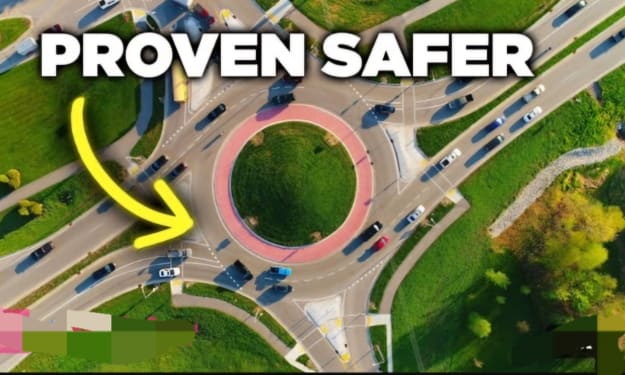
Why the U.S. Hates Roundabouts: Unpacking the Resistance and Benefits. AI-Generated.
### Why the U.S. Hates Roundabouts: Unpacking the Resistance and Benefits Carmel, Indiana, a city of 97,000 people just north of Indianapolis, holds an unusual record. It boasts over 125 modern roundabouts, more than any other city in the United States. This number accounts for three percent of the country’s total roundabouts. In contrast, the U.S. is far behind other countries in the adoption of roundabouts. France leads with over 30,000 roundabouts, followed closely by the United Kingdom with 25,000. So, how did this small Midwestern city become the roundabout capital of the U.S.? ### The Vision of Mayor Jim Brainard The transformation of Carmel can be credited to Mayor Jim Brainard. During a graduate school trip to England, he observed the ease and safety of the country’s numerous roundabouts. "Drivers were yielding to traffic, bikes, and pedestrians. There were no unsightly traffic signals and no long lines or congestion. It made me wonder why the U.S. had not done more roundabouts," Brainard recalls. When Brainard was elected mayor of Carmel in 1996, he made it his mission to cover the city with roundabouts. Beyond easing traffic congestion, roundabouts have a proven safety record. Carmel has seen an 80% reduction in injury-causing car accidents since the 1990s. ### The Safety and Efficiency of Roundabouts Roundabouts are not just about reducing congestion; they significantly enhance safety. Modern roundabouts have been shown to reduce accidents by 38% and fatal crashes by up to 90%. The key lies in their construction: a roundabout is a small, one-way circular intersection built around a raised center island. Drivers must yield to circulating traffic as they enter and exit. This design forces drivers to slow down, thus reducing collision rates. Even if accidents occur, injuries are less severe due to the lower speeds. It’s important to distinguish modern roundabouts from traffic circles or rotaries. Traffic circles are larger, allow higher speeds, and do not require drivers to yield to circulating traffic. These differences contribute to higher collision rates in traffic circles, which led to their decline in popularity. ### The History of Traffic Circles and Roundabouts The first traffic circle, Columbus Circle in New York City, was built in 1905. Traffic circles spread across the U.S. because they enabled high-speed merging and weaving, but they also caused more vehicle collisions and quickly fell out of favor. By the 1950s, their development had nearly halted worldwide. In 1966, Frank Blackmore, a city engineer in the United Kingdom, sought to rectify the problems caused by traffic circles. He developed the modern roundabout with a "give-way" rule, requiring entering drivers to yield to circulating traffic. This innovation made intersections much safer and the concept quickly spread throughout Europe. ### The Slow Adoption in the United States Despite Blackmore's success in Europe, the modern roundabout did not catch on quickly in the U.S. American engineers were skeptical, and public opinion was largely negative. In 1984, American engineer Leif Ourston set out to change that. Ourston reached out to Blackmore for help, drawing a parallel to Winston Churchill’s call for Anglo-American cooperation during World War II. Blackmore agreed, and the two traveled around California persuading traffic officials to build modern roundabouts. ### Public Perception and Resistance However, the public was not convinced. Surveys showed only 20% of drivers approved of roundabouts. Even when projects were approved, they were often met with protests. Despite this resistance, the first two modern roundabouts in the U.S. were successfully constructed in a Las Vegas subdivision in 1990. This success drew the attention of city planners, and roundabouts slowly began appearing across the country. ### The Availability Heuristic and Misconceptions One reason for the American distaste for roundabouts could be the availability heuristic, which describes how people form opinions based on immediate thoughts or memories. Many Americans confuse modern roundabouts with traffic circles, recalling scenes from movies like *European Vacation* where characters are trapped in endless loops. This misconception stems from the high collision rates of traffic circles in the early 1900s, leaving Americans with a lasting negative impression. ### The Comfort of Traffic Signals Americans are also comfortable with the binary system of traffic signals, where red means stop and green means go. This system creates an illusion of safety, as drivers feel more in control with clear instructions. In contrast, roundabouts require drivers to rely on their judgment and the actions of others, leading to confusion and stress, especially for those unfamiliar with the concept. ### Lack of Familiarity and Training Another theory is that Americans simply don’t know how to use roundabouts. In many parts of the country, roundabouts are still rare, and some states don’t even require drivers to navigate them during their driving tests. This lack of familiarity can make the first encounter with a roundabout stressful, establishing a negative experience. ### The Benefits of Roundabouts Despite the resistance, roundabouts offer significant benefits. They reduce vehicle collisions by 38%, are cheaper to construct and maintain, and reduce congestion. Roundabouts save $5,000 to $10,000 per year in maintenance and electrical costs. They improve traffic flow, with studies showing up to an 89% reduction in vehicle delays and a 56% reduction in vehicle stops. Additionally, roundabouts have environmental benefits. A study in Sweden found a 29% reduction in carbon emissions and an 8% reduction in fuel consumption in areas with roundabouts. ### Changing Attitudes Fortunately, more Americans are starting to accept roundabouts. Studies show that once drivers learn to use them, their attitudes improve. Community surveys reveal that approval rates for roundabouts increase from 30% before construction to 50-70% afterward. ### Conclusion While modern roundabouts may not yet be widely popular in the U.S., attitudes are slowly changing. With their proven safety and efficiency, roundabouts may become a more common sight on American roads in the future.
By Mbeha maliwa 2 years ago in History