Modern
The Origin of the Maneki Neko cat
The Maneki Neko, also known as the "beckoning cat," is a popular Japanese figurine believed to bring good luck and fortune to its owner. The origin of the Maneki Neko is steeped in folklore and historical anecdotes, with several stories explaining how this charming cat became a symbol of prosperity.
By m habibullah2 years ago in History
Why the U.S. Hates Roundabouts: Unpacking the Resistance and Benefits. AI-Generated.
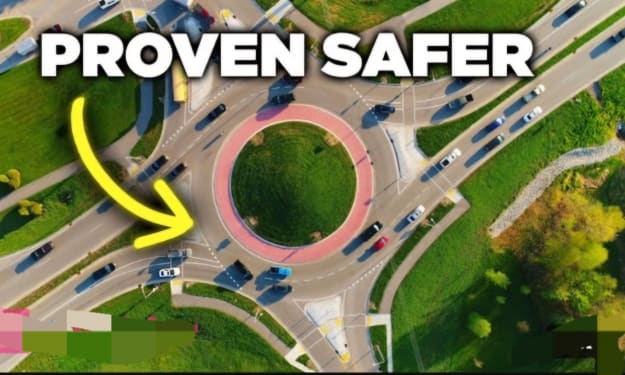
### Why the U.S. Hates Roundabouts: Unpacking the Resistance and Benefits Carmel, Indiana, a city of 97,000 people just north of Indianapolis, holds an unusual record. It boasts over 125 modern roundabouts, more than any other city in the United States. This number accounts for three percent of the country’s total roundabouts. In contrast, the U.S. is far behind other countries in the adoption of roundabouts. France leads with over 30,000 roundabouts, followed closely by the United Kingdom with 25,000. So, how did this small Midwestern city become the roundabout capital of the U.S.? ### The Vision of Mayor Jim Brainard The transformation of Carmel can be credited to Mayor Jim Brainard. During a graduate school trip to England, he observed the ease and safety of the country’s numerous roundabouts. "Drivers were yielding to traffic, bikes, and pedestrians. There were no unsightly traffic signals and no long lines or congestion. It made me wonder why the U.S. had not done more roundabouts," Brainard recalls. When Brainard was elected mayor of Carmel in 1996, he made it his mission to cover the city with roundabouts. Beyond easing traffic congestion, roundabouts have a proven safety record. Carmel has seen an 80% reduction in injury-causing car accidents since the 1990s. ### The Safety and Efficiency of Roundabouts Roundabouts are not just about reducing congestion; they significantly enhance safety. Modern roundabouts have been shown to reduce accidents by 38% and fatal crashes by up to 90%. The key lies in their construction: a roundabout is a small, one-way circular intersection built around a raised center island. Drivers must yield to circulating traffic as they enter and exit. This design forces drivers to slow down, thus reducing collision rates. Even if accidents occur, injuries are less severe due to the lower speeds. It’s important to distinguish modern roundabouts from traffic circles or rotaries. Traffic circles are larger, allow higher speeds, and do not require drivers to yield to circulating traffic. These differences contribute to higher collision rates in traffic circles, which led to their decline in popularity. ### The History of Traffic Circles and Roundabouts The first traffic circle, Columbus Circle in New York City, was built in 1905. Traffic circles spread across the U.S. because they enabled high-speed merging and weaving, but they also caused more vehicle collisions and quickly fell out of favor. By the 1950s, their development had nearly halted worldwide. In 1966, Frank Blackmore, a city engineer in the United Kingdom, sought to rectify the problems caused by traffic circles. He developed the modern roundabout with a "give-way" rule, requiring entering drivers to yield to circulating traffic. This innovation made intersections much safer and the concept quickly spread throughout Europe. ### The Slow Adoption in the United States Despite Blackmore's success in Europe, the modern roundabout did not catch on quickly in the U.S. American engineers were skeptical, and public opinion was largely negative. In 1984, American engineer Leif Ourston set out to change that. Ourston reached out to Blackmore for help, drawing a parallel to Winston Churchill’s call for Anglo-American cooperation during World War II. Blackmore agreed, and the two traveled around California persuading traffic officials to build modern roundabouts. ### Public Perception and Resistance However, the public was not convinced. Surveys showed only 20% of drivers approved of roundabouts. Even when projects were approved, they were often met with protests. Despite this resistance, the first two modern roundabouts in the U.S. were successfully constructed in a Las Vegas subdivision in 1990. This success drew the attention of city planners, and roundabouts slowly began appearing across the country. ### The Availability Heuristic and Misconceptions One reason for the American distaste for roundabouts could be the availability heuristic, which describes how people form opinions based on immediate thoughts or memories. Many Americans confuse modern roundabouts with traffic circles, recalling scenes from movies like *European Vacation* where characters are trapped in endless loops. This misconception stems from the high collision rates of traffic circles in the early 1900s, leaving Americans with a lasting negative impression. ### The Comfort of Traffic Signals Americans are also comfortable with the binary system of traffic signals, where red means stop and green means go. This system creates an illusion of safety, as drivers feel more in control with clear instructions. In contrast, roundabouts require drivers to rely on their judgment and the actions of others, leading to confusion and stress, especially for those unfamiliar with the concept. ### Lack of Familiarity and Training Another theory is that Americans simply don’t know how to use roundabouts. In many parts of the country, roundabouts are still rare, and some states don’t even require drivers to navigate them during their driving tests. This lack of familiarity can make the first encounter with a roundabout stressful, establishing a negative experience. ### The Benefits of Roundabouts Despite the resistance, roundabouts offer significant benefits. They reduce vehicle collisions by 38%, are cheaper to construct and maintain, and reduce congestion. Roundabouts save $5,000 to $10,000 per year in maintenance and electrical costs. They improve traffic flow, with studies showing up to an 89% reduction in vehicle delays and a 56% reduction in vehicle stops. Additionally, roundabouts have environmental benefits. A study in Sweden found a 29% reduction in carbon emissions and an 8% reduction in fuel consumption in areas with roundabouts. ### Changing Attitudes Fortunately, more Americans are starting to accept roundabouts. Studies show that once drivers learn to use them, their attitudes improve. Community surveys reveal that approval rates for roundabouts increase from 30% before construction to 50-70% afterward. ### Conclusion While modern roundabouts may not yet be widely popular in the U.S., attitudes are slowly changing. With their proven safety and efficiency, roundabouts may become a more common sight on American roads in the future.
By Mbeha maliwa 2 years ago in History
HERITAGE TOWN YOU MIGHT WANT TO VISIT WITH YOUR FAMILY
Taal is a small town in Batangas with a wealth of historical sights. It is known for its old and historical landmarks and buildings. If you are into historical and ancestral places, you might want to consider visiting the majestic heritage town of Taal. Take in and experience the bygone days of the Spanish era.
By Camille Angela Zarate2 years ago in History
Vanguard 1: A Legacy of Space Innovation
We all know there are tons of satellites floating around in space. Some are well-known, some might be secret, and some could even be controlled by supervillains—who knows? We often hear about new satellites being launched, but we rarely talk about the older ones. In this video, we’re going to explore the oldest man-made satellite that’s still out there.
By Wali Ahmed Khan2 years ago in History
The Mystery of Noah's Ark: Unraveling Ancient Flood Legends
In 1959, Army Captain Ilhan Durupınar flew an aerial reconnaissance mission for NATO to map a remote area in the Turkish Highlands, altered by recent earthquakes. During this routine flight, he spotted an unusual formation among the rocks, which he photographed. Upon developing the film, he was surprised to see what appeared to be the remains of a large ship far inland, 6,500 feet above sea level. This unexpected discovery stirred speculation that he might have stumbled upon a great biblical mystery: Noah's Ark.
By Benjie Maybuena2 years ago in History
The Art of Sport
Title: The Art of Sport: A Harmonious Blend of Skill, Creativity, and Beauty Introduction Sport and art may seem like vastly different entities, but they share a common thread - the pursuit of excellence, creativity, and beauty. While sport is often viewed as a physical activity, it also requires skill, strategy, and grace, making it an art form in its own right. In this article, we will explore the intersection of sport and art, highlighting the ways in which athletes, coaches, and teams use creativity, imagination, and technique to create a masterpiece on the field, court, or track.
By Kenneth Ugonna2 years ago in History
Juneteenth Day. Content Warning.
Juneteenth: A Celebration of Freedom's Long Road Juneteenth, otherwise called Celebration Day, Liberation Day, or Opportunity Day, is an occasion noticed yearly on June nineteenth in the US. It celebrates the appearance of Association Significant General Gordon Granger in Galveston, Texas, on June 19, 1865, with news that the oppressed individuals in the Confederate states were at long last free. This undeniable the finish of bondage in the US, north of more than two years after the Liberation Decree was given by President Abraham Lincoln. This paper dives into the rich history and meaning of Juneteenth, investigating its foundations, customs, and continuous pertinence in the battle for racial equity. **The Getting through Tradition of Slavery** To comprehend Juneteenth, we should initially go up against the merciless tradition of subjection in America. Oppressed Africans were gotten to the provinces the sixteenth hundred years and compelled to work under a framework that dehumanized them for a really long time. This framework turned into the groundwork of the Southern economy, with cotton estates depending intensely on subjugated individuals' neglected work. The battle against subjugation was long and burdensome. Abolitionist developments arose in the North, supporting for a finish to the training. Be that as it may, the profound financial and social divisions between the North and South eventually prompted the Nationwide conflict (1861-1865). **The Liberation Declaration and its Deferred Impact** In January 1863, President Lincoln gave the Liberation Decree, pronouncing oppressed individuals in Confederate states to be free. This was a critical defining moment, however it didn't quickly end bondage. It simply applied to states in resistance, not the line expresses that stayed faithful to the Association. Also, requirement was troublesome in regions still under Confederate control. **The Appearance of Opportunity in Texas: Juneteenth** The significant delay for opportunity at last finished for subjugated individuals in Texas on June 19, 1865. Significant General Gordon Granger showed up in Galveston, Texas, with north of 2,000 Association troops to declare the finish of the Nationwide conflict and, all the more critically, the freedom of oppressed individuals in the state. This news, postponed by the distant area and slow correspondence of the time, denoted another part in American history. **From Subjugation to Liberation: The Introduction of Juneteenth Traditions** Juneteenth festivities started promptly following the declaration in Galveston. Previous slaves, excited by their freshly discovered opportunity, held social affairs loaded up with music, supplication, and thanksgiving. These early festivals established the groundwork for the customs that proceed right up to the present day. **Juneteenth Customs: A Festival of Resilience** Juneteenth customs fluctuate across the US, yet a few normal topics arise: * **Food and Feasts:** Juneteenth festivities are much of the time revolved around common dinners. Customary dishes incorporate red velvet cake (emblematic of spilled blood), grill, seared chicken, and watermelon. * **Music and Dance:** Juneteenth is a glad event, and exuberant music assumes an indispensable part. Gospel, blues, and jazz frequently consume the space, joined by cheerful moving. * **Rodeos and Parades:** Rodeos and marches are a typical sight in numerous Juneteenth festivities. These occasions exhibit African American culture and equestrian ability. * **Instructive Programs:** Juneteenth is likewise a period for learning and reflection. Instructive projects and verifiable reenactments feature the historical backdrop of subjection and the battle for opportunity. **Past Festival: Juneteenth's Getting through Relevance** While Juneteenth is an euphoric event, it fills in as a sign of the drawn out, difficult experience towards racial equity in America. Regardless of liberation, African Americans confronted colossal difficulties in the fallout of servitude. Reproduction, the period following the Nationwide conflict, saw endeavors to incorporate African Americans into society. Nonetheless, these endeavors were hampered by white opposition, prompting the ascent of Jim Crow regulations and isolation that persevered for a large part of the twentieth 100 years. **Juneteenth and the Continuous Battle for Racial Justice** Juneteenth keeps on holding enormous importance in the battle for racial equity. It fills in as a sign of the continuous battle for equivalent privileges and valuable open doors for African Americans in the US. * **A Call for Unity:** Juneteenth brings individuals of all races together to celebrate opportunity and recognize the common history of the US. It is a call for solidarity and understanding. * **Civil rights Movements:** Juneteenth rouses proceeded with endeavors to address racial imbalances in regions like schooling, lodging, and law enforcement. The occasion energizes the battle for civil rights and makes a space for discourse about a more evenhanded future. * **Protecting Dark History:** Juneteenth fills in as an essential sign of the commitments of African Americans to American history and culture. It urges endeavors to protect Dark history and guarantee that the voices and accounts of African Americans are heard. **Juneteenth in the 21st Century**
By Bikash Purkait2 years ago in History
Flag Day. Content Warning.
A Tapestry Woven Red, White, and Blue: A Exploration of Flag Day Flag Day, an apparently straightforward public recognition held every year on June fourteenth in the US, conveys a load far more prominent than its solitary day on the schedule. It's daily to spread out the public standard, the Stars and Stripes, a lively embroidery woven with strings of history, imagery, and public character. In any case, to really comprehend Flag Day, we should dive further, investigating the banner's starting points, its importance as a bringing together image, and the customs that have developed around this public occasion. A Birth Story Sewed in Stripes and Stars The American Flag, formally named the "Stars and Stripes" or the "Star-Radiant Flag," flaunts a rich history entwined with the country's own. Its story starts in the juvenile long stretches of the American Upheaval. In 1775, the Second Mainland Congress requested that a panel plan a banner to address the recently framed settlements. This panel, including George Washington himself, chose a plan highlighting thirteen exchanging red and white stripes, representing the thirteen unique settlements, and an association banner of Extraordinary England in the canton (upper left corner). This banner, known as the "Mainland Tones," filled in as the principal official banner of the US. Be that as it may, as the battle for freedom escalated, the longing for a particular public image developed. In 1777, the Second Mainland Congress passed the Flag Goal, authoritatively embracing the plan we perceive today. The goal indicated thirteen red and white stripes, a blue canton enhanced with thirteen white stars addressing the heavenly body of new states, and a changed extent of the actual Flag. This plan, brought into the world from the pot of upheaval, turned into the image of a country fashioning its own way. An Image of Solidarity Woven with Strings of Significance The American banner rises above simple texture. It goes about as a strong image, a visual portrayal of the country's fundamental beliefs and goals. The actual varieties are pervaded with importance. Red connotes boldness and penance, the blood spilled by the people who battled for opportunity. White addresses immaculateness, harmony, and the beliefs whereupon the country was established. Blue typifies carefulness, equity, and steadiness, the characteristics expected to keep a free republic. The thirteen stripes represent the first provinces, a consistent indication of the country's solidarity brought into the world from variety. The stars, once addressing the first thirteen states, have developed with the country, each new star connoting the expansion of another state to the association. Together, these components make a strong image of solidarity, helping Americans to remember their common history and normal fate. Flag Day is a chance to ponder these images and their importance. It's daily to commend the standards of freedom, equity, and equity revered in the American examination. The Flag turns into a mobilizing point, helping residents to remember their common objectives and obligations as a country. An Embroidery of Customs: Observing Banner Day The country over Banner Day is set apart by various practices across the US. Public structures gladly fly the banner, a noticeable presentation of public pride. Schools hold gatherings for understudies, showing them the banner's set of experiences and appropriate showcase decorum. Marches and local meetings frequently highlight the Stars and Stripes conspicuously, encouraging a feeling of shared personality. Numerous Americans decide to fly the banner external their homes, an individual articulation of nationalism and an image of welcome. Veterans' associations frequently hold banner commitment functions, respecting the people who have served and forfeited for the country. These customs, both excellent and cozy, wind around together an embroidery of public pride, helping Americans to remember the importance behind the image. **Past Nationalism: A Conversation on Developing Symbolism** The American banner is certainly not a static image. Its significance has developed after some time, mirroring the country's changing social and political scene. Conversations and discussions about the banner's portrayal and inclusivity have turned into a significant piece of Flag Day. As far as some might be concerned, the banner addresses a defective past, a sign of battles for racial correspondence and civil rights. These conversations empower a more profound comprehension of the country's set of experiences and the continuous journey to satisfy its goals. Flag Day gives a stage to open discourse about the beliefs the banner addresses. It's daily to recognize the country's blemishes while committing once again to the quest for a more wonderful association. Looking Forward: A Heritage Woven in the Stars and Stripes Flag Day, however a solitary day on the schedule, fills in as a strong sign of the American story. It's daily to commend the country's beliefs, consider its set of experiences, and recognize the continuous mission for a more wonderful association. The Stars and Stripes are not only a piece of material; they are a living image, continually developing close by the country it addresses. As the country pushes ahead, Flag Day gives an amazing chance to commit once again to the beliefs of freedom, equity, and correspondence. By grasping the Flag'
By Bikash Purkait2 years ago in History