Lessons
Served the breast-tax
The day before the history exam (Social Studies), it was my mom who studied the whole book and taught me what was in each chapter. I tried to note down the years and the crucial events, believing that I would fail for sure, and only god could help me. But somehow, I landed on the margin of the pass mark, and I moved on to the next class. This was my way of learning history. I still wonder how I passed just by listening to my mother's recitations. I bow down to her strength and patience to sit down with me without raising her voice, with endurance and confidence as she prepared for my exam.
By Parvathi Jabout a year ago in History
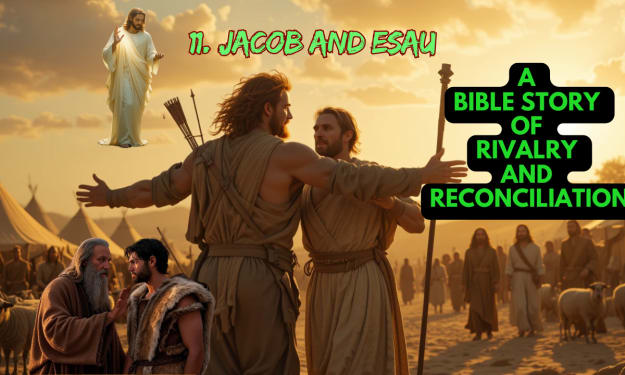
11. Jacob and Esau: A Bible Story of Rivalry and Reconciliation. AI-Generated.
In the ancient land of Canaan, around 1800 BC, a man named Isaac and his wife Rebekah lived as nomads, blessed by God with twin sons, Esau and Jacob. The story of Jacob and Esau, found in the Book of Genesis (25:19-34, 27:1-45, 33:1-20), is a dramatic tale of sibling rivalry, deception, and eventual reconciliation, revealing God’s sovereignty over human flaws and His power to bring healing to broken relationships. This narrative, a cornerstone of biblical history, offers timeless lessons on forgiveness, faith, and the unfolding of God’s plan.
By David Andrewsabout a year ago in History
📚 The Library of Ashurbanipal: The World’s First Great Archive of Knowledge
📚 The Library of Ashurbanipal: The World’s First Great Archive of Knowledge 📜Part I: Discovery Amid Ruins In the mid-1800s, long before archaeology had matured into the scientific discipline we know today, the deserts of northern Iraq were largely unexplored by Europeans. One such explorer was Austen Henry Layard, a British adventurer with a deep fascination for the biblical cities of Nineveh and Babylon. In 1849, while excavating near the village of Kuyunjik, Layard uncovered massive ruins buried under mounds of earth. These ruins belonged to Nineveh, the ancient capital of the Neo-Assyrian Empire — a city that had once been one of the most powerful urban centers in the ancient world.
By History Seekerabout a year ago in History
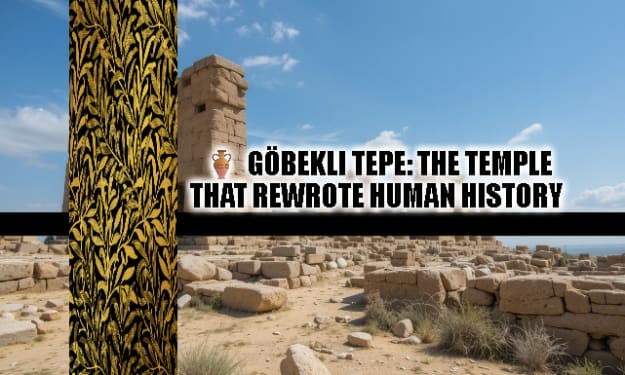
🏺 Göbekli Tepe: The Temple That Rewrote Human History
🏺 Göbekli Tepe: The Temple That Rewrote Human History I. Discovery and Location Göbekli Tepe, which translates from Turkish as “Potbelly Hill,” sits quietly in the dry, rolling hills of southeastern Turkey, near the modern city of Şanlıurfa. Though it had long appeared on maps as a minor mound — a common sight in the region — its true significance wasn’t understood until the mid-1990s. In fact, for decades, local farmers and researchers assumed the mound was a simple Bronze Age burial site or a ruined Byzantine outpost. But in 1994, the German archaeologist Klaus Schmidt, who had worked at nearby Neolithic sites, re-examined the mound and recognized that the flint tools and carved stones scattered across the surface pointed to something far older and more significant.
By History Seekerabout a year ago in History
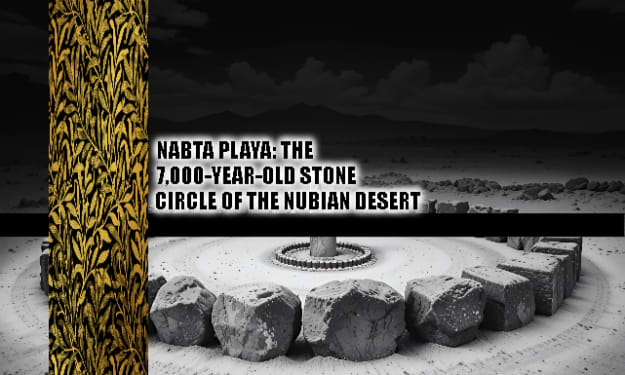
⛏️Nabta Playa: The 7,000-Year-Old Stone Circle of the Nubian Desert
⛏️Nabta Playa: The 7,000-Year-Old Stone Circle of the Nubian Desert Discovery and Location Nabta Playa lies hidden deep within the Nubian Desert, an arid and inhospitable region in southern Egypt, close to the border with Sudan. This vast desert landscape today is characterized by harsh winds, blazing sun, and seemingly endless sand dunes, but approximately 7,000 to 8,000 years ago, this area was dramatically different.
By History Seekerabout a year ago in History