General
Israel Reels Under Fire: Fallout from the Israel-Iran War and Trump's Escalating Rhetoric
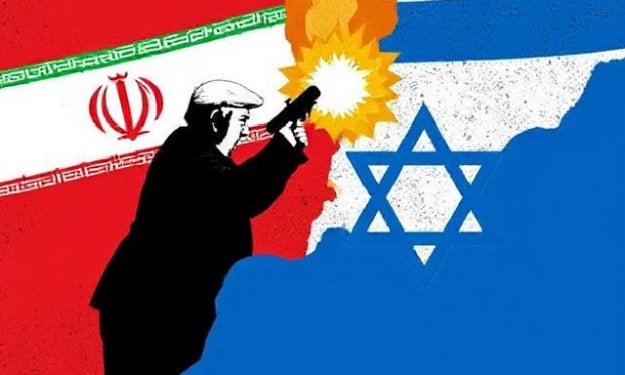
Tel Aviv, June 2025 — Israel is facing one of the most devastating crises in its modern history following the outbreak of full-scale war with Iran. What began as a series of proxy skirmishes and cyberattacks has now escalated into direct missile exchanges, air strikes, and a brutal economic collapse. The war, unprecedented in scale, has pushed Israel into a dangerous corner—militarily strained, diplomatically isolated, and internally fractured. Meanwhile, former U.S. President Donald Trump, never far from controversy, has seized on the conflict to launch a barrage of polarizing statements that have further inflamed international relations. His unfiltered support for Israel combined with caustic remarks toward Iran and current American leadership has made him a central, albeit unofficial, figure in the unfolding crisis. --- War Ignites: How the Israel-Iran Conflict Boiled Over The roots of the current war stretch back decades, but the spark was lit in early May 2025, when an alleged Israeli airstrike killed a top Iranian Revolutionary Guard commander near the Iraq-Syria border. In retaliation, Iran launched a coordinated wave of drone and missile attacks on Israeli military bases in the Golan Heights, Haifa, and the Negev desert. Within days, Israel responded with full-scale aerial bombardments of Iranian nuclear facilities and command centers in Tehran, Isfahan, and Mashhad. By June, the war had claimed over 20,000 lives—mostly civilians on both sides. Israel’s Iron Dome defense system, once considered nearly impenetrable, has been overwhelmed by the sheer volume of Iranian ballistic missiles and suicide drones. Major cities like Tel Aviv and Jerusalem now echo with daily sirens and the distant thud of missile intercepts. Hospitals are overflowing, and the government has imposed rolling blackouts to conserve power after several power stations were struck. --- Economic Collapse and Civil Unrest The war has shattered the Israeli economy. The Tel Aviv Stock Exchange has plunged over 60%, the shekel is in free fall, and international investors have pulled out in droves. Key sectors like tourism, tech, and agriculture are paralyzed. More than 500,000 Israelis are displaced, with many seeking refuge in hastily constructed shelters in the southern Negev or attempting to flee abroad. Simultaneously, civil unrest is erupting inside Israel. Arab-Israeli citizens, already marginalized, are staging protests against the war and the government's aggressive military response. Ultra-Orthodox communities are clashing with police over compulsory military service extensions, while left-wing and centrist Israelis demand a ceasefire and criticize the Netanyahu government’s handling of the crisis. --- Trump Enters the Stage—With a Megaphone Amid the chaos, former U.S. President Donald Trump has returned to the spotlight with his trademark mix of bravado and provocation. In a widely broadcast speech at a campaign-style rally in Florida, Trump declared: > “If I were in office, Iran wouldn’t dare launch a single firecracker at our great ally Israel. Biden is weak, pathetic, and letting Israel burn. When I’m back, we’ll bomb Iran into the stone age if they touch Israel again.” He added, with dramatic flair, “The Ayatollahs are terrorists in robes. And we don’t negotiate with terrorists. We eliminate them.” Trump’s words drew immediate rebuke from the White House, which called them “reckless, dangerous, and unhelpful at a time when diplomacy is the only path to prevent global catastrophe.” Iran’s Foreign Ministry responded by calling Trump “a war criminal hungry for more bloodshed.” Despite no formal government role, Trump’s comments have been aired repeatedly on Israeli channels, where right-wing factions hail him as a “true friend of Zion.” But others worry his rhetoric is only escalating the situation and undermining American diplomacy. --- Global Repercussions and the Shadow of Wider War The Israel-Iran conflict is not occurring in a vacuum. Hezbollah in Lebanon has opened a northern front, exchanging fire with Israeli Defense Forces daily. In Iraq, U.S. bases have come under attack by Iranian-backed militias. The Strait of Hormuz has seen several near-clashes between Iranian naval forces and U.S. destroyers, raising fears of a regional war that could draw in Saudi Arabia, the UAE, and possibly Russia and China. Oil prices have surged to $170 per barrel, triggering inflation spikes across Europe and Asia. UN Secretary-General António Guterres has pleaded for restraint, warning that “the world stands at the brink of a wider war unlike any we have seen in decades.” --- Israel’s Future: Uncertain and Fractured Within Israel, the psychological toll is mounting. The once-resilient national spirit is strained as families bury their dead and cities turn into fortresses. The Israeli Knesset remains deeply divided over how to proceed—some demand total war and occupation of Iranian territory, while others push for an immediate ceasefire, even at the cost of territorial concessions. Prime Minister Benjamin Netanyahu, under immense pressure, has called for national unity but faces growing calls for his resignation. A leaked IDF internal memo suggested that without significant foreign military aid, Israel’s defense infrastructure could begin to crumble within three months. --- Conclusion: A Nation on the Edge As Israel endures the most existential threat since its founding, it finds itself fighting not just an external war with Iran, but an internal battle for its soul. The global community watches anxiously, caught between sympathy, strategic interest, and fear. In the middle of it all, Donald Trump’s bombastic re-emergence adds fuel to the fire—proving that while he may be out of office, his impact on global politics remains dangerously potent. Whether Israel can survive this war intact remains an open question. What is certain is that the aftermath—military, political, and human—will echo for generations.
By Lal Sher Khan about a year ago in History
"Clash of Powers: The Complex Dynamics Between Iran and Israel"
In the heart of the Middle East, where ancient civilizations once thrived and modern power struggles continue to shape the world, a tense and fragile relationship has evolved between two of the region’s most influential nations: Iran and Israel. The story of their rivalry is not one of clear heroes and villains but of competing ideologies, security concerns, and deep-rooted historical narratives that fuel the conflict.
By Hissam khanabout a year ago in History
The Eight Kings Who Ruled Before the Flood: Unveiling the Sumerian King
A Forgotten Record of Impossible Reigns: Unraveling the Enigma of the Sumerian King List In the cradle of civilization, where the first written words were penned, and society took its earliest steps, ancient scribes inscribed a remarkable document into clay tablets: the Sumerian King List. This cuneiform text, over 4,000 years old, lists the names of kings who reigned in ancient Mesopotamia.
By The Secret History Of The Worldabout a year ago in History
How a Tiny Village Changed the Course of a War. Content Warning.
They called it Bellenhof— a dot on the map of Eastern Europe, barely big enough for a dozen homes and a crooked church. No one outside the region paid much mind to it — not until the autumn of 1943, when the winds of war swept too close. The Second World War had devoured much of the continent by then. Borders shifted like sand under boots; armies marched; cities crumbled. And somewhere on the edge of those shifting lines lay Bellenhof, its people caught between advancing Allied forces and retreating Axis divisions. The village sat atop an ancient Roman road — a narrow strip of cobblestone that connected two key mountain passes. Whoever controlled that road controlled access to the valley beyond, a vital route for troop movement and supply chains. In late September, a German convoy rolled through Bellenhof. Soldiers requisitioned homes, stabled their horses in the old barns. The villagers — farmers, bakers, craftsmen — said nothing. They knew better. But among them lived Anja Keller, a young woman whose husband had been conscripted years earlier. Her heart, like the war itself, burned quietly. She worked at the village bakery by day, but at night she listened — to passing soldiers, to whispered rumors from travelers. And what she heard chilled her: a large German column was massing to retreat through the mountain pass, hoping to cut off the advancing Allies. If they succeeded, thousands of Allied soldiers would be trapped in the lowlands. There was no time to send a message. No radios, no phones. Couriers would be shot on sight. But Anja had an idea — one born of old stories her grandmother used to tell about the Roman road. Beneath it, somewhere, ran the remains of an ancient aqueduct — partially collapsed, half-forgotten. If they could trigger a landslide, they could bury the road... delay the retreat... maybe long enough for the Allies to catch up. It was a mad plan. The villagers were farmers, not engineers or soldiers. But desperation sharpens the mind. Quietly, under cover of darkness, Anja gathered those she trusted: the blacksmith Otto, old Marta from the inn, and the young shepherd Emil, whose knowledge of the hills was unmatched. Over the next two nights, they dug — risking everything — beneath the hillside flanking the road. They packed the weakened soil with barrels of oil, gunpowder stolen from careless soldiers, anything they could find. At dawn on the third day, the German convoy prepared to move. Tanks, trucks, horses — hundreds of men lined the ancient road. Anja waited on the hilltop, heart pounding. At her signal — a single flaming arrow — Emil loosed the fuse. For a moment, nothing. Then — a roar like the gods themselves. The earth trembled. The hillside collapsed, tons of stone and soil pouring onto the road. Wagons toppled. Soldiers shouted in panic. The convoy ground to a halt. Word spread like wildfire. Nearby Allied scouts, hearing the blast, raced to investigate. Within hours, Allied forces launched a swift advance, overwhelming the stalled Germans. The trapped Axis units, unable to retreat, surrendered en masse. Historians would later write that the battle for the pass had turned the tide of that campaign — cutting off Axis reinforcements and hastening the liberation of the region. But few recorded the name of Bellenhof, or the villagers whose courage had sparked it. Anja never sought glory. When the war ended, she rebuilt the bakery, planted a garden where the road once lay buried. Life returned, as it always does. But sometimes, when travelers passed through and marveled at the beauty of the valley, they would hear an old tale — of how, in the darkest days of war, a tiny village changed the course of history. And on quiet nights, under the stars, Anja would remember — not the fear, nor the destruction, but the simple truth she had learned: that even the smallest voices, in the right moment, can echo through the ages. ---
By Huzaifa Writerabout a year ago in History
The Hidden Truths of Fatima
In the rolling hills of early 20th-century Portugal, nestled in the quiet village of Fátima, the world seemed untouched by war or politics. It was a land of shepherds and silence, of olive trees swaying gently in the wind. But in the spring of 1917, three children—Lucia dos Santos and her cousins Francisco and Jacinta Marto—would find themselves at the center of one of the most powerful divine revelations in modern history.
By wilson wongabout a year ago in History
Girl Who Survived a Plane Crash in the Jungle 🌿✈️
❖ A Normal Flight on Christmas Eve It was December 24, 1971—Christmas Eve. Juliane Koepcke, a 17-year-old girl from Peru, boarded LANSA Flight 508 with her mother. They were flying from Lima to visit Juliane’s father in another city. The plane was almost full, with 92 people on board. The sky looked cloudy. As the flight continued, they flew into a big thunderstorm. The plane began shaking badly. People were scared. Lightning flashed all around. Then, suddenly, there was a loud noise. The plane had been hit by lightning. It started breaking apart in the air. Juliane remembers falling through the sky, still tied to her seat, spinning and surrounded by wind and clouds. She fell from over 10,000 feet—almost 3 kilometers high—into the Amazon rainforest. ❖ Waking Up in the Jungle Juliane woke up the next day on the ground. She was alone. Her arm hurt, one eye was swollen shut, and she had deep cuts on her legs and shoulders. Her glasses were gone. She had only one sandal on her foot and a torn summer dress. There was no sign of her mother or anyone else. Only trees, insects, and silence. She was in the middle of the rainforest—a place full of wild animals, snakes, and insects. But Juliane didn’t panic. She remembered what her parents had taught her: follow water. Small streams usually lead to rivers, and rivers may lead to people ❖ Eleven Days of Survival For the next 11 days, Juliane walked through the jungle. She followed a small stream, hoping it would take her somewhere safe. She had no food, just a small bag of candy she had found near the crash site. She drank water from the stream to stay alive. Flies laid eggs inside the cuts on her arm. She could feel them moving under her skin. She pulled out as many as she could. She was tired, in pain, and scared. But she kept going. At night, it was cold. During the day, the jungle was hot and full of biting insects. She had to walk carefully, afraid of snakes or other animals. But she didn’t give up. ❖ The Rescue On the 11th day, Juliane saw something—a small wooden hut near the river. It was empty, but it had a path nearby. She waited. Soon, local lumber workers arrived. They were shocked to see a skinny, weak girl, covered in wounds, standing alone in the jungle. They took her in, cleaned her wounds, and gave her food. Later, a helicopter came to fly her to a hospital. She found out she was the only survivor of the crash. All 91 other people, including her mother, had died. ❖ Life After the Crash Juliane recovered from her injuries. She later became a scientist, just like her parents. Years later, she returned to the crash site with a film crew and told her story. She said she never thought she would survive—but something inside her told her to keep walking. ❖ Reflection Juliane Koepcke’s story is one of the most amazing survival stories ever told. A teenage girl fell from the sky, landed in one of the wildest places on Earth, and survived for 11 days on her own. She didn’t have special tools or equipment. She didn’t have help. She had only courage, knowledge from her parents, and a strong will to live. Her story reminds us that even when things seem impossible, hope and strength can help us get through anything. Juliane’s story is still taught today in survival courses, documentaries, and books. It shows that even in the most hopeless situations, calm thinking and determination can save lives. Her experience not only inspired millions but also raised awareness about jungle survival, aviation safety, and the importance of mental strength in life-threatening situations.
By Echoes by Imadabout a year ago in History
Ancient Egyptians – Are They White or Black?
For almost 200 years, blacks and whites have been unable to divide the ancient Egyptians. The question of what race the ancient Egyptians belonged to arose at the turn of the 18th and 19th centuries, when interest in racial classifications increased in the scientific community. Attempts to systematize peoples with external features have been made since time immemorial.
By Uchenna Cosmas Nwokafor about a year ago in History