General
Sunset in the mountains of Durmitor
Sunset in the mountains of Durmitor The afternoon was different. The sun was slowly setting on the mountainside, spreading golden colors in the sky. The sunset could be seen from the campus dormitory, like a perfectly arranged scene—as if painted by Allah with his own hands.
By Arshad Aliabout a year ago in History
Understanding Aggregate Trends for Apple Intelligence Using Differential Privacy
Apple's ecosystem has always placed a strong emphasis on user privacy. With the introduction of Apple Intelligence, a suite of AI features integrated across its devices, this commitment to privacy remains paramount. To enhance these intelligent features by understanding user behavior and trends without compromising individual privacy, Apple is leveraging a sophisticated technique called differential privacy.
By Mahdi Rahmanabout a year ago in History
Wink Martindale, Popular and Durable.
Wink Martindale passed away on Tuesday in Rancho Mirage, California. He was a radio personality who rose to fame on television as a stylish and friendly presenter of game shows such as "Gambit," "Tic-Tac-Dough," and "Debt" in the 1970s and 1980s. He was ninety-one.
By MD NAFIUL ISLAMabout a year ago in History
America may be a superpower now, but do you know which country was a superpower in 7 th century?
### Abu Bakr: The First Caliph's Life and Leadership **Lifestyle of Abu Bakr** 1. **Simplicity and Humility**: Abu Bakr al-Siddiq was known for his modest lifestyle. He lived simply, often wearing plain clothing and avoiding extravagance. His deep faith and dedication to Islamic principles were reflected in his humility. 2. **Piety and Devotion**: Abu Bakr was very committed to the teachings of Islam because he was a close friend of the Prophet Muhammad. He was known for his strong moral character, integrity, and dedication to prayer and community service. 3. **Family Man**: Abu Bakr was married several times and had multiple children. He was well-known for his kindness and support of his family and the community as a whole, frequently providing assistance to those in need. 4. **Role of Advisory] He frequently conferred with the Prophet's other companions, valuing their perspectives and fostering a sense of collective leadership within the early Muslim community. **War Style of Abu Bakr** 1. **Decisive Leadership**: Abu Bakr's leadership was marked by decisiveness. He quickly addressed challenges, particularly during the Ridda Wars, where he took swift action against tribes that had renounced Islam after the Prophet's death. 2. **Motivational Speeches**: He inspired his followers through powerful speeches, appealing to their faith and sense of duty. His ability to motivate troops was crucial in rallying support for military campaigns. 3. **Strategic Alliances**: Abu Bakr was aware of how crucial it was to form alliances with various tribes and leaders. This diplomatic approach helped consolidate power and expand the influence of the Islamic state. 4. **Military Organization**: He organized the Muslim army into units and appointed experienced commanders, such as Khalid ibn al-Walid, who played a significant role in military campaigns. His forces were well-coordinated and disciplined. The Conquests of Abu Bakr 1. **Ridda Wars (632–633 CE)**: After the death of Muhammad, several tribes in Arabia renounced Islam. Abu Bakr launched the Ridda Wars to bring these tribes back under Islamic authority. The apostate tribes were defeated by his forces, restoring Islamic unity in Arabia. 2. **Expansion into the Sassanian Empire**: Following the Ridda Wars, Abu Bakr focused on the Sassanian Empire (Persia). His military campaigns led to significant victories, including the Battle of Qadisiyyah, which opened the way for further conquests in Persian territory. 3. **Conquest of Byzantine Territories**: Abu Bakr also initiated campaigns against the Byzantine Empire, particularly in the Levant region. His forces seized important cities, paving the way for his successor, Umar ibn al-Khattab, to expand further. 4. **Foundation for Future Expansion**: Abu Bakr's military successes laid the groundwork for the Islamic state's rapid expansion. His leadership and strategies enabled the Muslim community to grow and thrive, leading to the establishment of one of the largest empires in history. ### Conclusion Abu Bakr's lifestyle, characterized by simplicity and devotion, combined with his decisive leadership and strategic military approach, enabled him to consolidate the Islamic community and expand its influence significantly. His successful campaigns against both the Sassanian and Byzantine empires set the stage for the further expansion of Islam, making him a pivotal figure in Islamic history. The Muslim world continues to honor and respect his legacy as the first caliph.
By MD.A.R Neazabout a year ago in History
Thucydides of Athens
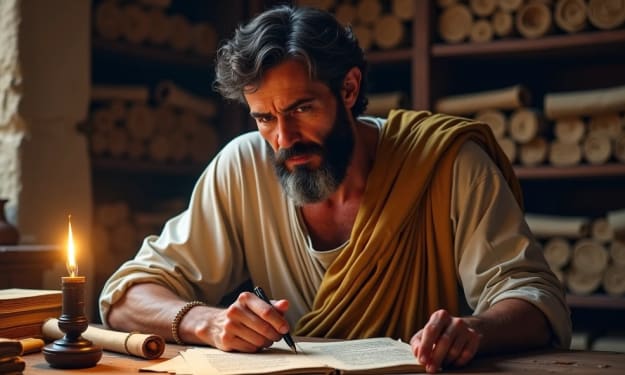
Thucydides of Athens (circa 460 – circa 400 BCE) is celebrated as one of history's foremost historians, recognized for his meticulous method of documenting historical events. In contrast to earlier historians who frequently intertwined myth with reality, Thucydides aimed to deliver a precise and analytical narrative grounded in evidence and firsthand accounts. His seminal work, The History of the Peloponnesian War, continues to be a cornerstone in the fields of historiography, political science, and military strategy.
By A Históriaabout a year ago in History
"Glimpse into the Abyss: First-Ever Footage of the Colossal Squid in Its Natural Habitat. . AI-Generated.
A Scientific Milestone Reveals the Deep-Sea Phantom in Motion. In the dark and icy waters of the Southern Ocean, a scientific breakthrough has electrified the marine biology community. For the first time in recorded history, the colossal squid (Mesonychoteuthis hamiltoni), long considered one of the ocean’s most mysterious and elusive giants, has been captured on film in its natural rdinary. event marks a monumental step in deep-sea exploration and sheds light on a species that has stirred legends, fear, and scientific curiosity for centuries.
By Ashfaque Mahmud 🇧🇩about a year ago in History
Whispers of the Heart
It was a crisp fall morning when Mahi first noticed him—Amjid, the quiet, mysterious boy from the neighboring class. He sat by himself in the back corner of the campus café, his dark hair slightly tousled, eyes lost in the pages of an old novel. His presence was magnetic, but it wasn’t just his looks that caught Mahi’s attention—it was the way he seemed to be in his own world, a world that somehow felt both distant and inviting. Mahi, on the other hand, was the opposite. Bright, outgoing, with an infectious smile that made people feel like they were the most important person in the room. She had an ease to her, a charm that could make even the grumpiest professor crack a smile. But despite her seemingly perfect life, Mahi often found herself searching for something more, something deeper. She had no idea that the missing piece was about to appear in the form of a quiet stranger with a book. One rainy afternoon, after a particularly grueling history class, Mahi found herself sitting alone at a table in the café. The storm outside had driven most of the students to the library or their dorms, but Mahi liked the solitude of the café when the rain fell—there was something comforting about the gentle tapping of raindrops against the window. As if on cue, Amjid entered the café, his wet jacket clinging to his broad shoulders. He glanced around before spotting Mahi and, to her surprise, made his way toward her. “Is this seat taken?” he asked, his voice deep and soft, yet with an unfamiliar warmth. Mahi shook her head, her heart suddenly racing. “No, not at all. You can sit here.” Amjid smiled faintly, pulling out the chair opposite her. “Thanks,” he muttered, setting his bag down before sliding into the seat. For a moment, neither of them spoke. Mahi couldn’t help but feel a strange pull toward him, a magnetic energy that she couldn’t quite understand. Amjid, too, seemed to be lost in thought, glancing out at the rain as if the storm outside held the answers to the questions in his mind. “What’s your name?” Mahi finally asked, breaking the silence. Amjid turned his gaze back to her, his eyes dark yet kind. “Amjid,” he replied, his voice like a soft melody. “And you?” “Mahi,” she said with a warm smile. “I’ve seen you around a few times. You’re in the literature class, right?” Amjid nodded, his lips curving into a small smile. “Yeah. I’m surprised you noticed me.” Mahi tilted her head slightly, curious. “Why?” “Most people don’t.” He glanced at his book, which was still open on the table. “I’m not exactly… what you’d call ‘social.’” “Sounds like we have something in common,” Mahi said lightly. “I’m not really the ‘let’s go party every weekend’ type either.” That was the beginning of something neither of them expected. What started as casual conversation quickly blossomed into something deeper. They began meeting every day after classes, sitting in the same corner of the café, talking for hours about books, music, dreams, and everything in between. There was an unspoken understanding between them, a bond that grew stronger with every passing day. Amjid’s stoic demeanor slowly unraveled around Mahi. She saw through the quiet exterior to the layers beneath—the tenderness, the vulnerability, the pain he carried. He had suffered loss in his life, a tragedy that had shaped him into the person he was. He often spoke of his mother, who had passed away when he was a child, and the weight of that loss still haunted him. Mahi, in turn, shared pieces of her own life with him—how she had always been the ‘perfect student,’ the girl who was always happy on the outside but sometimes felt lost and empty on the inside. She confided in Amjid like she had never done with anyone else. Their conversations were raw, real, and filled with a depth that neither of them had experienced before. As weeks passed, their bond evolved into something neither could deny. The first time Amjid kissed Mahi, it felt like the world had shifted beneath their feet. It was gentle at first, a soft brushing of lips, but it ignited something inside both of them, a flame that couldn’t be extinguished. From that moment on, their love grew—slowly but surely—into something all-encompassing. They spent late nights studying together, their hands brushing as they passed notes, their laughter echoing through the empty halls of the dorm. Amjid would walk Mahi to her dorm after every date, always holding her hand as if he never wanted to let go. And Mahi? She would rest her head on his shoulder, feeling like she had finally found the place where she belonged. But life, as it often does, had other plans. One rainy evening, just like the one when they first spoke, Mahi and Amjid found themselves walking through the campus park, hand in hand. The air was thick with the scent of rain-soaked earth, and the sound of distant thunder rumbled through the sky. “I have something to tell you,” Amjid said suddenly, his voice low and serious. Mahi looked at him, concern creeping into her chest. “What is it?” she asked, squeezing his hand. Amjid stopped walking, turning to face her. “I’ve been diagnosed with a rare heart condition. The doctors say it’s… terminal.” Mahi’s heart skipped a beat, her mind struggling to process the words. “What do you mean, terminal?” Amjid swallowed hard, his eyes dark with a sadness she had never seen before. “It means I don’t have much time left.” Mahi felt a wave of emotion crash over her. She wanted to scream, to demand that this wasn’t fair, that she couldn’t lose him—not now, not when they had just found each other. But instead, she reached up, cupping his face in her hands. “We’ll fight this together,” she said, her voice trembling but strong. “I don’t care what the doctors say, we’ll make the most of every moment we have.” And they did. They spent every day together, savoring each moment as if it were their last. They traveled to places they had always dreamed of, made memories that would last forever, and loved each other with a passion that transcended time. But despite their efforts, Amjid’s condition worsened, and one fateful night, as Mahi held him in her arms, he took his final breath. Mahi was devastated, lost in a grief so deep it threatened to consume her. But she knew that Amjid would never truly be gone. His love, his presence, would live on in her heart forever. And as she stood at the edge of the campus, looking out over the spot where they had first met, she whispered to the wind, “I’ll carry you with me, always.” Their love, though brief, had been the most beautiful thing either of them had ever known. And even in death, their hearts remained intertwined, forever whispering in the silence of the campus that had brought them together.
By Hassan Ahmadabout a year ago in History
Harvard’s Defiant Stand: Late Night Mocks Trump’s Degree Revocation Demand
In a moment that sparked both laughter and applause across late-night television, Harvard University’s resolute rejection of former President Donald Trump’s demand to revoke degrees of his critics became comedic gold. The Ivy League institution’s firm stance, rooted in academic integrity and free speech, provided ample fodder for hosts who gleefully dissected the absurdity of the request.
By MD. ANOARUL HAQUE HERAabout a year ago in History
The Day the World Almost Ended, And How We Dodged Disaster
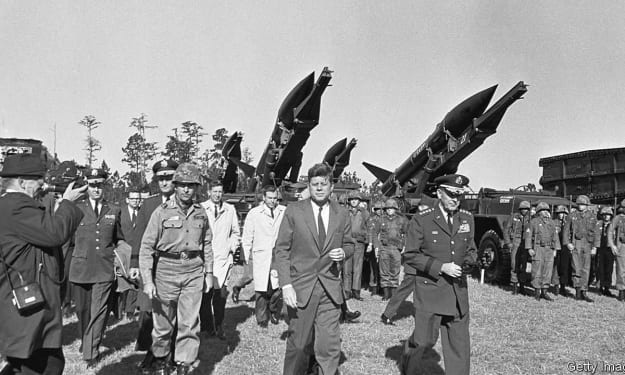
Have you ever lie awake at night wondering how close we’ve come to total annihilation? I’m not talking about asteroids or supervolcanoes—I’m talking about human decisions, split-second choices, and sheer dumb luck that kept us from blowing ourselves to smithereens. Spoiler alert: we're still around. But believe me, the story of how we survived is more bizarre than any Hollywood blockbuster. Let's dive into one of the most horrific times in history—the Cuban Missile Crisis—and see how humanity nearly dodged a nuclear catastrophe.
By ChronoCuratorabout a year ago in History
"The Ottoman Legacy: Uncovering the Greatest Treasure in Muslim History". AI-Generated.
The Concealed Treasures of Islam: Revealing the Most Significant Wealth in Muslim History Throughout Islamic chronology, numerous valuables have been amassed, uncovered, and safeguarded by various Muslim dynasties. Notably, the treasury of the Ottoman Empire is distinguished as the most precious and extensive. Featuring relics associated with the Prophet Muhammad, war spoils, royal jewels, and generous offerings from across the Islamic realm, the Ottoman Imperial Treasury remains one of the most remarkable assemblages of Islamic affluence ever gathered. This article examines its historical context, importance, and appraised worth. The Wealthy Heritage of Muslim Civilization From the illustrious period of the Abbasids to the pinnacle of the Ottoman Empire, Islamic civilization has been a nucleus of wisdom, architecture, cultureand substantial riches. Among the myriad treasures that Islam generated or acquired through epochs of conquest, commerce, and diplomacy, one rises above the rest: The Ottoman Imperial Treasury. Currently located in Istanbul's Topkapi Palace, this assemblage transcends a simple exhibition of gold and gemsit epitomizes centuries of Islamic authority, devotion, and distinction. Origins of the Ottoman Treasure The accumulation of treasure commenced in the 14th century as the Ottoman Turks, evolving from a modest Anatolian principality, began to expand into Byzantine and Balkan domains. As they subjugated territories, they absorbed wealth from local sovereigns and collected offerings from allied states and vassals. By the era of Suleiman the Magnificent in the 16th century, the Ottoman Empire had attained its zenith. Istanbul had transformed into not only the political center but also a spiritual and economic nucleus of the Muslim world. Lavish gifts streamed in from Persia, Egypt, India, and even Europe. The treasures also included the spoils of victorious military campaigns, especially against the Safavids and the Habsburgs. The Prophet’s Relics: A Sacred Treasure What distinguishes the Ottoman treasure from other royal hoards is the presence of revered Islamic relics. The Sultans, as Caliphs of the Muslim realm, were guardians of articles believed to have belonged to the Prophet Muhammad: The Prophet’s Mantle (Hırka-i Saadet) His Sword and Bow The Sacred Seal A Hair from His Beard These relics were kept with profound respect, watched over by dedicated Quran reciters who would continuously chant in their vicinity. For many Muslims, these were not merely treasures but sacred artifacts symbolizing their faith and identity. Jewels, Gold, and Gifts In addition to relics, the treasury included ornate weaponry, jewel-encrusted thrones, ceremonial armor, and gold Qurans. One of the most emblematic items is the Topkapi Dagger, an exquisite creation in emerald and gold, signifying Ottoman opulence and artistic genius. Another notable piece is the Spoonmaker’s Diamond, an 86-carat gemstone encircled by numerous smaller diamonds. This treasury also encompasses thousands of ceremonial garments, china from China, manuscripts, and ceremonial bannersmany of which were invaluable gifts from other Muslim monarchs or sultans. Estimated Net Worth While the precise value is challenging to ascertain due to the historical and religious significance of numerous artifacts, the net worth of the Ottoman Imperial Treasure is approximated to surpass $10 billion USD, with certain experts estimating it to be nearer to $20 billion when factoring in the cultural and historical context. The Spoonmaker’s Diamond alone is valued at more than $100 million. The worth of the sacred relics is, naturally, considered immeasurable in monetary terms by devotees. Preservation and Legacy Following the collapse of the Ottoman Empire after World War I, the Republic of Turkey implemented measures to safeguard this treasure, inaugurating Topkapi Palace as a museum in 1924. The Imperial Treasury remains one of the most frequented sections of the palace, drawing millions of visitors each year. More than mere wealth, this collection signifies a link between spiritual reverence and imperial strength. It stands as a testament to a civilization that once bridged East and West, governed three continents, and left an indelible impact on world history. Conclusion The treasure of the Ottoman Empire transcends the simplistic notions of diamonds, gold, and ceremonial items. It embodies a confluence of faith, history, politics, and identityall encompassed within the magnificence of the Islamic world’s most dominant dynasty. Its preservation today attests to the lasting legacy of Islamic civilization, and it remains arguably the greatest treasure ever possessed in Muslim history.
By Say the truth about a year ago in History